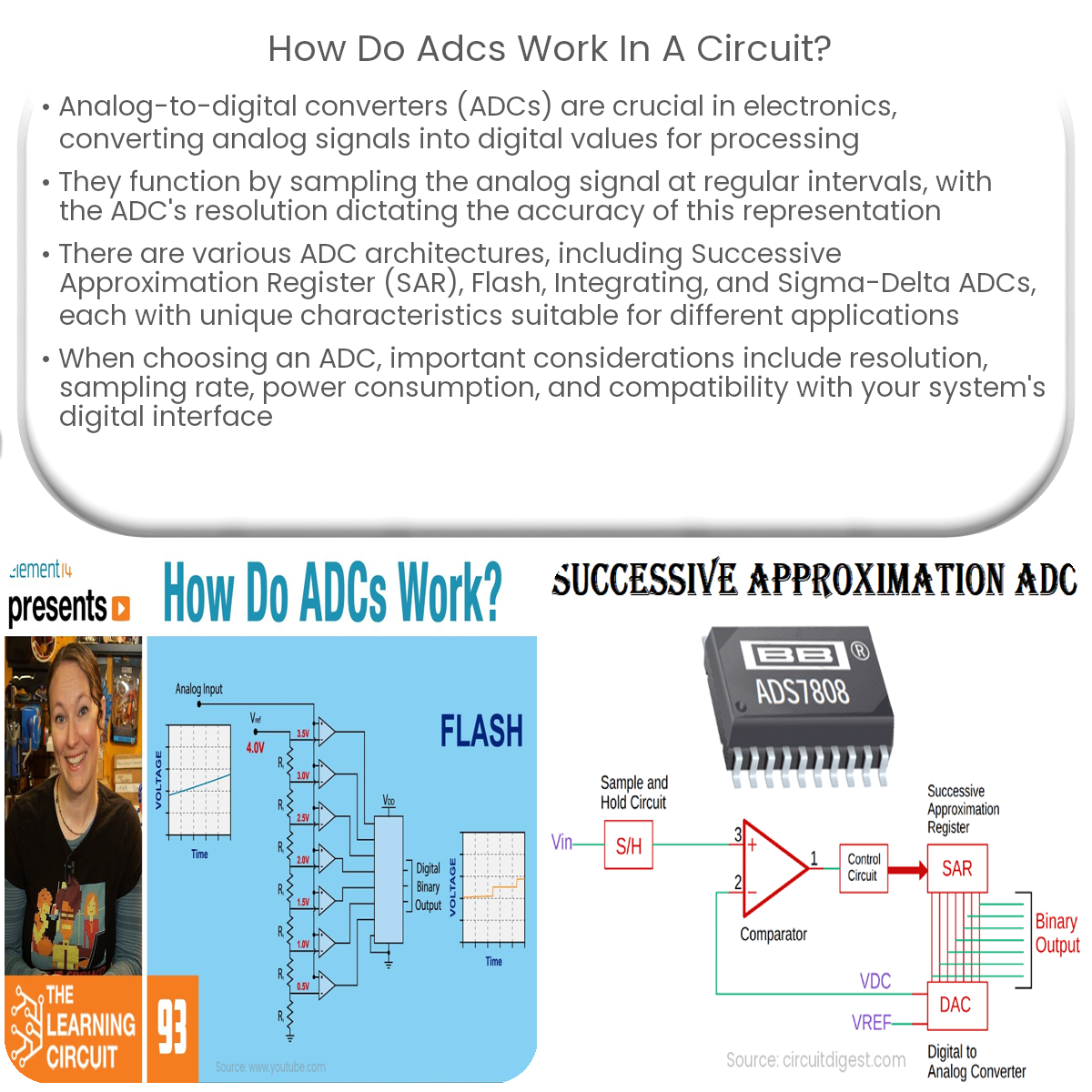
ADCs convert analog signals into digital values by sampling the input at a specific rate, quantizing the samples, and assigning digital values.
Understanding ADCs
Analog-to-digital converters (ADCs) are essential components in modern electronics, as they bridge the gap between the analog and digital worlds. ADCs convert continuous analog signals, such as voltage levels or current measurements, into digital values that can be processed and analyzed by microcontrollers or digital signal processors.
ADC Operation in a Circuit
ADCs work in a circuit by sampling the analog input signal at regular intervals, called the sampling rate. Each sample is then quantized, meaning it is assigned a digital value that represents the amplitude of the analog signal at that instant. The resolution of the ADC determines the number of possible digital values that can be assigned, and higher resolution ADCs can represent the input signal with greater accuracy.
Common ADC Architectures
- Successive Approximation Register (SAR) ADCs: SAR ADCs use a binary search algorithm to determine the digital value of the input signal. They are known for their moderate speed, low power consumption, and good resolution.
- Flash ADCs: Flash ADCs use an array of comparators to quickly determine the digital value of the input signal, making them suitable for high-speed applications. However, they are more complex and consume more power than other types of ADCs.
- Integrating ADCs: Integrating ADCs, such as dual-slope ADCs, use a capacitor and a comparator to integrate the input signal over a fixed time interval. This architecture provides excellent noise rejection but has a slower conversion rate.
- Sigma-Delta ADCs: Sigma-Delta ADCs use oversampling and digital filtering techniques to achieve high-resolution conversions with good noise rejection. They are well-suited for applications requiring high resolution, such as audio and sensor signal processing.
Choosing an ADC for Your Circuit
When selecting an ADC for your circuit, consider the following factors:
- Resolution: Higher resolution ADCs provide more accurate representations of the analog input signal but may require more processing power and memory.
- Sampling rate: The sampling rate should be at least twice the maximum frequency of the analog signal, as per the Nyquist-Shannon sampling theorem.
- Power consumption: Choose an ADC with appropriate power consumption for your application, especially if your design has strict power requirements.
- Interface: Ensure the ADC’s digital interface is compatible with your microcontroller or digital signal processor.