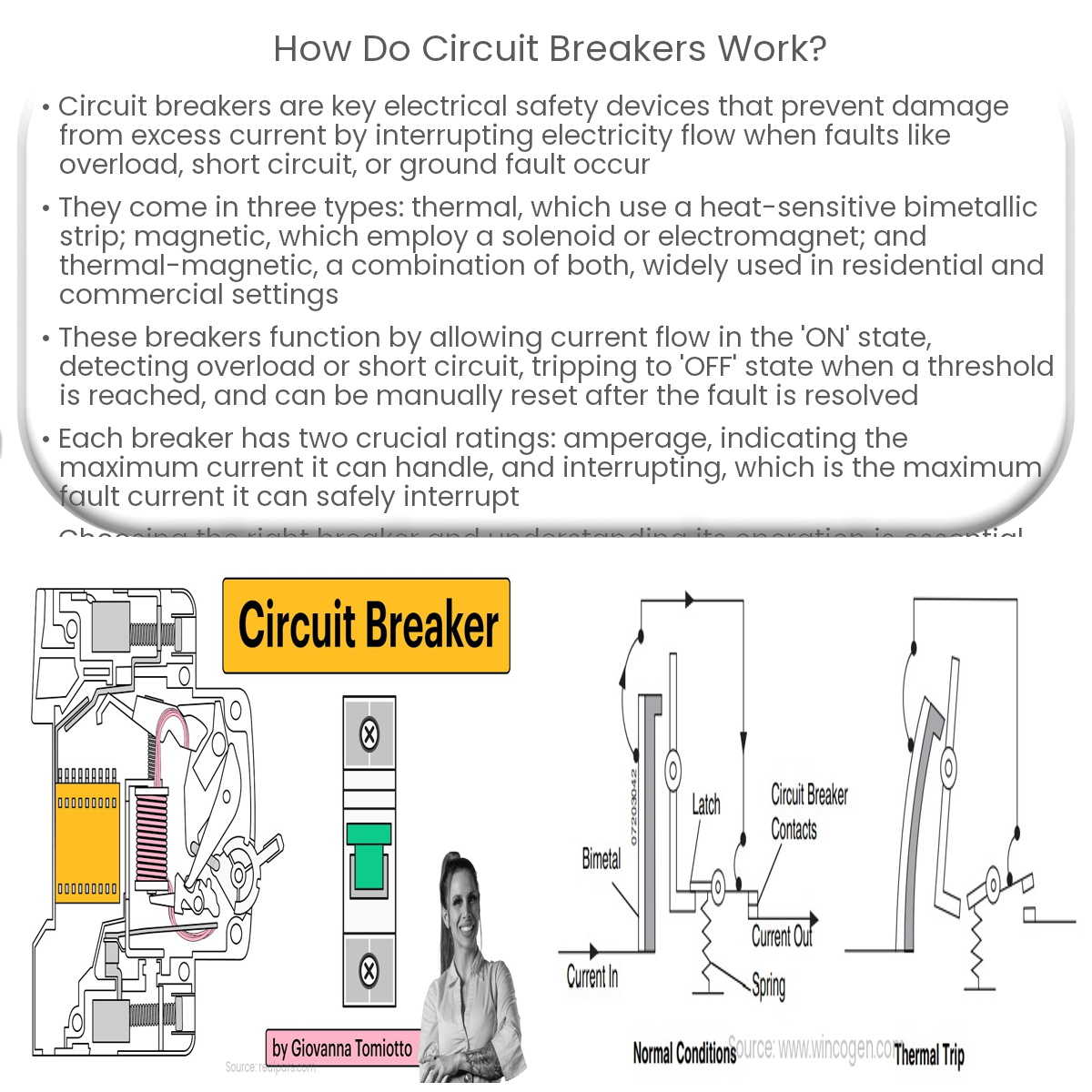
Circuit breakers work by detecting excess current and automatically interrupting the flow of electricity to prevent damage and fires.
How Do Circuit Breakers Work?
Circuit breakers are essential electrical safety devices that protect circuits from damage caused by excess current flow. They automatically interrupt the flow of electricity when a fault, such as an overload, short circuit, or ground fault, is detected. This article will explain how circuit breakers work and the different types available.
Types of Circuit Breakers
- Thermal Circuit Breakers: These breakers use a bimetallic strip that bends as it heats up due to current flow. When the strip bends far enough, it triggers the breaker to trip and cut off power to the circuit.
- Magnetic Circuit Breakers: These breakers utilize a solenoid or an electromagnet to trip the switch when the current exceeds the rated value. The magnetic force increases with the current, and when it becomes strong enough, it pulls a lever to open the circuit.
- Thermal-Magnetic Circuit Breakers: A combination of both thermal and magnetic technologies, these breakers are the most common type used in residential and commercial applications. They offer reliable protection from both overloads and short circuits.
Operation of Circuit Breakers
- When the circuit breaker is in the ‘ON’ position, current flows through it, allowing power to pass to the electrical devices connected to the circuit.
- If an overload or short circuit occurs, the current flow in the circuit increases rapidly. In response, the bimetallic strip in a thermal breaker or the solenoid in a magnetic breaker heats up or generates a magnetic field, respectively.
- When the temperature or magnetic field reaches a predetermined threshold, the breaker trips, and the internal mechanism moves to the ‘OFF’ position. This action disconnects the power supply to the affected circuit, preventing damage or fire.
- To restore power to the circuit, the issue causing the fault must be identified and resolved. Then, the circuit breaker can be manually reset to the ‘ON’ position.
Importance of Circuit Breaker Ratings
All circuit breakers have two critical ratings: the amperage rating and the interrupting rating. The amperage rating (A) indicates the maximum current the breaker can handle without tripping. Breakers are available in various ratings, such as 15A, 20A, or 30A, depending on the application. The interrupting rating (kA) represents the maximum fault current the breaker can safely interrupt without damage. It is crucial to choose a circuit breaker with appropriate ratings for the specific application to ensure reliable protection.
Conclusion
Understanding how circuit breakers work is vital for ensuring a safe and reliable electrical environment. By knowing the different types and their operating principles, you can make informed decisions when choosing and maintaining circuit breakers in your electrical system.