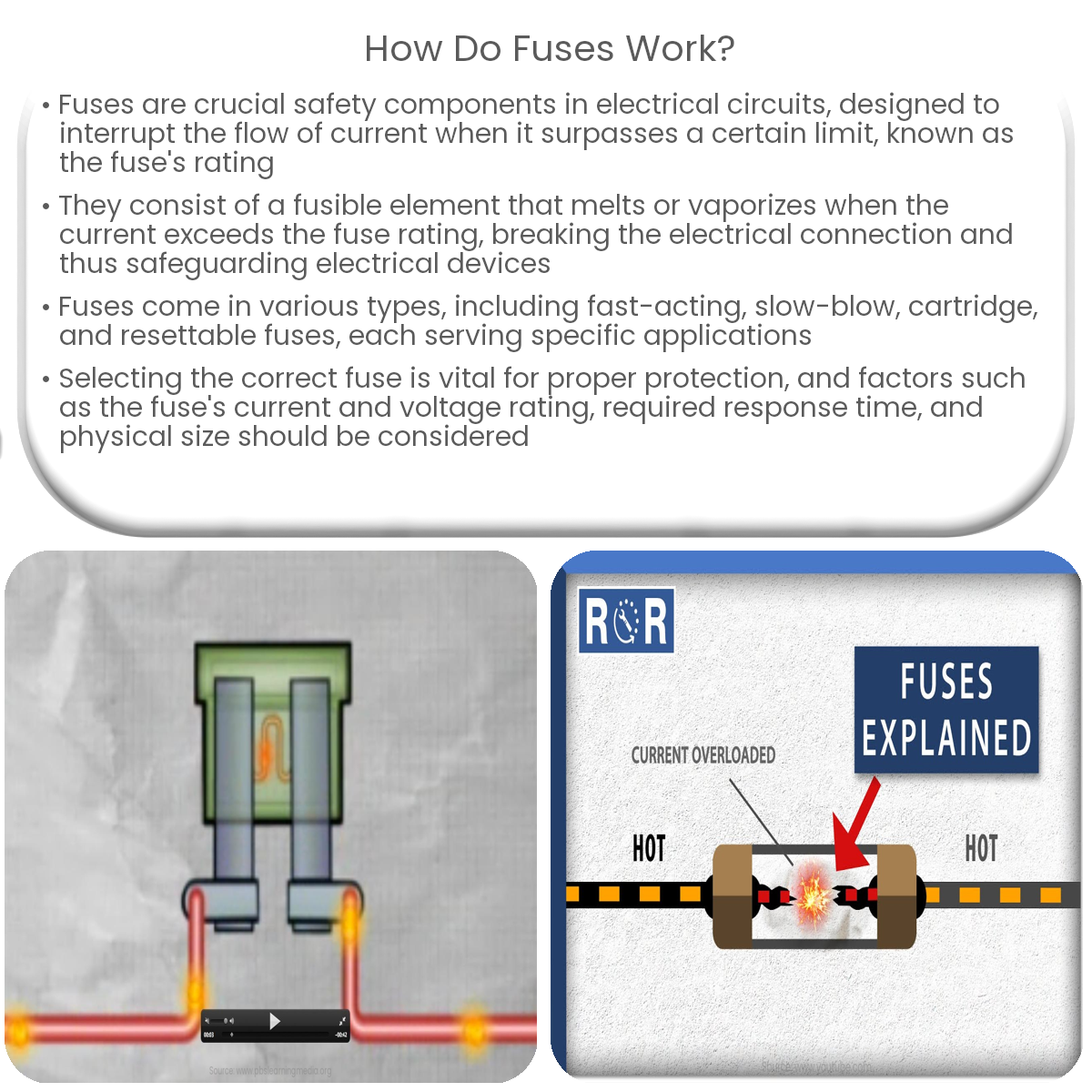
Fuses work by melting a thin wire or metal strip when current exceeds the fuse’s rating, breaking the circuit and protecting devices from overcurrent.
How Do Fuses Work?
A fuse is an essential safety component in electrical circuits, designed to interrupt the flow of current when it exceeds a specified limit. This current threshold is referred to as the fuse’s rating, which is usually measured in amperes (A). When an overcurrent condition occurs, the fuse “blows” or “trips,” breaking the circuit and protecting electrical devices from damage or potential fires.
Construction and Operation of Fuses
Fuses consist of a fusible element, which is typically a thin wire or strip of metal, enclosed within an insulating body. This element has a low melting point, and it is designed to melt or vaporize when the current exceeds the fuse rating. The insulating body often contains materials that help extinguish any resulting arc or flame.
When an overcurrent condition arises, the excessive current generates heat in the fusible element, causing it to melt. This process breaks the electrical connection and interrupts the current flow, effectively isolating the rest of the circuit from the fault condition. Once a fuse has blown, it must be replaced with a new one of the same rating to restore the circuit’s functionality.
Types of Fuses
There are various types of fuses, each designed for specific applications and conditions. Some common types include:
- Fast-acting fuses: These fuses react quickly to overcurrent conditions, providing protection for sensitive electronic components.
- Slow-blow fuses: Also known as time-delay fuses, these have a slower response time, allowing them to tolerate brief surges or inrush currents that may occur during normal operation.
- Cartridge fuses: Enclosed in a cylindrical body, these fuses are common in electrical panels and appliances. They can be either fast-acting or slow-blow.
- Resettable fuses (PTC): These fuses automatically reset themselves after an overcurrent condition has been resolved, eliminating the need for replacement.
Selecting the Right Fuse
Choosing the correct fuse for a given application is crucial to ensure proper protection. Considerations when selecting a fuse include:
- The fuse’s current rating, which should be slightly higher than the normal operating current of the circuit.
- The fuse’s voltage rating, which should be equal to or greater than the circuit’s maximum voltage.
- The required response time (fast-acting or slow-blow) based on the circuit’s characteristics and potential fault conditions.
- The physical size and mounting style of the fuse, depending on the available space and installation requirements.
In summary, fuses are essential safety devices that protect electrical circuits from overcurrent conditions by breaking the circuit when the current exceeds a specified limit. Understanding how fuses work and selecting the appropriate type and rating for a given application is critical to ensuring proper circuit protection.