
GASH is an eco-friendly ferroelectric material with a low Curie temperature and unique optical properties, ideal for memory devices, sensors, and optical applications.
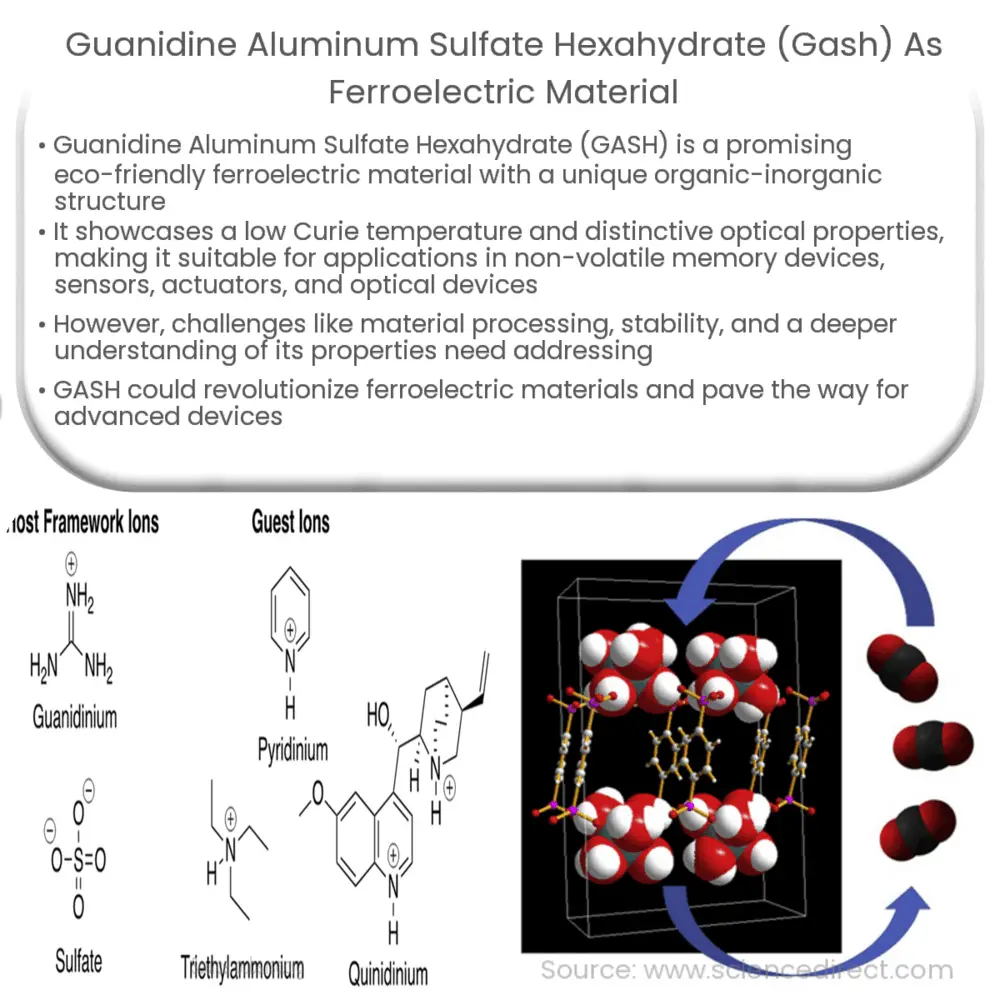
Guanidine Aluminum Sulfate Hexahydrate (GASH) as a Ferroelectric Material
Introduction
Ferroelectric materials are a unique class of materials that exhibit spontaneous electric polarization, which can be reversed by an external electric field. These materials have garnered significant attention due to their remarkable properties and potential applications in a wide range of industries, including sensors, actuators, and non-volatile memory devices. In recent years, researchers have been exploring new ferroelectric materials with improved properties and environmental sustainability. One such promising material is Guanidine Aluminum Sulfate Hexahydrate (GASH).
Structure and Properties of GASH
GASH, chemically represented as (C(NH2)3)2Al(SO4)3·6H2O, is an organic-inorganic hybrid material that belongs to the family of metal-organic frameworks (MOFs). It features a three-dimensional (3D) framework constructed by linking guanidine cations and aluminum sulfate anions, along with water molecules. The unique combination of organic and inorganic components in GASH results in its exceptional properties.
One of the most notable characteristics of GASH is its ferroelectric nature, which is a consequence of its polar crystal structure. The material undergoes a phase transition at a relatively low temperature of around -7°C, which is referred to as the Curie temperature (Tc). Above the Tc, GASH exhibits a paraelectric phase, while below the Tc, it demonstrates a ferroelectric phase. The polarization in GASH arises from the displacement of the guanidine cations within the crystal lattice, which generates a net dipole moment. The resulting ferroelectric properties are comparable to those of well-established ferroelectric materials, such as barium titanate (BaTiO3).
Advantages of GASH as a Ferroelectric Material
There are several benefits of using GASH as a ferroelectric material over conventional materials, which can be attributed to its unique structure and composition:
- Eco-friendliness: GASH is composed of earth-abundant elements, which makes it a sustainable and environmentally friendly alternative to other ferroelectric materials that may contain toxic or rare elements.
- Low Curie temperature: The low Tc of GASH allows it to be employed in applications that require a wide temperature range, as its ferroelectric properties can be maintained across varying temperatures.
- Optical properties: Due to its organic-inorganic nature, GASH exhibits interesting optical properties, such as transparency and birefringence, which can be advantageous in optical devices and applications.
Potential Applications of GASH
The unique properties of GASH make it a promising candidate for various applications in different industries. Some of the potential applications include:
- Non-volatile memory devices: Ferroelectric materials, such as GASH, can be utilized to develop non-volatile memory devices due to their ability to store information through reversible polarization. These devices can retain data even when the power is turned off, making them ideal for memory-intensive applications.
- Sensors and actuators: The sensitivity of GASH to external electric fields, temperature changes, and mechanical stress enables its use in sensors and actuators. For instance, GASH can be used in piezoelectric sensors to detect pressure or vibration, and in thermal sensors to measure temperature changes.
- Optical devices: The transparency and birefringence properties of GASH can be leveraged in optical devices, such as electro-optic modulators and waveplates, which are used to manipulate light in optical communication systems.
Challenges and Future Directions
While GASH holds great potential as a ferroelectric material, there are still some challenges that need to be addressed before its widespread adoption:
- Material processing: The development of reliable and scalable methods for synthesizing and processing GASH is crucial for its successful application in various industries. Researchers are currently exploring novel techniques to improve the quality and performance of GASH-based devices.
- Stability: The long-term stability of GASH, especially under different environmental conditions, such as humidity and temperature, needs to be thoroughly investigated to ensure its reliability in practical applications.
- Further understanding of properties: A more comprehensive understanding of the relationships between GASH’s structure, properties, and performance is essential for optimizing its use in different applications. Advanced characterization techniques and theoretical studies can provide valuable insights into these relationships.
In conclusion, Guanidine Aluminum Sulfate Hexahydrate (GASH) is an emerging ferroelectric material that offers several advantages over traditional ferroelectric materials, such as eco-friendliness, low Curie temperature, and intriguing optical properties. Its potential applications span a wide range of industries, including non-volatile memory devices, sensors, actuators, and optical devices. As research progresses, addressing the challenges related to material processing, stability, and understanding of its properties, GASH has the potential to revolutionize the field of ferroelectric materials and enable the development of next-generation devices and systems.



