
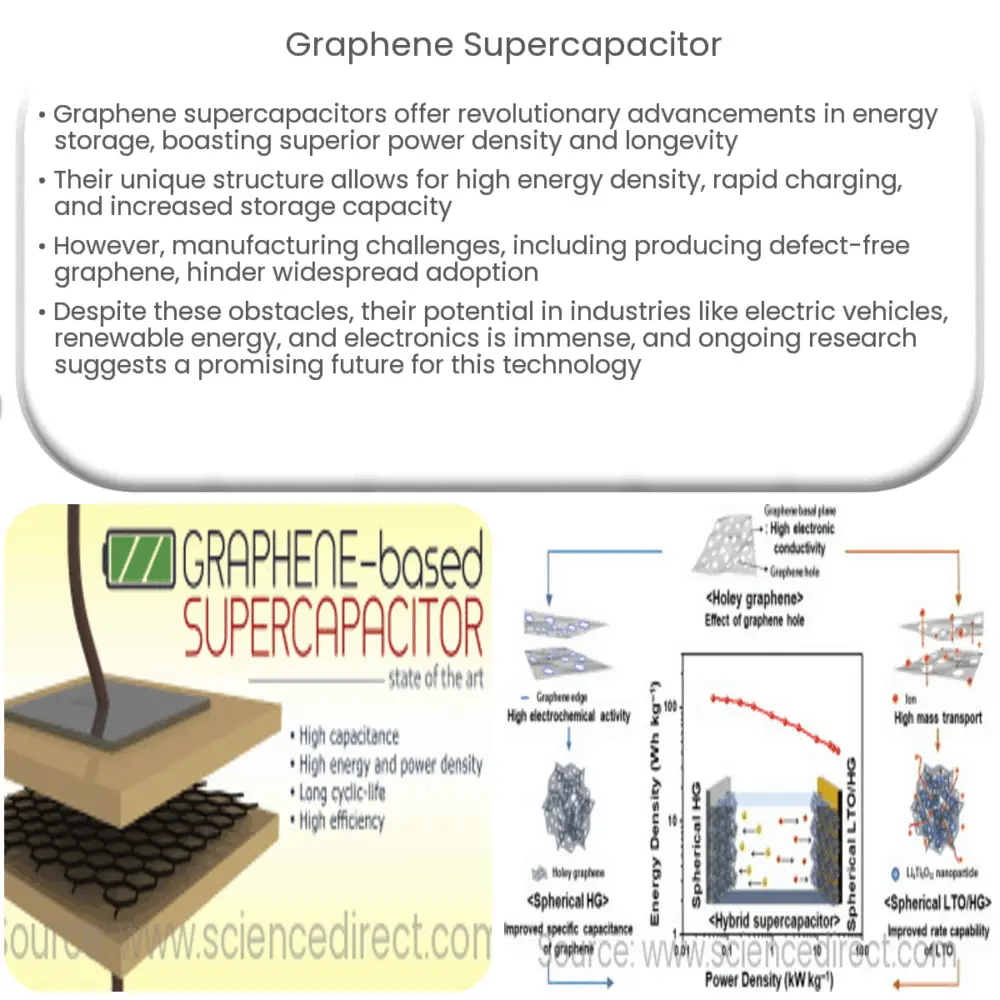
Graphene supercapacitors offer high energy density, quick charging, and long lifespan, paving the way for revolutionary changes in energy storage.
Introduction to Graphene Supercapacitors
Graphene supercapacitors represent a revolution in energy storage technology, promising unprecedented levels of power density and longevity. They are at the forefront of research into next-generation power solutions, offering exciting potential for industries as diverse as electric vehicles, renewable energy, and consumer electronics.
Graphene is a single layer of carbon atoms arranged in a two-dimensional honeycomb lattice. This structure gives graphene its unique properties: high electron mobility, thermal conductivity, and mechanical strength. Moreover, graphene’s large surface area to mass ratio makes it an ideal material for supercapacitors.
Supercapacitors and Their Limitations
Traditional supercapacitors, also known as ultracapacitors, store energy by accumulating electrical charge at the interface between a conductive electrode and an electrolyte. They bridge the gap between conventional capacitors, which deliver high power but store little energy, and batteries, which store large amounts of energy but deliver it over a longer period.
Supercapacitors can charge and discharge rapidly, withstand millions of cycles without significant capacity loss, and operate effectively in a broad range of temperatures. However, they have traditionally been limited by low energy density – the amount of energy they can store relative to their mass.
The energy density of a supercapacitor is primarily determined by the surface area of the electrode material and the separation distance between the charged particles in the electrolyte. Conventional supercapacitors use activated carbon as the electrode material, which, while having a high surface area, cannot match the theoretical performance of graphene.
The Promise of Graphene in Supercapacitors
Graphene supercapacitors offer a potential solution to the energy density limitation. Due to graphene’s extraordinary properties, particularly its high surface area and excellent electrical conductivity, it can significantly increase the energy density of supercapacitors.
Graphene’s superior electrical conductivity allows for faster movement of ions between the electrode and the electrolyte, leading to rapid charging and discharging. Moreover, the large surface area of graphene provides more space for the accumulation of charge, thereby increasing the overall storage capacity of the supercapacitor.
While the practical application of graphene supercapacitors is still under active research and development, early results show significant promise. These devices have the potential to transform a multitude of industries, from transportation to grid energy storage, by offering a sustainable and high-performing alternative to traditional energy storage technologies.
Manufacturing Challenges and Solutions
Despite the potential of graphene supercapacitors, their widespread adoption has been hampered by manufacturing challenges. Graphene production techniques such as exfoliation, chemical vapor deposition (CVD), and epitaxial growth often result in sheets with defects and impurities, which can limit the material’s performance in supercapacitors.
However, research and innovation have led to advancements in graphene production. For instance, a technique known as flash Joule heating has been developed to produce high-quality graphene in large quantities. This process involves sending a high-voltage current through carbon-rich materials, instantaneously raising their temperature and causing them to transform into graphene.
Real-World Applications and Future Prospects
The potential applications of graphene supercapacitors are broad and transformative. In electric vehicles, for example, they could enable rapid charging and discharging, extending driving range and reducing charging time. In the renewable energy sector, graphene supercapacitors could offer a highly efficient means of storing energy from intermittent sources like wind and solar.
Furthermore, in consumer electronics, these supercapacitors could facilitate the development of devices with longer battery life and shorter charging times. They could even enable entirely new classes of devices, such as flexible or wearable electronics, by providing a flexible, high-capacity power source.
Graphene supercapacitors also have potential military applications. For example, they could provide a lightweight, high-energy power source for advanced electronics, radar, and directed-energy weapons.
While graphene supercapacitors are not yet ready for widespread commercial use, the field is advancing rapidly. As manufacturing processes continue to improve and the cost of graphene decreases, it’s likely we’ll see more applications emerge in the coming years.
Conclusion
In conclusion, graphene supercapacitors represent a significant breakthrough in energy storage technology, with the potential to revolutionize many industries. They offer high energy density, rapid charging and discharging, and long lifecycle, overcoming many of the limitations of traditional supercapacitors. However, challenges remain in terms of manufacturing and cost. With ongoing research and development, the promise of graphene supercapacitors is likely to be realized, heralding a new era in energy storage and utilization.



