
Flyback converters are compact, efficient power supplies that provide galvanic isolation, enabling use in various applications like battery charging and LED lighting.
Flyback Converter: An Introduction
The flyback converter is a type of switched-mode power supply (SMPS) that has gained significant popularity in recent years due to its compact size, high efficiency, and low cost. This versatile power conversion topology is often employed in applications such as battery charging, power over Ethernet, and LED lighting, to name a few. In this article, we will provide an overview of the flyback converter, its key components, and its working principles.
Basic Principles and Components
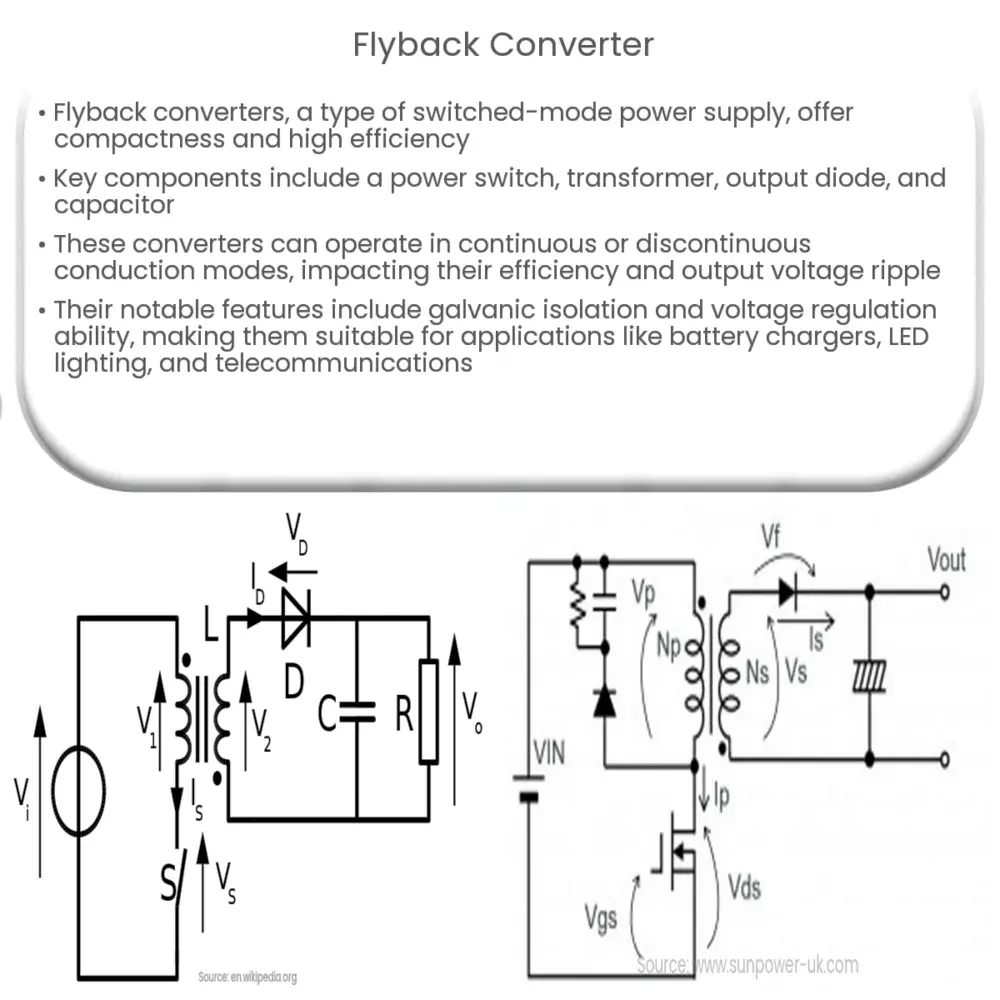
A flyback converter operates by storing energy in a magnetic field during one half of the switching cycle and then releasing that energy to the load during the other half. The key components of a flyback converter include the power switch, the transformer, the output diode, and the output capacitor. The power switch, typically a MOSFET or IGBT, is responsible for controlling the flow of energy into the transformer. The transformer serves to step up or step down the input voltage, depending on the desired output voltage. The output diode rectifies the voltage, converting it from alternating current (AC) to direct current (DC), while the output capacitor filters and smooths the output voltage.
Operating Modes
Flyback converters can operate in two primary modes: continuous conduction mode (CCM) and discontinuous conduction mode (DCM). The choice between these two modes depends on the specific application and design requirements.
Continuous Conduction Mode (CCM): In CCM, the current through the transformer never falls to zero during the switching cycle. This mode is often preferred for high-power applications due to its lower output voltage ripple and reduced stress on the output diode. However, CCM can also result in higher losses and reduced efficiency compared to DCM.
Discontinuous Conduction Mode (DCM): In DCM, the current through the transformer falls to zero before the start of the next switching cycle. This mode offers several advantages, such as reduced switching losses, simpler control, and improved transient response. However, DCM can also result in higher output voltage ripple and increased stress on the output diode compared to CCM.
Isolation and Regulation
One of the key features of flyback converters is the galvanic isolation provided by the transformer. This isolation is crucial for applications where the load must be separated from the power source, such as in medical equipment and telecommunications systems. The isolation also allows for the implementation of multiple output voltages from a single converter.
Another important aspect of flyback converters is their ability to regulate the output voltage. This is typically achieved using feedback control, where the output voltage is sensed and compared to a reference voltage. The error signal generated by this comparison is used to adjust the duty cycle of the power switch, ensuring a stable output voltage despite changes in the input voltage or load conditions.
Advantages and Disadvantages
Like any power conversion topology, flyback converters have their own set of advantages and disadvantages. Understanding these trade-offs can help determine if a flyback converter is the best choice for a particular application.
Advantages:
- Compact size and reduced component count
- High efficiency, especially at low to moderate power levels
- Galvanic isolation provided by the transformer
- Capability to produce multiple output voltages
- Cost-effective for low to medium power applications
Disadvantages:
- Higher output voltage ripple compared to other topologies
- Increased stress on output diode, especially in DCM
- Reduced efficiency at higher power levels compared to other topologies
- Complexity in designing high-frequency transformers
Applications
Flyback converters are widely used in a variety of applications due to their versatility and attractive features. Some common applications include:
- Battery chargers and power adapters
- Power over Ethernet (PoE) devices
- LED drivers and lighting systems
- Telecommunications equipment
- Industrial and medical power supplies
Conclusion
The flyback converter is a versatile and efficient power conversion topology that has become increasingly popular due to its compact size, low cost, and galvanic isolation capabilities. Understanding the basic principles, operating modes, advantages, and disadvantages of this topology can help engineers make informed decisions when designing power supplies for various applications. With continuous advancements in semiconductor technology and improved control techniques, the performance of flyback converters is expected to keep improving, further expanding their applicability in a wide range of industries.



