
Faraday rotation magnetometers measure magnetic fields by analyzing light polarization rotation through a magnetic field.
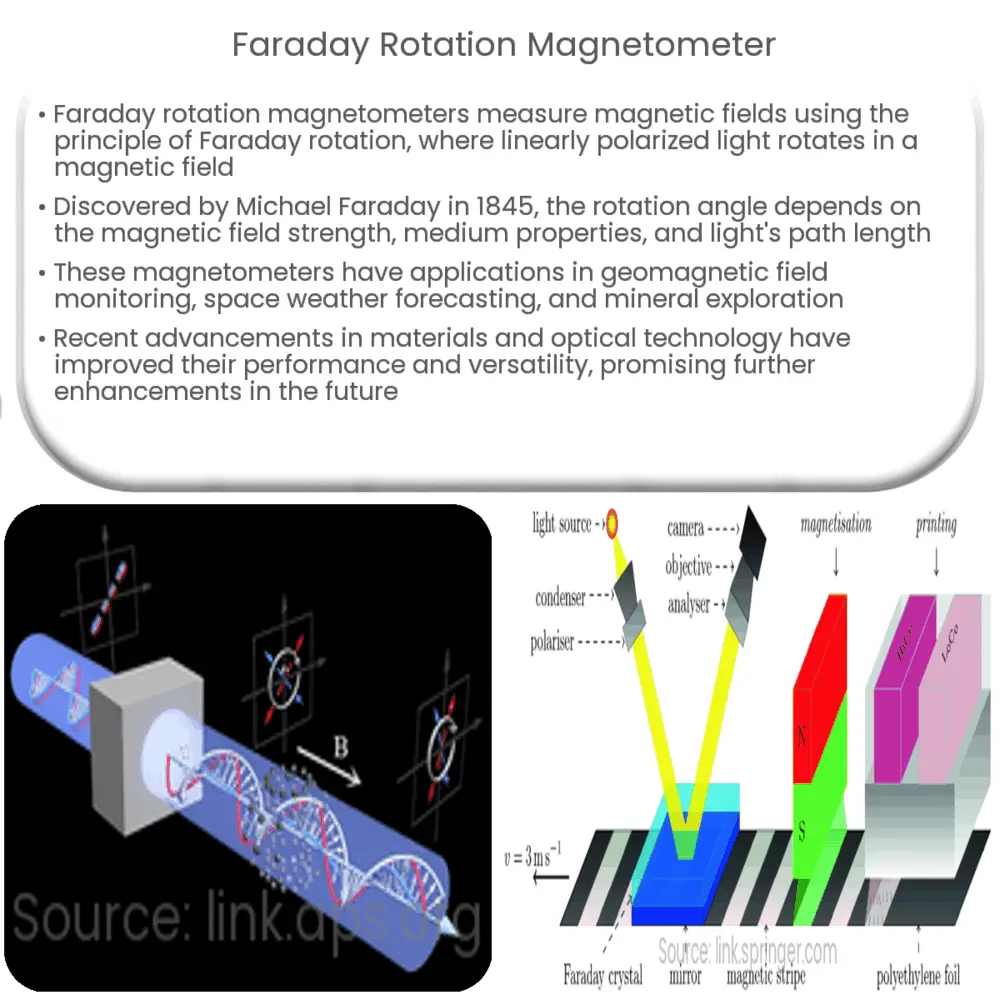
Faraday Rotation Magnetometer: An Overview
Introduction
Faraday rotation magnetometers are a class of instruments used for measuring magnetic fields, particularly in the Earth’s magnetosphere. These magnetometers operate on the principle of Faraday rotation, a physical phenomenon that occurs when linearly polarized light passes through a magnetic field. This article provides an overview of the Faraday rotation magnetometer, its working principles, and applications.
Faraday Rotation: The Underlying Principle
The Faraday rotation effect, also known as the magneto-optic effect, was first discovered by Michael Faraday in 1845. This phenomenon occurs when linearly polarized light propagates through a medium that is subjected to a magnetic field. The interaction between the magnetic field and the medium causes the plane of polarization of the light to rotate. The angle of rotation is proportional to the strength of the magnetic field and the length of the path the light travels through the medium.
The Faraday rotation effect is mathematically described by the following equation:
θ = V * B * L
Where:
- θ is the rotation angle of the plane of polarization
- V is the Verdet constant, a property of the medium
- B is the magnetic field strength
- L is the path length through the medium
Components and Working of a Faraday Rotation Magnetometer
A Faraday rotation magnetometer consists of several key components, including a light source, a polarizer, a Faraday rotation medium, an analyzer, and a photodetector. The instrument’s operation can be summarized in the following steps:
- The light source emits linearly polarized light, which is directed towards the polarizer.
- The polarizer ensures that only light with a specific polarization angle passes through and enters the Faraday rotation medium.
- The magnetic field being measured interacts with the medium, causing the plane of polarization of the light to rotate according to the Faraday rotation effect.
- The rotated light then passes through the analyzer, which allows only light with a specific polarization angle to reach the photodetector.
- The photodetector measures the intensity of the light, which is used to calculate the angle of rotation and, subsequently, the magnetic field strength.
By comparing the intensity of the light before and after passing through the Faraday rotation medium, the magnetometer can accurately determine the strength of the magnetic field.
Applications of Faraday Rotation Magnetometers
Faraday rotation magnetometers have a wide range of applications, including:
- Geomagnetic field monitoring: These magnetometers are commonly used to study the Earth’s magnetic field, which is essential for understanding the planet’s geophysical processes and for monitoring geomagnetic storms.
- Space weather forecasting: Faraday rotation magnetometers can help predict space weather events, such as solar flares and coronal mass ejections, which can have significant impacts on satellite operations and communication systems.
- Mineral exploration: By measuring local magnetic field anomalies, these magnetometers can assist in the discovery of mineral deposits and other geological features.
In conclusion, Faraday rotation magnetometers are valuable tools for accurately measuring magnetic fields. Their wide range
Advantages and Limitations of Faraday Rotation Magnetometers
Faraday rotation magnetometers offer several advantages over other types of magnetometers:
- High sensitivity: These magnetometers can detect very small changes in magnetic field strength, making them ideal for various scientific and industrial applications.
- Wide dynamic range: Faraday rotation magnetometers can measure magnetic fields across a broad range of magnitudes, from weak to strong.
- Low interference: The Faraday rotation effect is specific to the interaction between light and a magnetic field, so these magnetometers are less susceptible to interference from other sources, such as temperature variations or mechanical vibrations.
However, there are also some limitations to consider:
- Dependency on the medium: The performance of a Faraday rotation magnetometer depends on the properties of the medium used, such as its Verdet constant and the length of the path the light travels through it. This can make it challenging to design a magnetometer that is both compact and sensitive.
- Optical alignment: Precise alignment of the optical components is required for accurate measurements, which can make these magnetometers more complex and susceptible to misalignment errors.
Recent Developments and Future Outlook
Recent advances in materials science and optical technology have led to significant improvements in the performance and versatility of Faraday rotation magnetometers. For example, new materials with higher Verdet constants, such as terbium-doped glasses and crystalline materials, have been developed to enhance the sensitivity of these devices. Additionally, advances in laser and fiber-optic technology have made it possible to create more compact and robust magnetometers, suitable for a wider range of applications.
Looking forward, the ongoing development of novel materials and optical techniques is expected to further improve the performance of Faraday rotation magnetometers. Researchers are exploring the potential of using nanostructured materials and metamaterials to create even more sensitive and compact devices. Furthermore, the integration of Faraday rotation magnetometers with other sensing technologies, such as gradiometers and magnetoresistive sensors, could lead to the development of new hybrid devices with enhanced capabilities.
Conclusion
Faraday rotation magnetometers are powerful tools for measuring magnetic fields, with applications ranging from geomagnetic field monitoring to mineral exploration. These devices offer high sensitivity, a wide dynamic range, and low interference, making them well-suited for a variety of scientific and industrial uses. As advances in materials science and optical technology continue to push the boundaries of what is possible, Faraday rotation magnetometers will likely play an increasingly important role in understanding and harnessing the power of magnetic fields in the years to come.



