
Electric Car Battery
Electric vehicles have reemerged as a viable alternative means of transportation, driven by energy security concerns, pressures to mitigate climate change, and soaring energy demand. The battery component will play a key role in the adoption of these vehicles as it defines their cost, range, and safety. An electric car battery (known as the electric vehicle battery – EV battery) is a rechargeable battery used to power the electric motors of a battery electric vehicle (BEV) or hybrid electric vehicle (HEV). Electric car batteries differ from starting, lighting, and ignition (SLI) batteries as they are designed to give power over sustained periods of time and are deep-cycle batteries. Batteries for electric vehicles are characterized by their relatively high power-to-weight ratio, specific energy, and energy density; smaller, lighter batteries are desirable because they reduce the vehicle’s weight and improve its performance.
Previous battery technologies failed to provide the required specifications, particularly in terms of driving range. However, recent developments in lithium-ion battery technology have eliminated these limitations. Today, the most common battery type in modern electric vehicles are lithium-ion and lithium polymer because of their high energy density compared to their weight. Advances in lithium-ion battery technology are creating possibilities for electric vehicles to compete with their gasoline counterparts for the first time. However, many challenges remain, the most important of which is cost.
Cell → Module → Pack
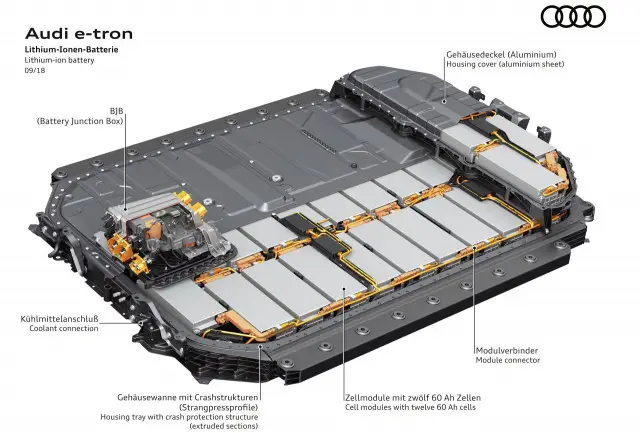
The composition of an EV battery might vary slightly depending on the types of electric vehicles, but generally, EV batteries are composed of
- Electrochemical Cells. An electric cell is essentially a source of DC electrical energy. It converts stored chemical energy into electrical energy through an electrochemical process.
- Battery Modules. A battery module is an assembly of battery cells, which is put into the frame by combining a fixed number of cells to protect the cells from vibration, heat, or external hazards. A battery module will always incorporate many discrete cells connected in series and parallel to achieve the module’s total voltage and current requirements.
- Battery Pack. The final shape of an electric vehicle battery installed to an electric vehicle. The collection of data from the pack sensors and activation of the pack relays are accomplished by the pack’s battery monitoring unit (BMU) or the battery management system (BMS).
An electric car battery is composed of many electrochemical cells. The actual battery cells can have different chemistry, physical shapes, and sizes, as preferred by various pack manufacturers. To operate an electric vehicle, an enormous amount of power a thousand times stronger than that of a smartphone is required. That is why EVs need dozens of battery cells up to as many as thousands. The large stack of cells is typically grouped into smaller stacks called modules. Several of these modules are placed into a single pack. The cells are welded within each module to complete the electrical path for current flow. Modules can also incorporate cooling mechanisms, temperature monitors, and other devices.
Types of Lithium-ion Batteries for Car Batteries
The cathode is made of a composite material (an intercalated lithium compound) and defines the name of the Li-ion battery cell. There are two kinds of electrodes: intercalation and conversion electrodes. The intercalation electrodes are materials that function as host materials where lithium ions can intercalate. A typical example is LiCoO2 and its derivatives. Conversion-type cathode materials are some of the key candidates for the next generation of rechargeable Li and Li-ion batteries.
One of the most common lithium batteries is:
- Lithium Cobalt Oxide (LiCoO2). LiCoO2 is the most commonly used cathode material. LiCoO2 batteries have very stable capacities, although their capacities are lower than those based on nickel-cobalt-aluminum (NCA) oxides. However, cobalt is relatively expensive compared to other transition metals, such as manganese and iron, despite the attractive electrical properties of LiCoO2 cathodes. Currently, we can find this type of battery in mobile phones, tablets, laptops, and cameras.
- Lithium Manganese Oxide (LiMn2O4). LiMn2O4 is a promising cathode material with a cubic spinel structure. LiMn2O4 is one of the most studied manganese oxide-based cathodes because it contains inexpensive materials. A further advantage of this battery is enhanced safety and high thermal stability, but the cycle and calendar life is limited. This type of battery is found in power tools, medical devices, and powertrains.
- Lithium Nickel Manganese Cobalt Oxide (LiNiMnCoO2) – NMC. Nickel manganese cobalt (NMC) batteries contain a cathode made of a combination of nickel, manganese, and cobalt. NMC is one of the most successful cathode combinations in Li-ion systems. It can be tailored to serve as energy cells or power cells like Li-manganese. NMC batteries are used for power tools, e-bikes, and other electric powertrains.
- Lithium Iron Phosphate (LiFePO4) – LFP. LiFePO4 is one of the most recent cathode materials to be introduced. As of 2017, LiFePO4 is a candidate for large-scale production of lithium-ion batteries, such as electric vehicle applications, due to its low cost, excellent safety, and high cycle durability. The energy density of an LFP battery is lower than that of other common lithium-ion battery types, such as Nickel Manganese Cobalt (NMC). Because of their lower cost, high safety, low toxicity, long cycle life, and other factors, LFP batteries are finding a number of roles in vehicle use, utility-scale stationary applications, and backup power. Working voltage = 3.0 ~ 3.3 V. Cycle life ranges from 2,700 to more than 10,000 cycles depending on conditions.
- Lithium Nickel Cobalt Aluminum Oxide (LiNiCoAlO2) – NCA. In 1999, Lithium nickel cobalt aluminum oxide battery, or NCA, appeared in some special applications, and it is similar to the NMC. It offers high specific energy, a long life span, and a reasonably good specific power. NCA’s usable charge storage capacity is about 180 to 200 mAh/g. The capacity of NCA is significantly higher than that of alternative materials such as LiCoO2 with 148 mAh/g, LiFePO4 with 165 mAh/g, and NMC 333 (LiNi0,33Mn0,33Co0,33O2)with 170 mAh/g. The voltage of these batteries is between 3.6 V and 4.0 V, at a nominal voltage of 3.6 V or 3.7 V. Another advantage of NCA is its excellent fast charging capability. Nevertheless, its weak points are the limited resources of cobalt and nickel and the high cost.