
Lithium Metal Battery
Lithium-based primary cells are batteries that have metallic lithium as an anode. These types of batteries are also referred to as lithium-metal batteries. Note that disposable primary lithium batteries must be distinguished from secondary lithium-ion or lithium-polymer, which are rechargeable batteries. Lithium-ion batteries do not contain metallic lithium.
Primary lithium batteries have the lowest self-discharge rate hence the longest available shelf time, up to 10 years, and in temperatures up to 70. The first letter in the IEC standard system identifies the battery’s chemical composition. C is for lithium metal batteries (as CR2032). The characteristics that make lithium an exceptional electrode material for high energy density batteries include low electrode potential and very high conductivity. It is soft and malleable and can be extruded into thin foils.
They may be classified in several ways, but one convenient method is by the cathode material and voltage. Using an iron disulfide cathode gives a battery with a nominal voltage of 1.5 volts. This cell is used for high-performance AA batteries. Most other lithium batteries are 3.0 volt systems using cathodes comprising either solids (manganese dioxide or carbon monofluoride) or highly toxic liquids (sulfur dioxide or thionyl chloride).
Advantages and Disadvantages of Lithium Metal Batteries
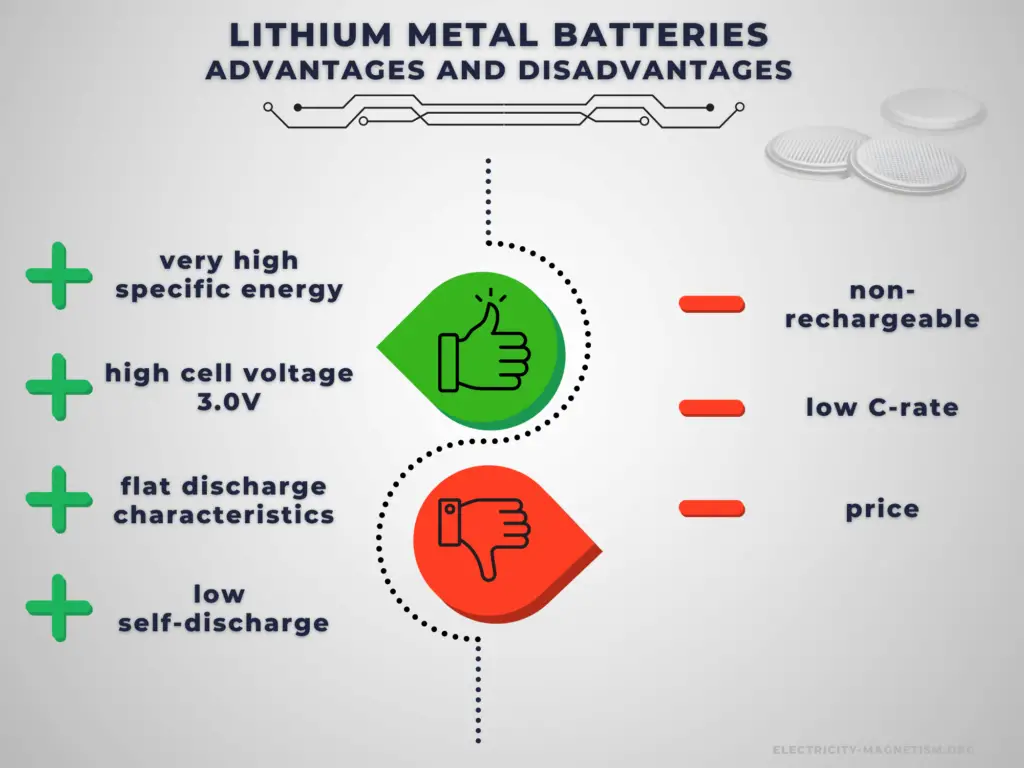
Advantages:
Primary batteries have higher energy density than rechargeable secondary cells. High specific energy, long storage times (low self-discharge), and instant readiness give primary batteries a unique advantage over other power sources. They are usually the best choice for low-drain applications. They can be carried to remote locations and used instantly, even after long storage; they are also readily available and environmentally friendly when disposed.
Lithium metal batteries have a very high energy density, double that of premium alkaline batteries. They also have high cell voltage, flat discharge characteristic, low self-discharge, a very long operating life (15 to 20 years for lithium thionyl chloride), and a wide operating temperature range ( -60 ° C to +85 ° C for lithium-sulfur dioxide), excellent durability, and small cell size.
Disadvantages:
The main disadvantage of primary batteries is that they are non-rechargeable. Another disadvantage is their low C-rate. Even high current types are considered low in comparison to rechargeable batteries. They are also less environment friendly than rechargeable batteries. The application of primary batteries leads to a large amount of waste batteries to be recycled. For large batteries, primary batteries are usually not cost-effective.
The major disadvantage of lithium metal batteries is their price.

