
Explore the fascinating world of diodes, their types, working principles, and diverse applications in electronics. Dive into this comprehensive guide.
Introduction to Diodes
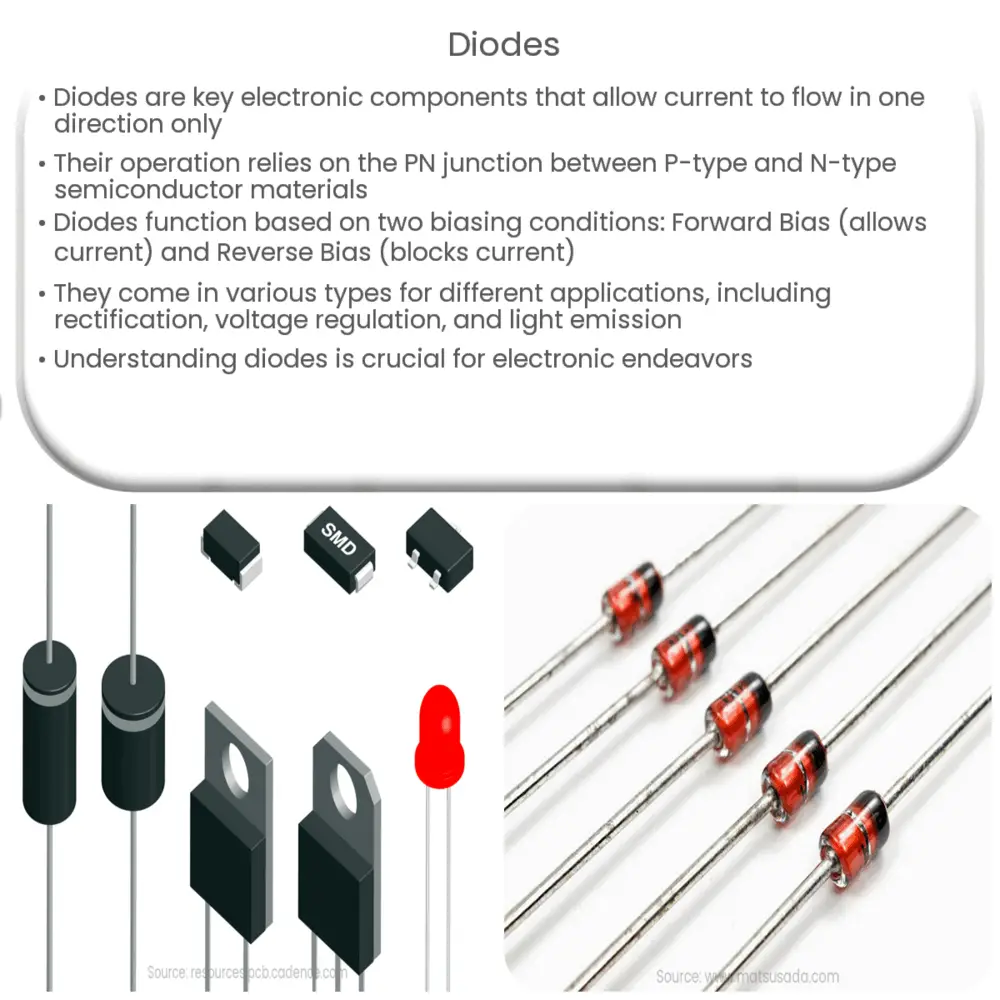
A diode is a significant component in the world of electronics. It is a two-terminal electronic device that permits current flow in one direction only. Essentially, it is a “one-way street” for electric current. With its unique property, the diode plays a crucial role in various applications like rectification, regulation, signal modulation, and more.
Working Principle
The working principle of a diode is fairly simple. It relies on the PN junction, an interface between two types of semiconductor material – P-type and N-type. These materials are doped with impurities to create free charge carriers: the P-type with holes and the N-type with electrons. When these two materials come into contact, an interesting phenomenon occurs at their junction, giving rise to what is known as the depletion region.
Forward Bias and Reverse Bias
The operation of a diode is based on two different biasing conditions: Forward Bias and Reverse Bias.
- Forward Bias: In this state, the P-type material (anode) is connected to the positive terminal of the battery, and the N-type material (cathode) is connected to the negative terminal. This arrangement allows electric current to flow through the diode.
- Reverse Bias: In this condition, the P-type material is connected to the negative terminal of the battery, and the N-type material is connected to the positive terminal. In this arrangement, the diode blocks the flow of electric current.
Types of Diodes
There are numerous types of diodes, each designed to fulfill specific needs in electronic and electrical circuits. Some of the common types include:
- Rectifier Diode: This is the most common type of diode, widely used in power rectification.
- Zener Diode: This is specially designed for voltage regulation in circuits.
- LED (Light Emitting Diode): This type of diode emits light when current flows through it and is widely used in lighting and display applications.
Additional Types of Diodes
Continuing with the different types of diodes, we have:
- Photodiode: These diodes convert light into electric current. They are commonly used in solar cells and light detection systems.
- Tunnel Diode: Known for their high speed, tunnel diodes are primarily used in high-frequency oscillators and amplifiers.
- Varactor Diode: Also called varicap diodes, these are used in frequency modulation and tuning applications due to their variable reactance.
- Shockley Diode: A four-layer diode, also known as a PNPN diode. This type of diode is generally used in switching circuits.
Applications of Diodes
The diode’s capability to control the flow of current has made it an integral part of many electrical and electronic devices. Some common applications are:
- Rectification: The primary use of diodes is in rectification circuits, where they convert alternating current (AC) into direct current (DC).
- Voltage Regulation: Zener diodes are commonly used for voltage regulation, keeping the voltage within a circuit at a constant level.
- Signal Modulation and Demodulation: Diodes are also used in signal processing for amplitude modulation and demodulation.
- Light Emission: LEDs find extensive use in lighting, digital displays, indicators, and optocouplers.
Conclusion
In conclusion, diodes are pivotal elements in the electronic world due to their unique property of allowing current to flow in one direction. They come in various types, each designed for a specific purpose, from power rectification to signal modulation, light emission, and more. Understanding their working principles and applications is essential for anyone interested in electronics, whether for professional engineering, DIY electronics projects, or general knowledge. Despite their simplicity, diodes play an indispensable role in shaping our technologically advanced world.



