
Capacitor
A capacitor is a device that can store electric charge and normally consists of two conducting objects (usually plates or sheets) placed near each other but not touching. Basically, capacitors consist of two metal plates separated by an insulator. The insulator is called a dielectric. (e.g., polystyrene, oil, or air). Capacitors are one of the most used and useful electronic components used in any modern electronic and electrical circuit and devices.
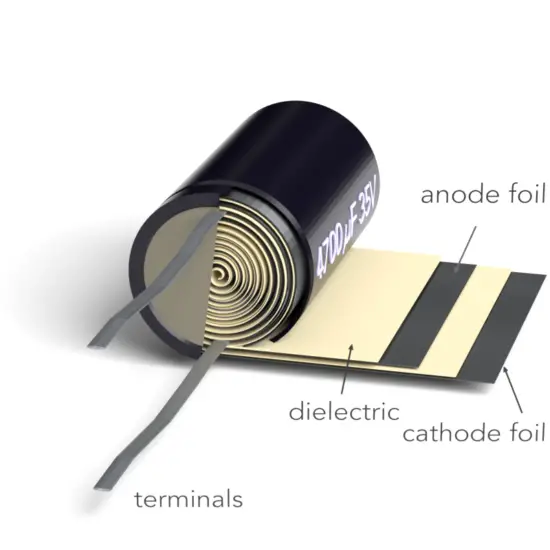
Their capacitance depends only on the size, shape, and relative position of the two conductors, and also on the material that separates them.
A simple capacitor consists of a pair of parallel plates of area A separated by a small distance d. Often the two plates are rolled into the form of a cylinder with plastic, paper, or other insulator separating the plates.
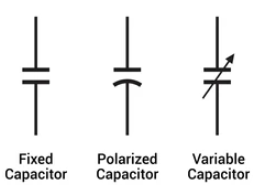
In circuit diagrams, a capacitor is represented by either of these symbols:
Types of Capacitors
Capacitors are divided into three basic groups:
- Fixed capacitors. The capacitors whose value is fixed during the manufacturing process and cannot be latter altered are called fixed capacitors. Fixed capacitors are also further classified into two kinds, electrolytic and non-electrolytic capacitors.
- Polarized capacitors. Polarized Capacitors are the ones that have specific positive and negative polarities. While using these capacitors in circuits, it should always be taken care that they are connected in perfect polarities.
- Variable capacitors with a variable capacitance. They are made as trimmers that are typically adjusted only during circuit calibration, and as a device tunable during the operation of the electronic instrument.
The most common group is fixed capacitors. Many are named based on the type of dielectric. For a systematic classification, these characteristics cannot be used because one of the oldest, the electrolytic capacitor, is named instead by its cathode construction.
The most common kinds of capacitors are:
- Electrolytic capacitors
- Ceramic capacitors
- Paper capacitors
- Film capacitors
- Mica capacitors
- Supercapacitors
- ….
DC and AC Capacitors
DC (Direct Current) and AC (Alternating Current) capacitors are types of capacitors that are designed to work with either DC or AC circuits.
DC capacitors are designed to work with circuits that have a steady, unchanging voltage. They are commonly used in power supply circuits, where they are used to filter out unwanted noise or ripple from the output voltage. DC capacitors are typically rated for their maximum voltage and capacitance value. They are often polarized, meaning they must be connected to the circuit in the correct orientation to work properly.
On the other hand, AC capacitors are designed to work with circuits that have a changing voltage over time, such as in AC power circuits. They are commonly used in motors, lighting, and power factor correction applications. AC capacitors are typically rated for their capacitance value, maximum voltage, and frequency range. They are often non-polarized, meaning they can be connected to the circuit in either direction.
It’s worth noting that some capacitors, such as electrolytic capacitors, can be used in both DC and AC circuits but may have different specifications depending on the application. For example, an electrolytic capacitor used in a DC power supply circuit may have a higher voltage rating than the same capacitor used in an AC lighting circuit due to the different voltage characteristics of the circuits.



