
Carbon nanotube supercapacitors are advanced energy storage devices offering high power density, rapid charge/discharge rates, and long cycle life.
Introduction to Carbon Nanotube Supercapacitors
Carbon nanotube supercapacitors are at the forefront of energy storage technology, promising to revolutionize fields from electronics to electric vehicles. Their prominence is primarily due to the remarkable properties of carbon nanotubes (CNTs) and the exceptional energy storage capabilities of supercapacitors.
CNTs, a type of nanomaterial made from one or more layers of graphene rolled into a tube, possess extraordinary strength, flexibility, and thermal and electrical conductivity. This, combined with their nanoscale dimensions and high surface area, makes them ideal materials for energy storage devices.
Supercapacitors, also known as ultracapacitors or electrochemical capacitors, differ from traditional batteries in their energy storage mechanism. Rather than relying on chemical reactions to store and release energy, supercapacitors accumulate energy electrostatically on the surface of materials. This property enables them to charge and discharge rapidly, providing high power density while enduring millions of cycles without significant degradation.
The Emergence of Carbon Nanotube Supercapacitors
The integration of CNTs into supercapacitors has resulted in devices with substantially enhanced energy storage performance. Their high electrical conductivity accelerates the charge/discharge rates, while the large surface area available for energy storage increases the energy density.
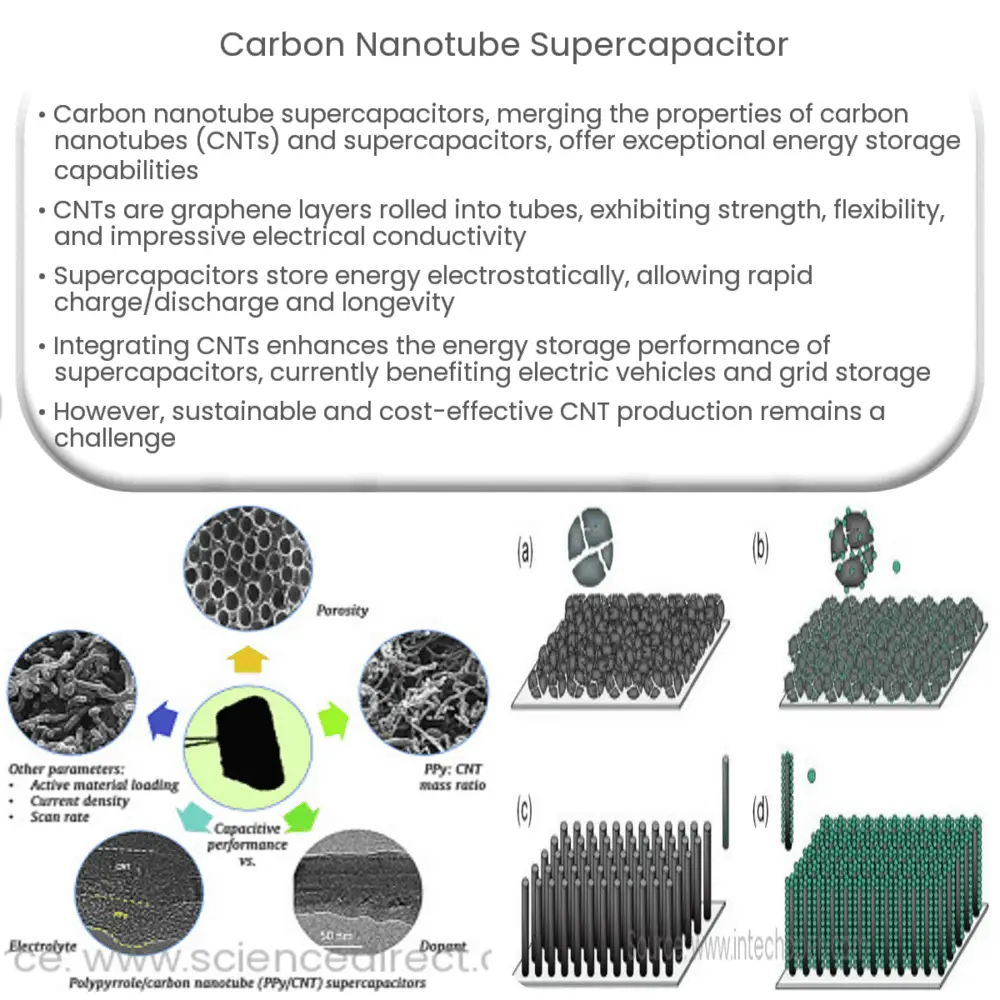
The structure of CNTs is crucial for their functionality in supercapacitors. The walls of the nanotubes serve as the surface for charge accumulation, and the spaces between the tubes act as reservoirs for electrolyte ions. This structure enhances both the electrical double layer capacitance and the pseudocapacitance, two key factors determining the energy storage capacity of supercapacitors.
Carbon nanotube supercapacitors are not just theoretical constructs; they are already finding practical applications. For instance, they are being utilized in electric vehicles to provide rapid power bursts for acceleration, and in grid storage systems to smooth out power fluctuations and ensure a stable supply of electricity.
Despite these promising advancements, there are still challenges that need to be addressed to fully realize the potential of carbon nanotube supercapacitors. The production of CNTs at a large scale in a cost-effective and environmentally friendly manner is one of the key obstacles. Additionally, further research is required to optimize the performance of supercapacitors and to create devices that can store as much energy as batteries while maintaining their high power density and cycle durability.
Advancements in Carbon Nanotube Supercapacitor Technology
In recent years, researchers have made significant strides in tackling the challenges associated with carbon nanotube supercapacitors. One of the promising developments is the hybridization of supercapacitors and batteries, creating devices that combine the high energy density of batteries with the power density and cycle life of supercapacitors.
This has been achieved by incorporating active materials, such as transition metal oxides or conducting polymers, into the carbon nanotube structure. These materials contribute to the pseudocapacitance of the device, thereby increasing its energy density. Simultaneously, the CNTs provide high power density and cycle life due to their excellent electrical conductivity and mechanical durability.
Furthermore, progress has been made in the production of CNTs. Techniques such as chemical vapor deposition and laser ablation have been refined to produce high-quality CNTs on a large scale. While these processes are energy-intensive and require precise control, ongoing research is focusing on developing more sustainable and cost-effective production methods.
Future Prospects of Carbon Nanotube Supercapacitors
The future of carbon nanotube supercapacitors looks promising. With continuous advancements in nanotechnology and materials science, we can anticipate further improvements in the performance of these devices. Potential future applications extend beyond electric vehicles and grid storage, into areas such as portable electronics, renewable energy systems, and even space exploration.
Moreover, the development of flexible and wearable supercapacitors is an exciting prospect. The inherent flexibility of CNTs could allow the creation of energy storage devices that can be integrated into clothing or flexible electronics, opening up a whole new realm of possibilities.
However, the road to these future applications is not without challenges. Ensuring the safety of these devices, particularly under conditions of rapid charging and discharging, is paramount. Additionally, the environmental impact of CNT production and the lifecycle of supercapacitors must be thoroughly evaluated and minimized.
While there is still much work to be done, the progress made thus far in the field of carbon nanotube supercapacitors is encouraging. As we continue to push the boundaries of what is possible with this technology, it is increasingly clear that carbon nanotube supercapacitors have the potential to play a significant role in the future of energy storage.



