
Explore the innovative world of Carbon Aerogel Supercapacitors, their creation, advantages, applications, and future potential in energy storage.
Understanding Carbon Aerogel Supercapacitors
Supercapacitors, also known as ultracapacitors or electrochemical capacitors, have gained significant attention due to their high power density, long cycle life, and rapid charge/discharge rate. Among the various types of supercapacitors, Carbon Aerogel Supercapacitors are at the forefront of cutting-edge energy storage technology. But what is a Carbon Aerogel Supercapacitor, and what makes it so unique?
What is Carbon Aerogel?
Carbon Aerogel is a type of aerogel that is primarily composed of carbon. Aerogels are open-porous materials with a sponge-like structure, characterized by high porosity and a vast internal surface area. They are incredibly lightweight and have excellent thermal, acoustic, and electrical properties. By manipulating the properties of the raw materials used, scientists have been successful in creating Carbon Aerogels, known for their excellent electrical conductivity.
Creation of Carbon Aerogel Supercapacitors
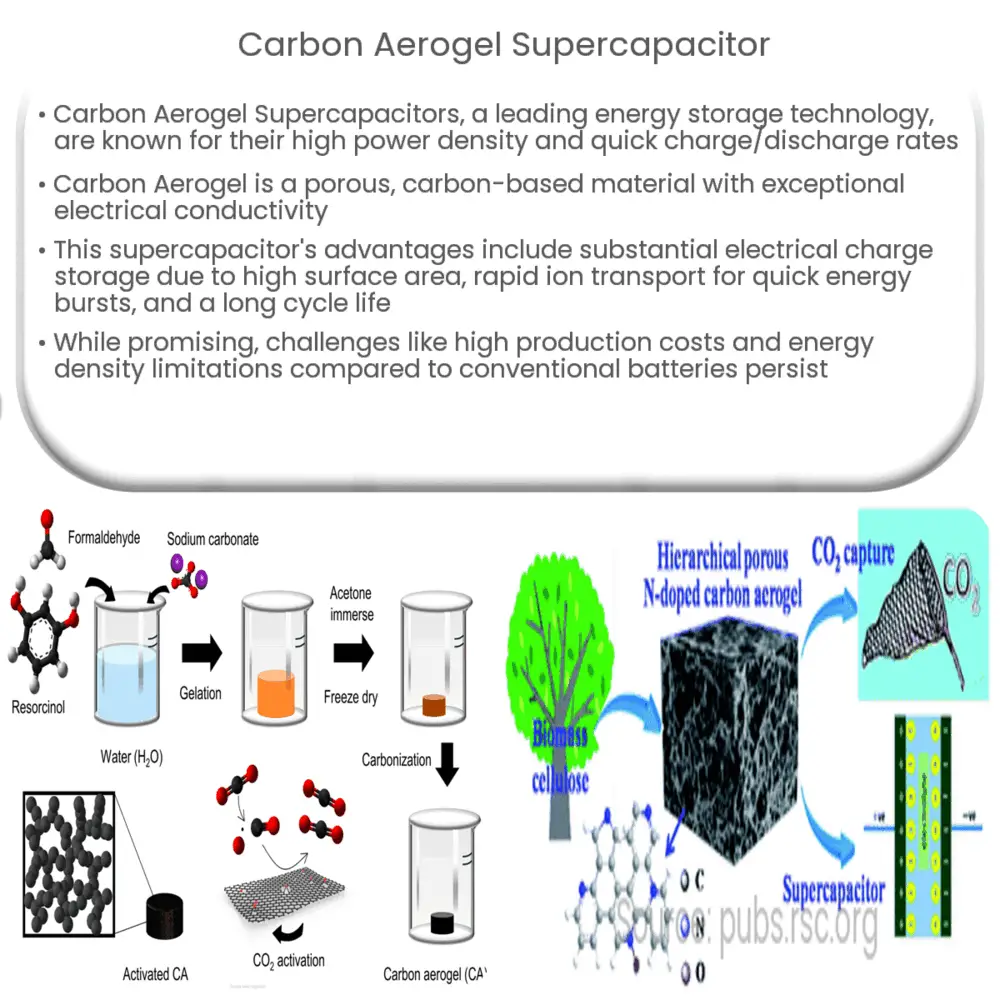
The process of creating a Carbon Aerogel Supercapacitor involves several stages. Initially, a gel is formed by mixing resorcinol and formaldehyde under specific conditions. The gel is then subjected to supercritical drying, which removes the liquid inside the gel’s pores without causing the structure to collapse. The resulting product is a Resorcinol-Formaldehyde (RF) Aerogel. This RF Aerogel is then pyrolyzed in an inert atmosphere to create the Carbon Aerogel.
Why Use Carbon Aerogel in Supercapacitors?
The use of Carbon Aerogel in supercapacitors brings numerous advantages. Due to its high porosity and large surface area, a Carbon Aerogel can store a large amount of electrical charge. Moreover, the open-porous structure enables rapid electron and ion transport, which results in high power density and quick charge/discharge rate.
- High Energy Storage: The high surface area and porosity of Carbon Aerogel allow it to store a substantial amount of electrical charge, resulting in high energy density.
- Rapid Charge/Discharge: The open structure of the Carbon Aerogel enables quick ion transport, leading to a high power density and rapid charge/discharge rate. This makes Carbon Aerogel Supercapacitors ideal for applications requiring quick bursts of energy.
- Long Cycle Life: Unlike traditional batteries, Carbon Aerogel Supercapacitors do not rely on chemical reactions for storing energy, which results in longer cycle life.
Applications of Carbon Aerogel Supercapacitors
Given their impressive properties, Carbon Aerogel Supercapacitors find application in a broad range of industries.
- Energy Sector: With their high energy density and rapid charge/discharge capabilities, these supercapacitors are used for energy storage in renewable energy systems like wind turbines and solar panels.
- Automotive Industry: Carbon Aerogel Supercapacitors are also used in electric vehicles for regenerative braking systems, start-stop function, and power assist.
- Electronics: The long cycle life and high power density of these supercapacitors make them suitable for use in electronic devices like mobile phones, laptops, and other portable devices.
Future Perspectives
The future of Carbon Aerogel Supercapacitors seems promising, especially with ongoing research and development. Efforts are being made to further enhance the energy density, lifespan, and safety of these supercapacitors. Also, as the demand for cleaner, more efficient energy storage systems grows, the potential for Carbon Aerogel Supercapacitors only looks set to increase.
Challenges
Despite their numerous advantages, there are certain challenges that need to be overcome. The production of Carbon Aerogels is currently expensive and requires special equipment and conditions. Additionally, while their energy density is superior to traditional capacitors, it is still lower compared to conventional batteries. Future research and technological advancements may help in overcoming these limitations.
Conclusion
In conclusion, Carbon Aerogel Supercapacitors represent a major breakthrough in the field of energy storage. Their high power density, long cycle life, and rapid charge/discharge capabilities make them ideal for various applications in the energy sector, automotive industry, and electronics. While there are still challenges to be addressed, the future of Carbon Aerogel Supercapacitors is certainly promising, with their potential only set to expand with ongoing research and development.



