
Explore the world of CAN Controllers, their types, benefits, and diverse applications in modern technology systems. (120 characters)
Introduction to CAN Controllers
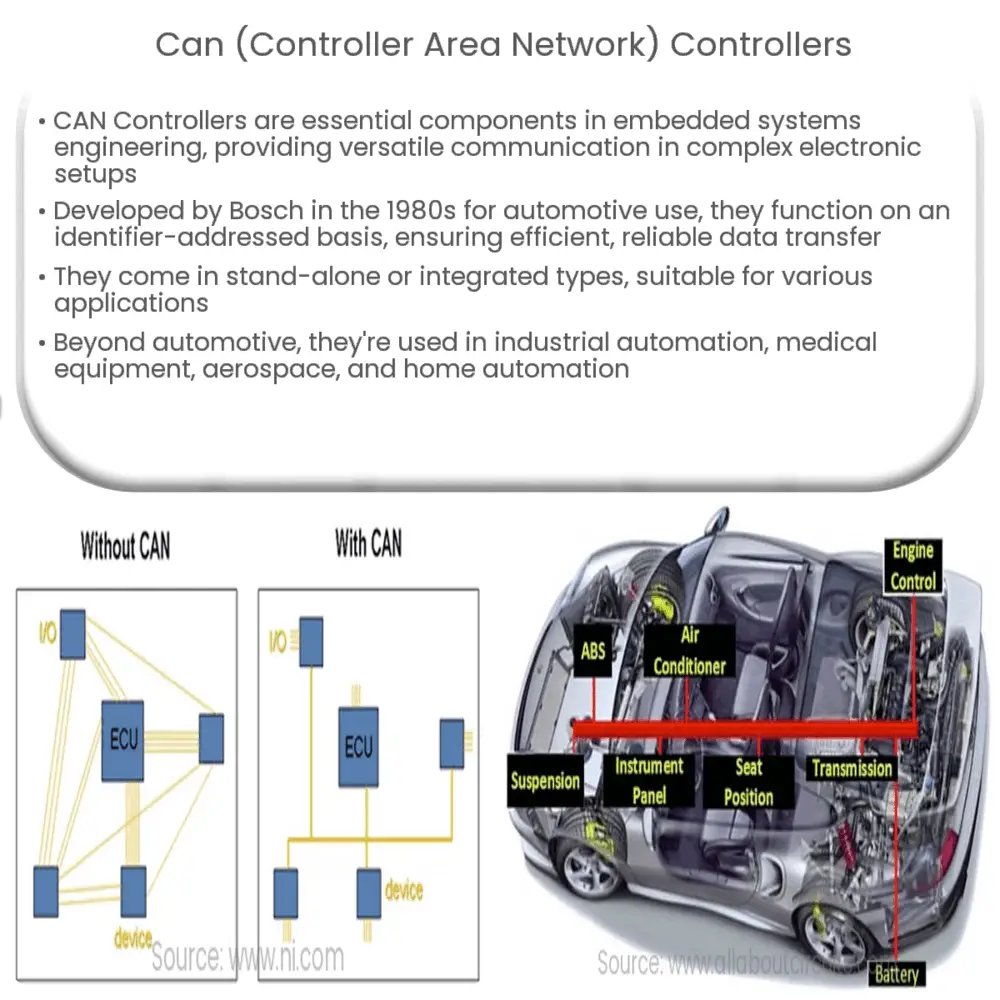
Within the vast universe of modern technology, a critical and highly integral component remains relatively unknown outside the sphere of embedded systems engineering – the CAN (Controller Area Network) Controller. This technological marvel forms the backbone of embedded networking applications, providing a robust and versatile means of communication between various subsystems within a complex electronic environment.
Origin and Purpose of CAN Controllers
The CAN Controller was initially developed by Bosch GmbH in the mid-1980s for use in automotive applications, aiming to simplify wiring and reduce vehicle weight. This advanced piece of technology was designed to facilitate communication between various electronic devices, known as nodes, without the need for a host computer. It operates within a multi-master broadcast serial bus standard, combining hardware and software features to enable efficient and reliable communication within complex systems.
Functioning of CAN Controllers
CAN Controllers are unique in their method of operation. Unlike most other communication protocols, which operate on a message-addressed basis, CAN Controllers function on an identifier-addressed basis. This means that messages transmitted through the CAN network are marked with identifiers, which are then recognized by the nodes that need that particular information. This approach facilitates high-speed data transfer and allows for greater flexibility and control in data communication.
Benefits of CAN Controllers
-
Reliability: The CAN Controller ensures robustness and reliability in the system. It is designed to function in harsh environmental conditions and withstand high levels of electrical noise.
-
Efficiency: The multi-master communication model of CAN allows multiple devices to control the bus without significant interference, leading to an efficient data transfer process.
-
Scalability: With the CAN protocol, you can add or remove nodes without interrupting the system’s operation. This quality makes it a scalable solution for growing technological needs.
Types of CAN Controllers
CAN Controllers can be broadly divided into two categories: Stand-alone controllers and integrated controllers. Stand-alone controllers are designed to be used with a microcontroller, while integrated controllers are built into the microcontroller itself. Both types serve the same essential function, but their use depends on specific application requirements.
Stand-alone CAN Controllers
Stand-alone CAN Controllers offer a separate, dedicated hardware solution for managing CAN-based communication. This type of controller interfaces with a microcontroller or processor through a peripheral interface like SPI. The advantage of a stand-alone CAN controller is its flexibility; it can be used with virtually any microcontroller, regardless of its processing capability or availability of in-built CAN functionality.
Integrated CAN Controllers
Integrated CAN Controllers, on the other hand, come as part of a microcontroller. They are integrated directly into the microcontroller’s silicon, allowing for seamless operation and reducing the need for additional components. The integrated CAN controllers are often favoured for their simplicity and reduced system complexity, though their usage is limited to the capabilities of the specific microcontroller.
Applications of CAN Controllers
Initially designed for automotive systems, CAN Controllers have found widespread use in numerous other applications, demonstrating their versatility. Some of these applications include:
-
Industrial automation: For linking various components in production lines and process control systems.
-
Medical equipment: For interconnecting devices and systems within a medical setup.
-
Aerospace and defence: For system-level communication within aircraft and defence systems.
-
Home automation: For creating smart home networks where various appliances and systems can communicate with each other.
Conclusion
In conclusion, the CAN Controller, with its advanced capabilities and broad range of applications, forms an integral part of today’s technologically advanced world. Whether in vehicles, industry, home automation, or even advanced aerospace applications, it plays a critical role in facilitating communication and coordination among numerous subsystems. Its robustness, efficiency, and scalability make it a preferred choice for engineers and system designers. As we continue to push the boundaries of technology, the role of CAN Controllers is set to become increasingly significant, revolutionizing the way we think about and manage system-level communication in our increasingly interconnected world.



