
Explore the unique world of ball bearing motors, their operation, advantages, disadvantages, and potential applications in this comprehensive article.
Introduction to Ball Bearing Motors
A ball bearing motor is a fascinating and unusual type of electric motor that, instead of using conventional electromagnetic principles, relies on the principles of rolling friction. This concept is fundamentally different from typical motors and can often be a topic of curiosity and confusion.
The Basics of Ball Bearing Motors
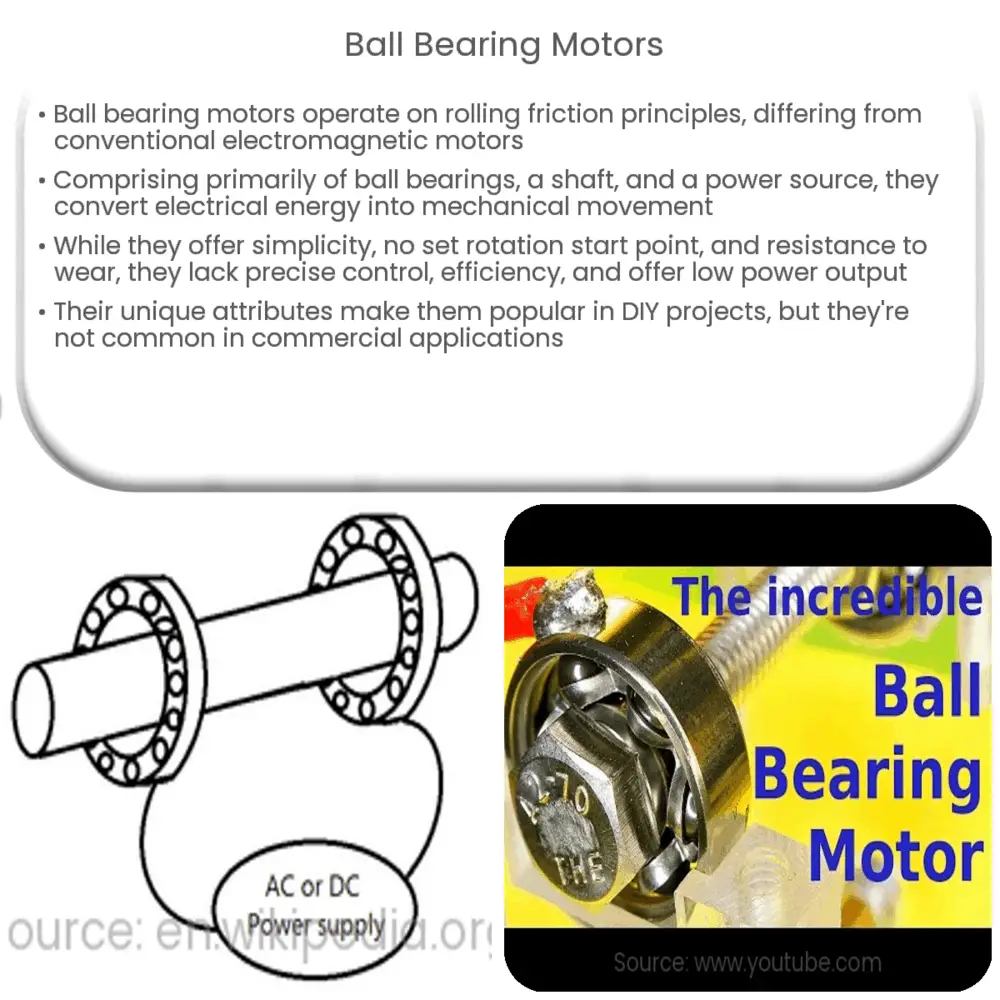
A ball bearing motor essentially involves two ball bearings connected by a shaft, with one or both bearings subject to an electrical current. This initiates a rolling movement in the bearings which effectively makes the shaft rotate. The most remarkable attribute of a ball bearing motor is its simplicity: it only requires ball bearings, a shaft, and a power source.
How Ball Bearing Motors Work
- The ball bearing motor operates on the principle of rolling friction or rolling contact electrification. It’s the conversion of electrical energy into mechanical energy.
- When current is applied to the bearings, it creates a magnetic field. The interaction of this magnetic field with the conductive bearings produces a force that sets the bearings in motion.
- Because of the design and simplicity, this motor type has no specific starting or ending point, meaning it can start moving in any direction.
Key Components of Ball Bearing Motors
- Ball Bearings: The fundamental component, ball bearings, is a set of steel balls encased in a metal ring. They reduce rotational friction and support radial and axial loads, critical for the operation of the motor.
- Shaft: This is the central rod that connects the two ball bearings. It rotates as the bearings start to move under the influence of an electric current.
- Power Source: Ball bearing motors require a power source, usually a direct current (DC), to initiate motion.
In summary, ball bearing motors stand as an intriguing example of simplicity and efficiency in electromechanical design. Although not commonly used for commercial applications, these motors have garnered attention due to their unique operation principle and simplicity. The second part of this article will further explore the practical applications, advantages, and disadvantages of ball bearing motors.
Practical Applications of Ball Bearing Motors
While ball bearing motors are not commonly seen in mainstream commercial applications, they have been leveraged for specific use cases due to their unique attributes. Hobbyists and inventors often use these types of motors in DIY projects or prototypes due to their simple design and ease of assembly.
Advantages of Ball Bearing Motors
- One of the significant advantages of ball bearing motors is their simplicity. They are relatively easy to construct, requiring minimal components and no complex assembly procedures.
- The absence of specific starting or ending points allows these motors to start moving in any direction, which can be beneficial in certain applications.
- They have an inherent resistance to wear and tear due to their lack of brushes and commutators, common failure points in conventional motors.
Disadvantages of Ball Bearing Motors
- The primary disadvantage is the lack of control over the initial direction of rotation, which makes them unsuitable for applications requiring precision control.
- They are less efficient compared to traditional motors due to higher energy losses, predominantly due to rolling and air friction.
- Their low power output limits their use in commercial applications where high power and efficiency are required.
Conclusion
In conclusion, ball bearing motors, while not typically used in conventional applications, hold a distinct place in the world of electric motors due to their unique operational principles and simplicity. They demonstrate the power of basic physics principles and inspire creativity and innovation in design. However, their limitations in terms of control, efficiency, and power output necessitate further research and development if they are to find wider applications in the future.