
How do you calculate the magnetic field produced by a current-carrying wire?

Use Biot-Savart law for arbitrary wire geometries, and Ampere’s law for symmetrical configurations to calculate the magnetic field produced.
Use Biot-Savart law for arbitrary wire geometries, and Ampere’s law for symmetrical configurations to calculate the magnetic field produced.
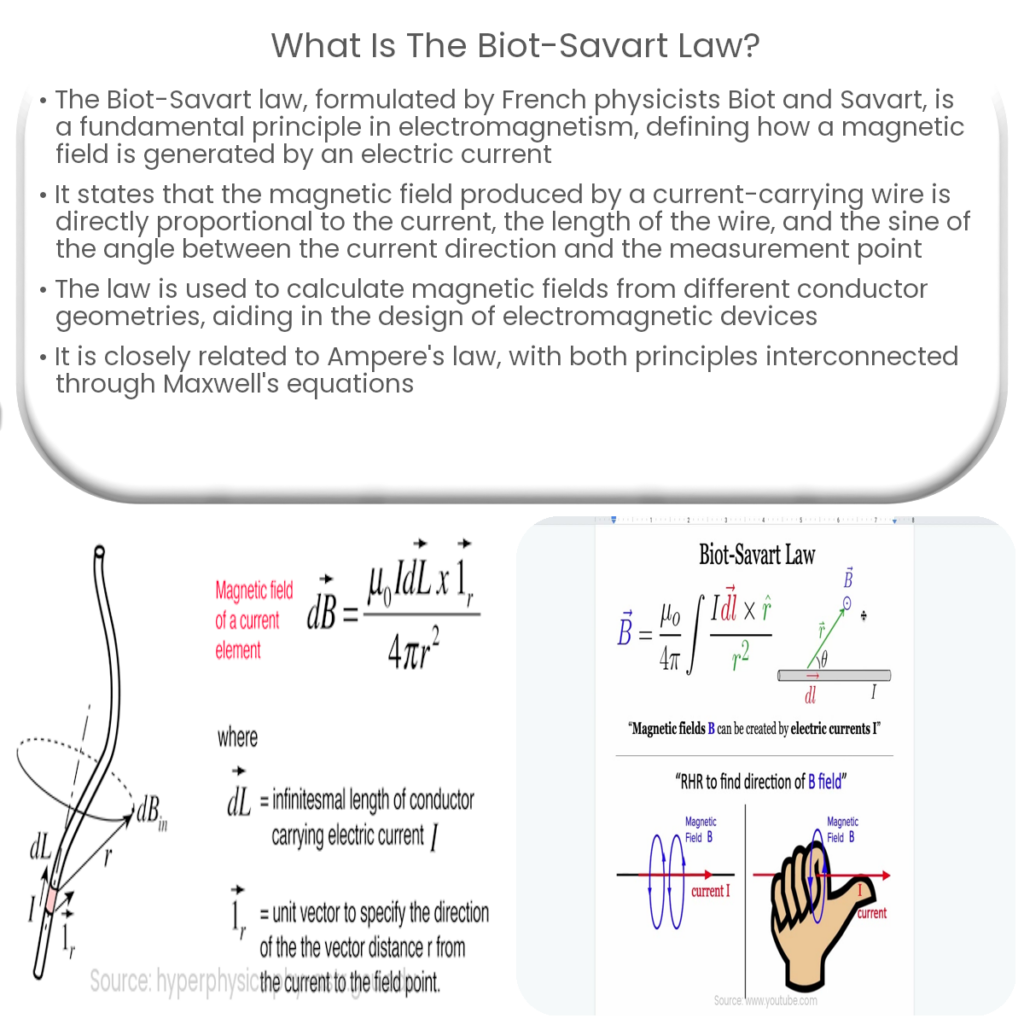
The Biot-Savart law describes how a magnetic field is generated by an electric current and is used to calculate magnetic field distributions.
Ampere’s law relates magnetic fields to electric currents, stating that the line integral of a magnetic field around a closed loop is proportional to the net electric current passing through the loop.

Magnetic fields and electric currents are related as currents generate magnetic fields, and changing magnetic fields can induce electric currents.

Magnetic fields interact with electric fields through phenomena like the Lorentz force, electromagnetic induction, and the propagation of electromagnetic waves.

The Lorentz force is the force experienced by a charged particle in electric and magnetic fields, crucial in electromagnetism and various applications.

The magnetic force on a charged particle in a magnetic field can be calculated using the Lorentz force equation: F = q(v x B), where F is the force, q is the charge, v is the velocity, and B is the magnetic field.

A magnetic field is a region around a magnet or moving charge where forces occur, while magnetic force is the actual force acting on charged particles.

Magnetic field units include tesla (T), gauss (G), and amperes per meter (A/m). Tesla is the primary SI unit, while gauss and A/m have specific uses.

A magnetic field is created by permanent magnets, electromagnets, and moving electric charges, influencing magnetic materials and electric currents.

The primary purpose of this project is to help the public to learn some exciting and important information about electricity and magnetism.
Our Website follows all legal requirements to protect your privacy. Visit our Privacy Policy page.
The Cookies Statement is part of our Privacy Policy.
The information contained on this website is for general information purposes only. This website does not use any proprietary data. Visit our Editorial note.
It’s simple:
1) You may use almost everything for non-commercial and educational use.
2) You may not distribute or commercially exploit the content, especially on another website.


