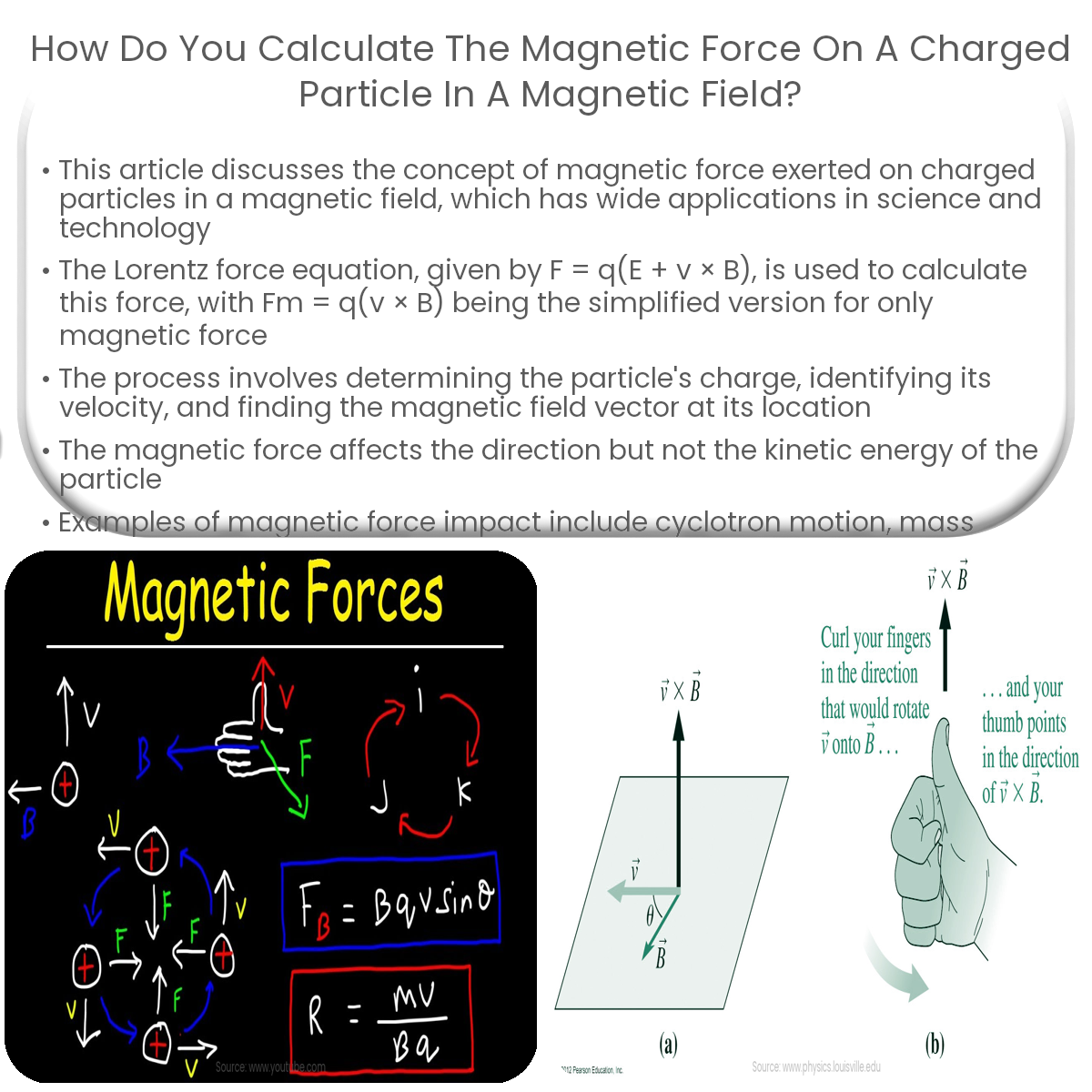
The magnetic force on a charged particle in a magnetic field can be calculated using the Lorentz force equation: F = q(v x B), where F is the force, q is the charge, v is the velocity, and B is the magnetic field.
Calculating the Magnetic Force on a Charged Particle in a Magnetic Field
Magnetic fields exert forces on charged particles, influencing their motion and trajectories. This phenomenon is the basis for many scientific and technological applications, such as particle accelerators, mass spectrometers, and even the Earth’s magnetic field affecting charged particles in space. In this article, we will discuss how to calculate the magnetic force on a charged particle in a magnetic field using the Lorentz force equation.
The Lorentz Force Equation
The Lorentz force equation is a fundamental principle in electromagnetism that describes the force experienced by a charged particle in an electric and magnetic field. The equation is given by:
- F = q(E + v × B)
Here, F is the total force on the charged particle, q is the charge of the particle, E is the electric field vector, v is the velocity vector of the particle, and B is the magnetic field vector. The cross product (v × B) represents the interaction between the particle’s velocity and the magnetic field.
When considering only the magnetic force, the equation can be simplified as:
- Fm = q(v × B)
Calculating the Magnetic Force
To calculate the magnetic force on a charged particle, follow these steps:
- Determine the charge (q) of the particle. The charge is measured in coulombs (C).
- Identify the velocity vector (v) of the particle. This is typically given in meters per second (m/s).
- Find the magnetic field vector (B) at the particle’s location. The magnetic field strength is measured in tesla (T).
- Calculate the cross product (v × B) to determine the direction and magnitude of the magnetic force.
- Multiply the charge (q) by the cross product to obtain the magnetic force (Fm) on the particle.
Note that the magnetic force is always perpendicular to both the velocity vector and the magnetic field vector. This results in a force that does not perform work on the charged particle, meaning that the particle’s kinetic energy remains constant while its direction changes.
Examples of Magnetic Force on Charged Particles
Some common examples of magnetic forces acting on charged particles include:
- Cyclotron motion: In a uniform magnetic field, a charged particle follows a helical path or a circular path if its velocity is perpendicular to the magnetic field.
- Mass spectrometry: This analytical technique separates charged particles based on their mass-to-charge ratio by subjecting them to a magnetic field.
- Auroras: The Earth’s magnetic field interacts with charged particles from the solar wind, creating spectacular light displays known as auroras.
In conclusion, the magnetic force on a charged particle in a magnetic field can be calculated using the Lorentz force equation. Understanding this fundamental concept is crucial for various scientific and technological applications that rely on the behavior of charged particles in magnetic fields.