
What is Lenz’s law?
Lenz’s law states that the induced electromotive force (EMF) and current in a closed loop oppose the change in the magnetic field that produced them.
Lenz’s law states that the induced electromotive force (EMF) and current in a closed loop oppose the change in the magnetic field that produced them.
To calculate induced EMF, apply Faraday’s law: ε = -dΦB/dt, considering the geometry, motion of the conductor, magnetic field strength, and angle.
Faraday’s law of electromagnetic induction describes the relationship between changing magnetic fields and induced electromotive force in a conductor.
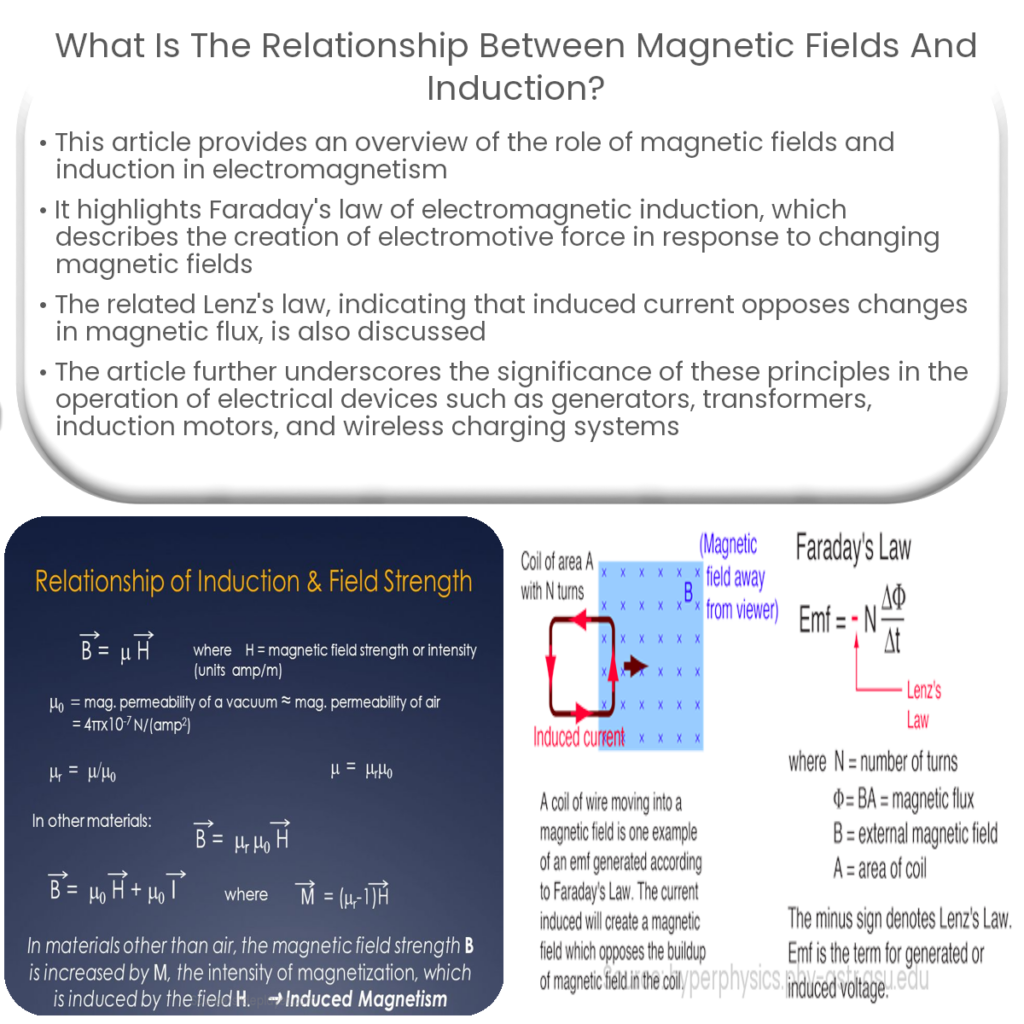
Magnetic fields and induction are related through Faraday’s law, which states that a changing magnetic field induces an electromotive force in a conductor.

Magnetic hysteresis is the lagging of magnetization in ferromagnetic materials when the magnetic field changes, resulting in a hysteresis loop.

Magnetic domains are microscopic regions in ferromagnetic materials where magnetic moments align, creating an overall magnetic field.

Magnetic fields affect materials as diamagnetic, paramagnetic, or ferromagnetic, influencing electronics, medicine, transportation, and materials science.

Absolute permeability is a material’s inherent property measured in H/m, while relative permeability is dimensionless and compares a material’s permeability to free space.

Magnetic permeability is a material’s ability to support magnetic field formation, measured in henries per meter. It varies based on material type.
Diamagnetic materials repel magnetic fields, paramagnetic materials show weak attraction, and ferromagnetic materials have strong attraction and can retain magnetization.

The primary purpose of this project is to help the public to learn some exciting and important information about electricity and magnetism.
Our Website follows all legal requirements to protect your privacy. Visit our Privacy Policy page.
The Cookies Statement is part of our Privacy Policy.
The information contained on this website is for general information purposes only. This website does not use any proprietary data. Visit our Editorial note.
It’s simple:
1) You may use almost everything for non-commercial and educational use.
2) You may not distribute or commercially exploit the content, especially on another website.


