
Near-Field Imaging Touch Sensor

Explore the revolution in touch technology with near-field imaging touch sensors, their mechanism, applications, and future potential.
Explore the revolution in touch technology with near-field imaging touch sensors, their mechanism, applications, and future potential.

Explore the principles of Frustrated Total Internal Reflection (FTIR) touch sensors, their applications, challenges, and future prospects.

Explore Gesture Recognition Touch Sensors, their working principle, applications, advancements, and future potential in our comprehensive guide.

Explore the basics of single-touch sensors, their working mechanism, uses, and comparison with multi-touch technology in our comprehensive guide.

Explore the fascinating world of multi-touch sensors, their workings, applications, and the exciting future that awaits this transformative technology.

Explore the world of piezoelectric touch sensors, their working principles, benefits, applications, challenges, and future prospects.

Explore the world of Force Sensitive Touch Sensors: their working principle, types, applications, and future prospects.

Explore the innovative Acoustic Pulse Recognition (APR) touch sensor technology, its benefits, limitations, and the future outlook.

Explore the fundamentals of Dispersive Signal Touch Sensors, their operation, advantages, disadvantages, applications, and future prospects.
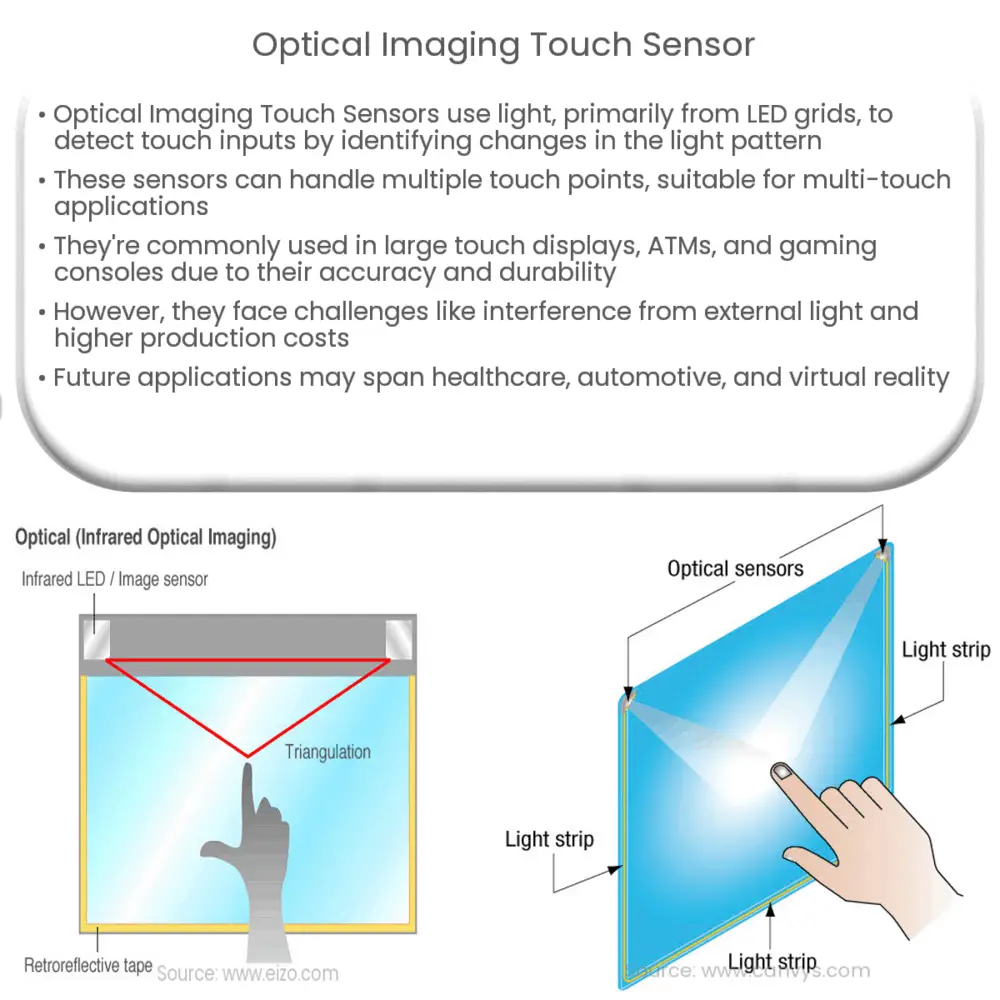
Explore the workings, applications, advancements, and future prospects of Optical Imaging Touch Sensors in our comprehensive guide.

The primary purpose of this project is to help the public to learn some exciting and important information about electricity and magnetism.
Our Website follows all legal requirements to protect your privacy. Visit our Privacy Policy page.
The Cookies Statement is part of our Privacy Policy.
The information contained on this website is for general information purposes only. This website does not use any proprietary data. Visit our Editorial note.
It’s simple:
1) You may use almost everything for non-commercial and educational use.
2) You may not distribute or commercially exploit the content, especially on another website.


