
Explore the fundamentals of Dispersive Signal Touch Sensors, their operation, advantages, disadvantages, applications, and future prospects.
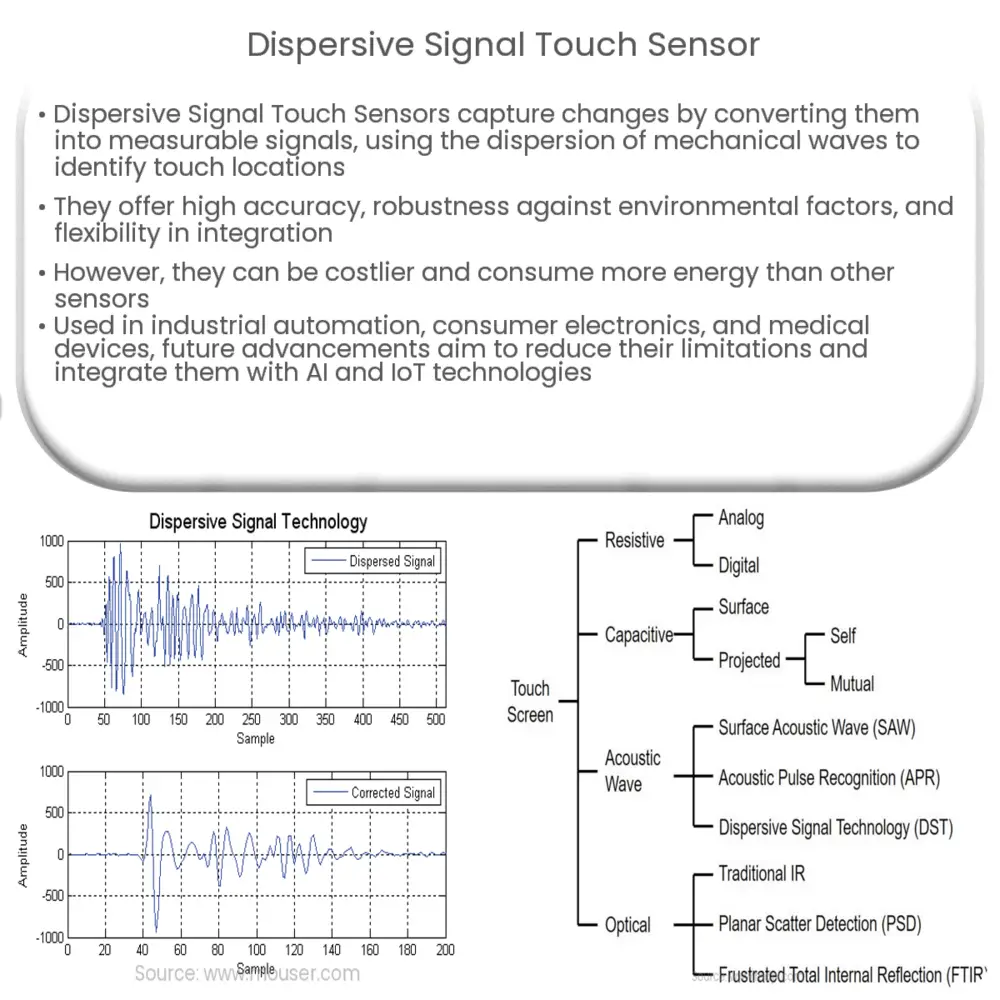
The Fundamentals of Dispersive Signal Touch Sensors
A touch sensor is a type of equipment that captures and records changes in a physical quantity by converting it into signals which can be easily measured and analyzed. Among numerous types of touch sensors, the Dispersive Signal Touch Sensor has gained notable attention due to its distinct methodology and functionality.
Understanding the Concept of Dispersive Signal
The key concept behind a dispersive signal touch sensor revolves around the use of mechanical waves, specifically the dispersion of these waves. In physical terms, dispersion is the phenomenon where wave speed depends on frequency. In these sensors, dispersion of a mechanical wave is typically used for identifying the touch location on the sensor surface.
Operation of Dispersive Signal Touch Sensors
Dispersive signal touch sensors operate by emitting a wave into the substrate when the screen is touched. The touch generates a wave that propagates throughout the surface of the sensor. This wave then reaches the corners of the screen where sensors are located. The time taken by the wave to reach these sensors is calculated, and this time difference aids in determining the exact location of the touch.
Advantages of Dispersive Signal Touch Sensors
-
High Accuracy: The dispersive signal technique allows for high precision in detecting touch locations, making it a preferred choice for numerous applications.
-
Robustness: Unlike capacitive or resistive touch sensors, dispersive signal sensors are not affected by dust, water, or other environmental factors, thus offering robust performance.
-
Flexibility: These sensors can be integrated into screens of various sizes and shapes, demonstrating exceptional flexibility.
Disadvantages of Dispersive Signal Touch Sensors
-
Cost: The complexity of the technology can lead to higher costs in comparison to other touch sensor technologies.
-
Energy Consumption: Dispersive signal touch sensors might require more power for operation due to the wave propagation process.
Applications of Dispersive Signal Touch Sensors
Given their high precision and robustness, dispersive signal touch sensors are utilized in a myriad of applications. Here are a few notable ones:
-
Industrial Automation: In industries where precision is paramount, these sensors are used for accurate detection and control.
-
Consumer Electronics: Many high-end smartphones and tablets incorporate this technology for reliable and precise touch detection.
-
Medical Devices: Certain medical equipment uses these sensors for exact touch responses, significantly enhancing user experience.
The Future of Dispersive Signal Touch Sensors
As technology continues to evolve, we can expect significant advancements in the field of dispersive signal touch sensors. The focus is likely to be on overcoming the current limitations, such as reducing the power consumption and cost associated with these sensors. Moreover, with the increasing trend of AI and IoT, the integration of these sensors with AI algorithms and smart devices will open up new avenues for exploration and application.
Conclusion
In conclusion, dispersive signal touch sensors offer a unique blend of precision, robustness, and flexibility, making them a valuable tool in numerous applications. While they do have certain drawbacks such as high cost and energy consumption, ongoing research and development promise to mitigate these issues. As we move towards a more connected and automated world, the significance of these sensors is poised to grow, offering endless possibilities for innovation and improvement.



