
Antimony-lead solder is a versatile alloy known for its low melting point, good wetting, thermal stability, and oxidation resistance, used in electronics, automotive, and plumbing applications.
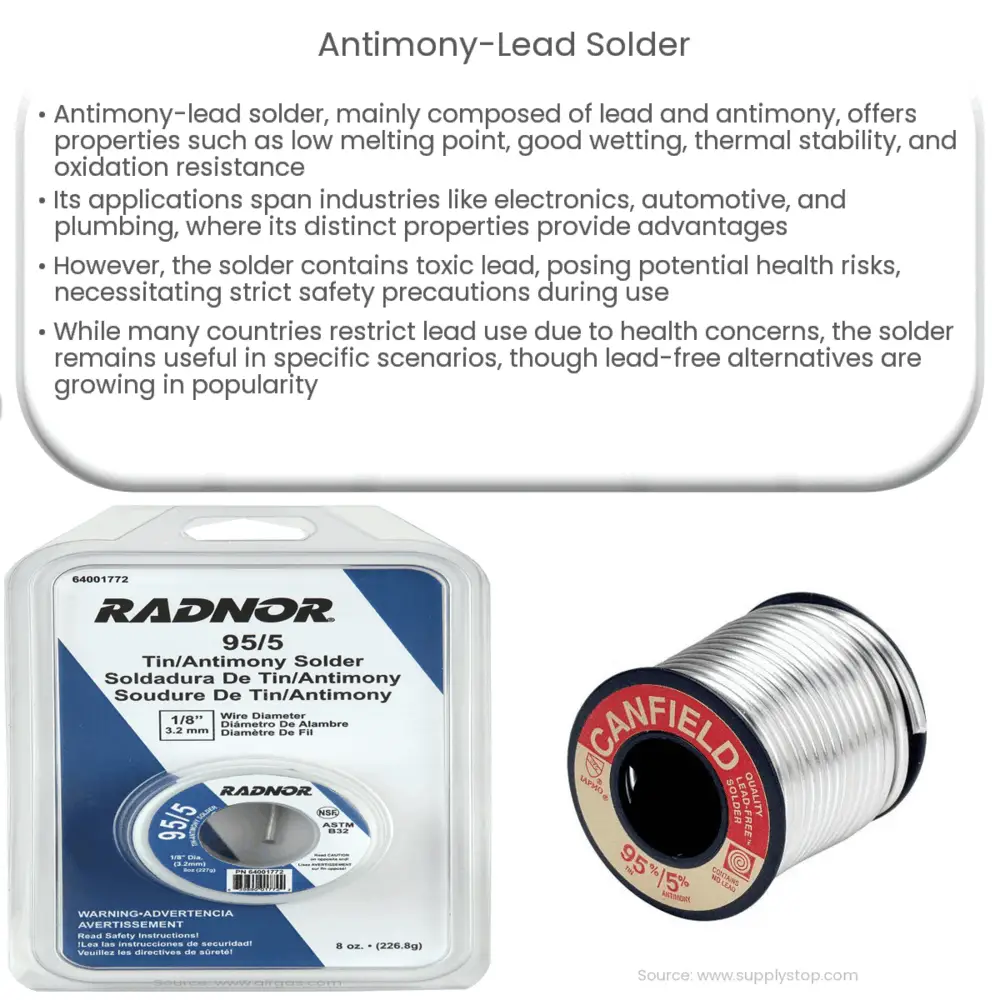
Antimony-Lead Solder: Properties, Applications, and Safety Considerations
Introduction
Solders are widely used in electronic, electrical, and mechanical applications for joining metal components together. Over the years, various solder alloys have been developed, each offering specific properties and characteristics to meet the requirements of different applications. One such alloy is the antimony-lead solder, which has gained attention due to its desirable properties and wide range of applications. In this article, we will explore the properties, applications, and safety considerations of antimony-lead solder.
Composition and Properties of Antimony-Lead Solder
Antimony-lead solder is an alloy primarily composed of lead (Pb) and antimony (Sb), with small amounts of other elements like tin (Sn) and copper (Cu) to enhance specific properties. The composition of antimony-lead solder typically ranges from 1-5% antimony, with the remaining percentage being lead. The addition of antimony imparts desirable characteristics to the solder, such as improved mechanical strength, thermal stability, and resistance to oxidation.
Some of the key properties of antimony-lead solder include:
- Low melting point: Depending on the specific composition, the melting point of antimony-lead solder can be as low as 183°C (361°F), making it suitable for various electronic applications.
- Good wetting: The alloy demonstrates good wetting properties, which means it can easily spread and adhere to the surfaces of the metals being joined.
- Thermal stability: Antimony-lead solder has better thermal stability compared to other lead-based solders, reducing the risk of joint failure due to thermal cycling.
- Resistance to oxidation: The alloy exhibits good resistance to oxidation, which helps maintain the integrity of the solder joint over time.
Applications of Antimony-Lead Solder
Antimony-lead solder is used in various industries, including electronics, automotive, and plumbing, due to its unique properties. Some of the main applications of antimony-lead solder include:
- Electronics: In the electronics industry, antimony-lead solder is used for assembling printed circuit boards (PCBs) and connecting electronic components. Its low melting point, good wetting properties, and thermal stability make it suitable for surface-mount technology (SMT) and through-hole technology (THT) assembly processes.
- Automotive: The alloy is used for soldering components in automotive electrical systems, such as wiring harnesses, connectors, and switches, due to its mechanical strength and resistance to oxidation.
- Plumbing: Antimony-lead solder is employed in plumbing applications for joining pipes, fittings, and fixtures, as it provides a strong, leak-proof joint with good resistance to corrosion.
Safety Considerations
Despite its numerous advantages, antimony-lead solder poses potential health risks due to the presence of lead, a toxic heavy metal. Long-term exposure to lead can cause serious health issues, including neurological, cardiovascular, and reproductive system damage. To mitigate these risks, proper safety measures should be followed when working with antimony-lead solder, including:
- Using appropriate personal protective equipment (PPE), such as gloves and safety goggles
- Ensuring proper ventilation in the workspace to minimize exposure to lead fumes
- Implementing strict hygiene practices, including washing hands thoroughly after handling solder and avoiding eating or drinking in the work area
- Properly disposing of solder waste to prevent environmental contamination
Due to the health risks associated with lead, many countries have introduced legislation to restrict or prohibit its use in certain applications, particularly in the electronics industry. As a result, alternative lead-free solders have been developed and are becoming increasingly popular. However, antimony-lead solder still remains a viable option in specific applications where its unique properties provide significant advantages.
Conclusion
Antimony-lead solder is a versatile and widely-used alloy, offering a range of desirable properties, including low melting point, good wetting, thermal stability, and resistance to oxidation. These characteristics make it suitable for various applications across industries, such as electronics, automotive, and plumbing. However, the presence of lead in the alloy raises concerns about the potential health risks associated with its use. As such, it is essential to follow proper safety measures when working with antimony-lead solder and to consider alternative lead-free solders in applications where they are feasible.
References
- Chen, Z., et al. (2011). Solder Joint Reliability Assessment: A Practical Guide. Materials Park, OH: ASM International.
- Manko, H. H. (1992). Solders and Soldering: Materials, Design, Production, and Analysis for Reliable Bonding. New York, NY: McGraw-Hill.
- Rizvi, M. J. (2006). Lead-free Electronics: iNEMI Projects Lead to Successful Manufacturing. Hoboken, NJ: John Wiley & Sons.
- Shangguan, D. (2005). Lead-free Solder Interconnect Reliability. Materials Park, OH: ASM International.
- U.S. Environmental Protection Agency. (n.d.). Learn About Lead. Retrieved from https://www.epa.gov/lead/learn-about-lead



