
Explore the importance and functionality of antenna tuners in radio communication, along with an in-depth look at their different types.
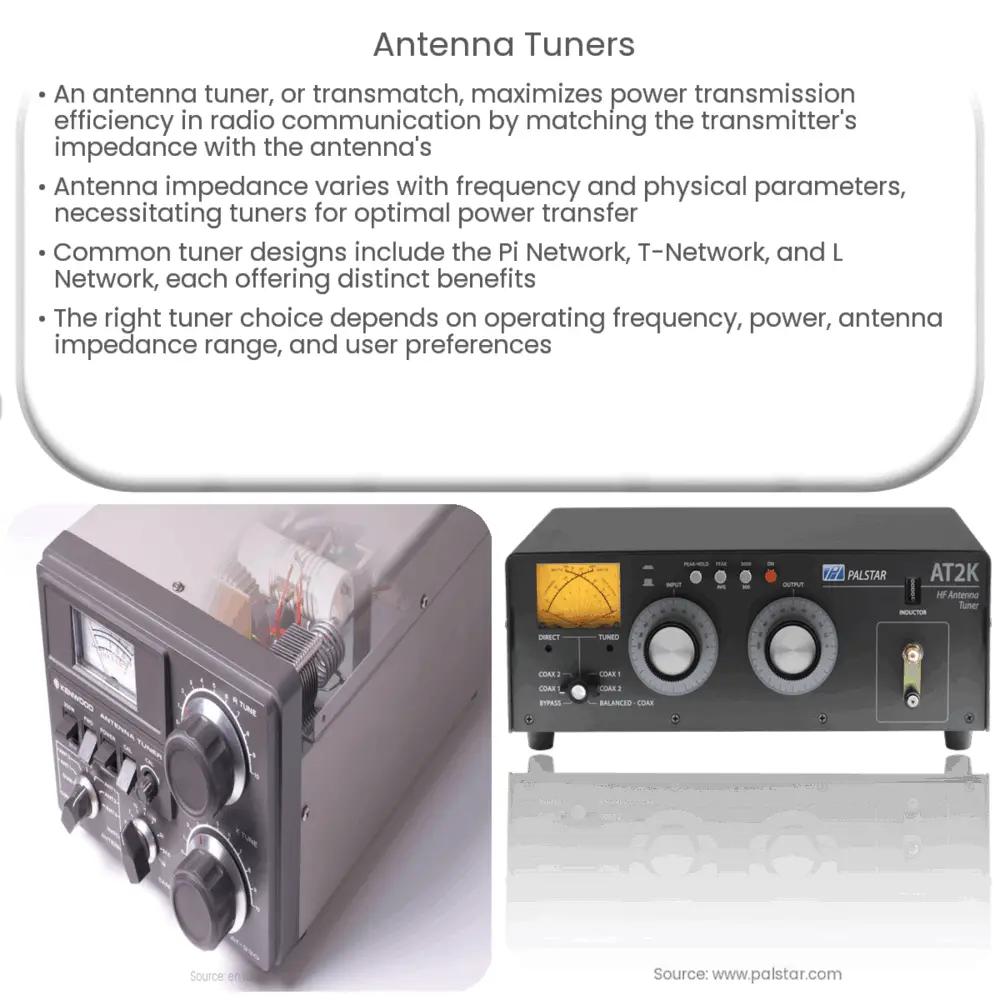
Introduction to Antenna Tuners
An Antenna Tuner, often referred to as a transmatch, is a device often used in radio communication to maximize the efficiency of power transmission. It primarily functions to match the impedance of the radio transmitter to the antenna’s impedance, in order to reduce standing wave ratio (SWR) and therefore ensure effective power transfer.
Working Principle of Antenna Tuners
The working principle of an antenna tuner is grounded in the theory of impedance matching. An ideal power transfer scenario occurs when the impedance of the power source perfectly matches that of the load – in this case, the radio transmitter and the antenna, respectively. However, this is seldom the case, as the impedance of an antenna varies with frequency and its physical parameters. This is where an antenna tuner comes into play.
The Need for Antenna Tuners
Given the importance of effective power transfer in radio communication, one might wonder why antenna tuners are needed in the first place. The answer lies in the variable nature of the antenna’s impedance. Antenna impedance is not fixed; it changes with the frequency at which the antenna is operating. Additionally, physical factors such as antenna length, height, and the surrounding environment also influence the antenna’s impedance. Therefore, to achieve optimal power transfer at different frequencies, a device is needed that can adapt to these changing conditions. This device is the antenna tuner.
- Matching Impedance: An antenna tuner can adjust the impedance of the antenna to match the impedance of the radio transmitter, hence ensuring maximum power transfer.
- Reducing SWR: High SWR, or standing wave ratio, signifies a significant mismatch between the transmitter and antenna. An antenna tuner can reduce this SWR to an acceptable level, thereby enhancing transmission efficiency.
Varieties of Antenna Tuners
Antenna tuners come in a range of types, each suited to specific needs and situations. The most commonly used include the Pi Network, T-Network, and L Network. These designs each offer unique benefits and are chosen based on factors such as frequency range, power level, and the specific impedance range that needs to be matched.
Now, let’s delve deeper into these types of antenna tuners and their particular benefits and drawbacks…
Types of Antenna Tuners
As mentioned earlier, antenna tuners come in a few key designs, each with their own unique properties.
Pi Network
The Pi Network is named after its resemblance to the Greek letter ‘Pi’ in its circuit diagram. It comprises two capacitors and an inductor. It’s renowned for its ability to match a wide range of impedances and for its high power handling capability. However, its tuning can be a bit tricky, requiring the adjustment of two controls simultaneously.
T-Network
Similarly, the T-Network gets its name from its circuit’s resemblance to the letter ‘T’. This tuner typically has two inductors and a capacitor. The primary benefit of this design is its simplicity, which allows for easy tuning. However, the range of impedance it can match is usually narrower than that of the Pi Network.
L Network
The L Network is the simplest of all, consisting of just one inductor and one capacitor. This design is quite efficient and easy to use, but it has a limited range and may not be suitable for antennas with extreme impedance values.
Choosing an Antenna Tuner
Choosing the right antenna tuner depends on several factors. It’s essential to consider the operating frequency range, power level, and the antenna’s likely impedance range. Personal preferences, such as ease of tuning and the available space for the device, can also play a significant role in making a decision.
Conclusion
In conclusion, an antenna tuner is an invaluable device in the world of radio communication. It helps optimize power transfer between the transmitter and the antenna by matching their impedances and reducing SWR. Available in several varieties, such as the Pi Network, T-Network, and L Network, the choice of an antenna tuner depends on the specific requirements of the radio setup and user preferences. By understanding these elements, one can significantly improve the efficiency and effectiveness of their radio communication system.



