
Acoustic gas sensors use sound waves to detect gas presence and concentration, offering non-intrusive, real-time monitoring across industries.
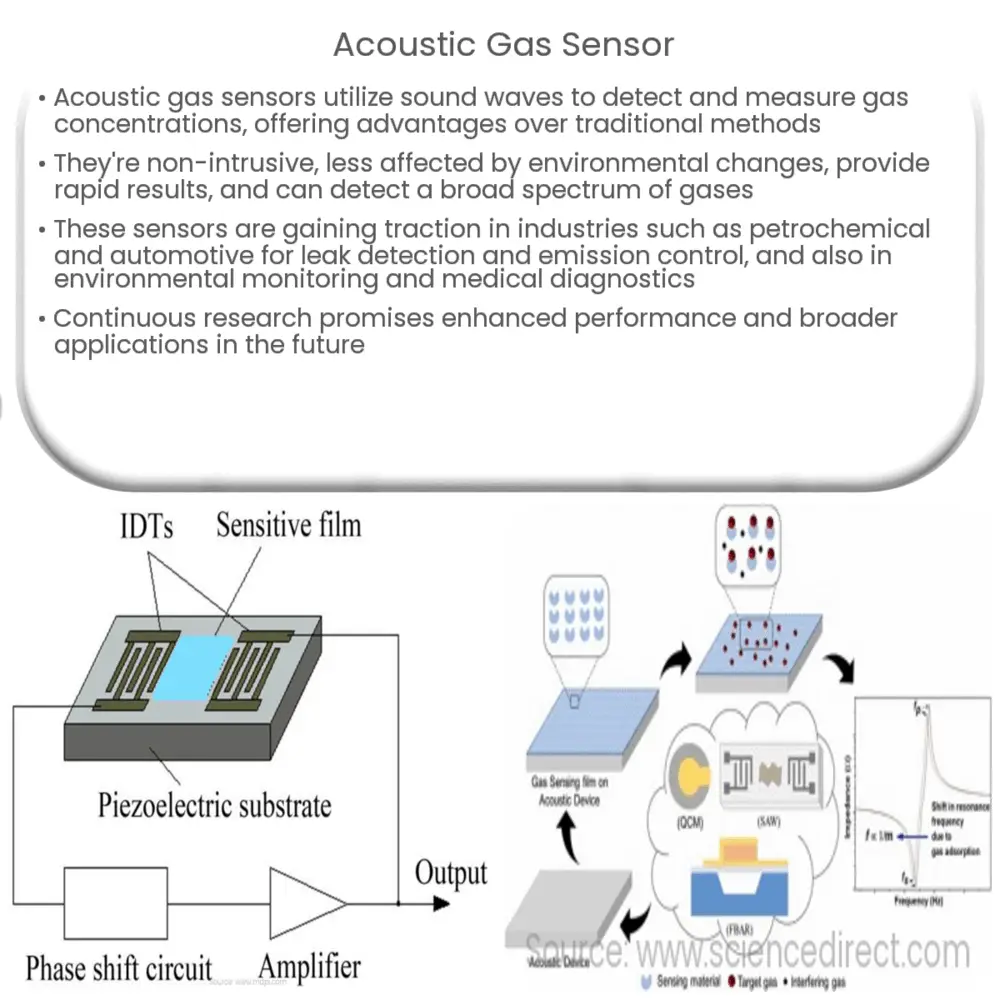
Acoustic Gas Sensor: A Comprehensive Overview
Introduction
Gas sensors play a crucial role in various industries, including petrochemical, automotive, and environmental monitoring, as they ensure safety and maintain proper working conditions. Traditional gas sensors rely on chemical or optical sensing mechanisms, which may be influenced by environmental factors or limited by the types of gases they can detect. Acoustic gas sensors offer a promising alternative, as they leverage sound waves to measure the presence and concentration of gases. This article provides an in-depth overview of acoustic gas sensors, discussing their working principle, advantages, and potential applications.
Working Principle of Acoustic Gas Sensors
Acoustic gas sensors operate based on the principle of acoustic wave propagation in a medium. When a sound wave travels through a gas, its speed is influenced by the physical and chemical properties of the gas, such as its density, viscosity, and composition. By measuring the changes in the speed of sound, it is possible to determine the presence and concentration of specific gas components in the mixture.
These sensors typically consist of a transmitter, a receiver, and a gas cell containing the gas sample. The transmitter generates an acoustic signal, which travels through the gas sample and is detected by the receiver. The time taken for the sound wave to travel from the transmitter to the receiver, referred to as the time-of-flight (TOF), is affected by the gas composition. By analyzing the TOF data, the sensor can identify the type and concentration of the target gas.
Advantages of Acoustic Gas Sensors
Acoustic gas sensors offer several advantages over traditional gas sensing technologies, which contribute to their growing popularity:
- Non-intrusive: Acoustic sensors do not require direct contact with the gas sample, minimizing the risk of contamination and ensuring a longer sensor lifetime.
- Insensitive to environmental factors: Unlike chemical or optical sensors, acoustic sensors are less susceptible to interference from temperature, humidity, or pressure fluctuations, ensuring more accurate and reliable readings.
- Fast response: Acoustic sensors can provide real-time measurements, making them ideal for applications where rapid detection is critical.
- Broad range of detectable gases: Acoustic sensors can potentially detect a wide range of gases, including combustible, toxic, and greenhouse gases, by tuning the acoustic frequency and signal processing algorithms.
Applications of Acoustic Gas Sensors
Due to their versatility and accuracy, acoustic gas sensors find applications in various industries and sectors:
- Petrochemical industry: Leak detection and monitoring of flammable or toxic gases in pipelines, storage facilities, and processing plants are essential for safety and operational efficiency. Acoustic sensors can provide real-time monitoring and early detection of leaks, preventing accidents and minimizing environmental impact.
- Automotive emissions: Acoustic sensors can be integrated into exhaust systems to monitor and control harmful emissions, contributing to improved air quality and compliance with environmental regulations.
Environmental Monitoring
Atmospheric pollution: Acoustic gas sensors can be employed to monitor air quality in urban and industrial environments. They can detect various pollutants, such as volatile organic compounds (VOCs), nitrogen oxides (NOx), and particulate matter (PM), providing valuable data for assessing pollution levels and implementing mitigation strategies.
Greenhouse gas monitoring: The accurate measurement of greenhouse gas concentrations, such as carbon dioxide (CO2) and methane (CH4), is vital for understanding climate change and enforcing environmental regulations. Acoustic gas sensors can offer continuous, real-time monitoring of these gases in remote or challenging environments.
Medical and Biomedical Applications
Breath analysis: The analysis of exhaled breath can reveal valuable information about a person’s health status. Acoustic gas sensors can detect specific biomarkers in breath samples, such as acetone for diabetes or nitric oxide for asthma, enabling non-invasive diagnostics and monitoring of chronic diseases.
Biogas production: In anaerobic digestion processes, acoustic gas sensors can monitor the composition of biogas, which primarily consists of methane, carbon dioxide, and trace amounts of other gases. This information can help optimize biogas production and assess the efficiency of the digestion process.
Research and Development
Acoustic gas sensors have great potential for further development, with ongoing research focusing on improving their sensitivity, selectivity, and stability. For instance, advances in microelectromechanical systems (MEMS) and nanotechnology enable the miniaturization of acoustic sensors, leading to more compact and portable devices. Additionally, the integration of machine learning algorithms can enhance the analysis and interpretation of acoustic signals, paving the way for more sophisticated gas detection and discrimination capabilities.
Conclusion
Acoustic gas sensors have emerged as a versatile and reliable alternative to traditional gas sensing technologies, offering numerous advantages such as non-intrusive detection, insensitivity to environmental factors, and real-time measurements. Their wide range of applications, spanning from petrochemical and automotive industries to environmental monitoring and medical diagnostics, highlights their potential to significantly contribute to safety, health, and sustainability. With ongoing research and technological advancements, we can expect to see further improvements in the performance and capabilities of acoustic gas sensors, solidifying their position as a valuable tool in various domains.



