
Explore the fundamentals of AC-to-DC power supplies, their role in powering electronic devices, and the key differences between linear and switching types.
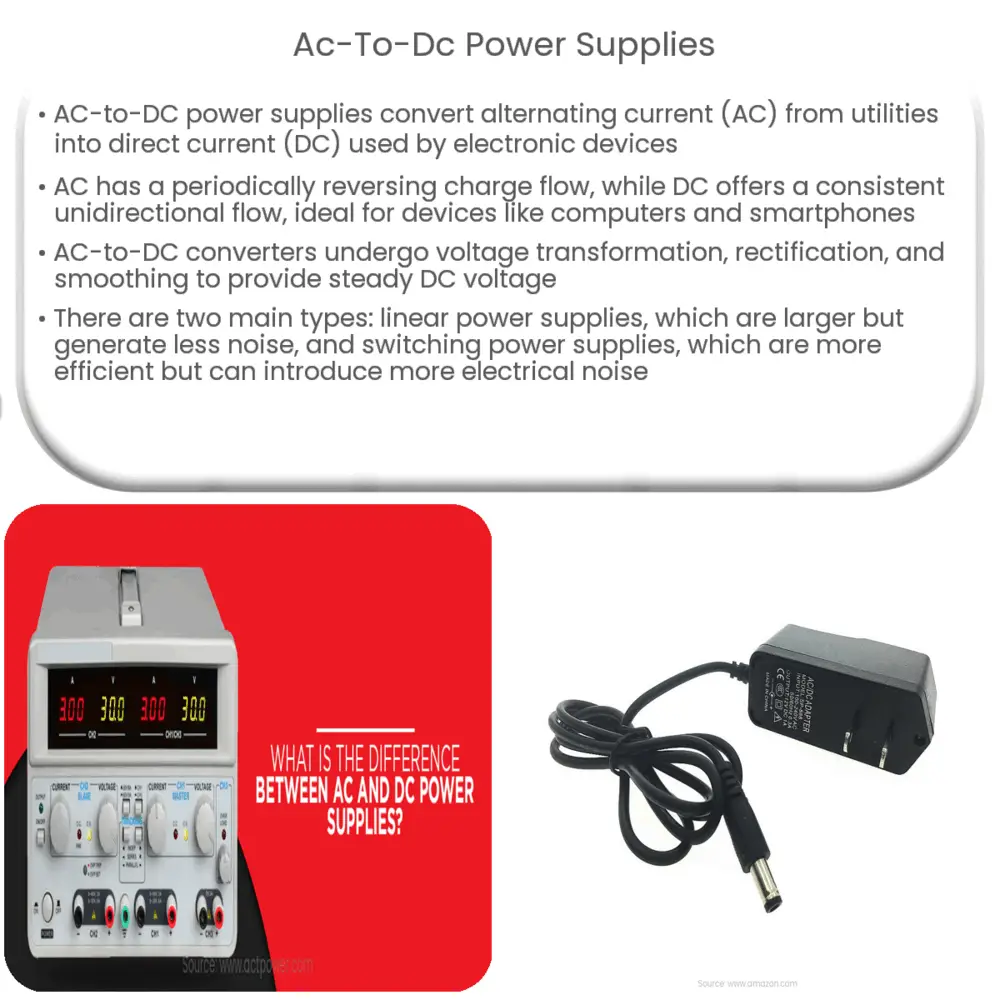
Understanding AC-to-DC Power Supplies
AC-to-DC power supplies are vital components of virtually every piece of electronic equipment. They play a significant role in converting alternating current (AC), commonly supplied by utility companies, into direct current (DC) that is used by most electronic devices.
AC and DC Power: A Basic Overview
Before diving into AC-to-DC power supplies, let’s briefly understand AC and DC power. Alternating Current (AC) is the type of electrical current where the flow of electric charge periodically reverses direction. This is the form of electric power delivered by electric utilities to businesses and residences.
On the other hand, Direct Current (DC) is the unidirectional flow of electric charge. It is typically used by electronic devices because it flows consistently and provides a constant voltage level. Examples of devices using DC power include computers, smartphones, and LEDs.
The Role of AC-to-DC Power Supplies
AC-to-DC power supplies, also known as power adapters or power converters, come into play to bridge the gap between AC power and the DC power required by electronic devices. They convert the AC voltage from the mains (typically 110V or 220V) into a DC voltage that electronic devices can use (usually 5V, 12V, or 24V).
- Voltage Transformation: This process reduces the AC input voltage to a level suitable for the device. For example, transforming 110V or 220V AC to 12V DC for a laptop.
- Rectification: In this stage, the power supply converts the AC voltage, which has a sinusoidal waveform, into a pulsed DC voltage.
- Smoothing: This phase eliminates the variations in the rectified voltage, resulting in a steady DC voltage.
Types of AC-to-DC Power Supplies
There are two major types of AC-to-DC power supplies: linear power supplies and switching power supplies.
- Linear Power Supplies: These power supplies use a transformer to reduce the voltage. They are simple, reliable, and generate less noise, but they tend to be larger and less efficient.
- Switching Power Supplies: These use a switcher technology, which makes them more efficient and smaller, but they generate more electrical noise.
In conclusion, understanding AC-to-DC power supplies and their functionalities is essential, considering our reliance on electronic devices in the modern world.
Linear Power Supplies
Linear power supplies are an older type of power supply. They operate by transforming the input voltage to the required level using a transformer, then rectifying and smoothing it to generate a steady DC output. While linear power supplies are known for their reliability, simplicity, and ability to generate less electrical noise, they are not as energy-efficient as switching power supplies and tend to be bulkier due to the size of the transformer.
Switching Power Supplies
Switching power supplies, on the other hand, use a different mechanism. They ‘switch’ the input voltage on and off rapidly via a transistor, which is then averaged out to achieve the required output voltage. This switching operation happens at a very high frequency, which allows for the use of small components, making the overall power supply unit compact and lightweight. However, this process may introduce more electrical noise into the system. Despite this, switching power supplies are preferred for most modern applications due to their higher efficiency and smaller size.
Choosing the Right AC-to-DC Power Supply
The choice between a linear and switching power supply depends on your specific needs. For applications where electrical noise must be kept to a minimum, such as audio or medical equipment, a linear power supply might be preferable. However, for most other applications, especially where space and energy efficiency are of concern, a switching power supply would typically be the more suitable choice.
Conclusion
In a world where electronic devices are omnipresent, AC-to-DC power supplies serve a fundamental role in making these devices function properly. They provide the bridge between our AC main supplies and the DC power that our devices require. Understanding the functionality, types, and differences of these power supplies can help individuals and businesses make informed decisions, ensuring the efficiency and longevity of their electronic devices. Whether you choose a linear or switching power supply, each has its merits and considerations. Hence, it’s important to choose the one that best fits your specific application.