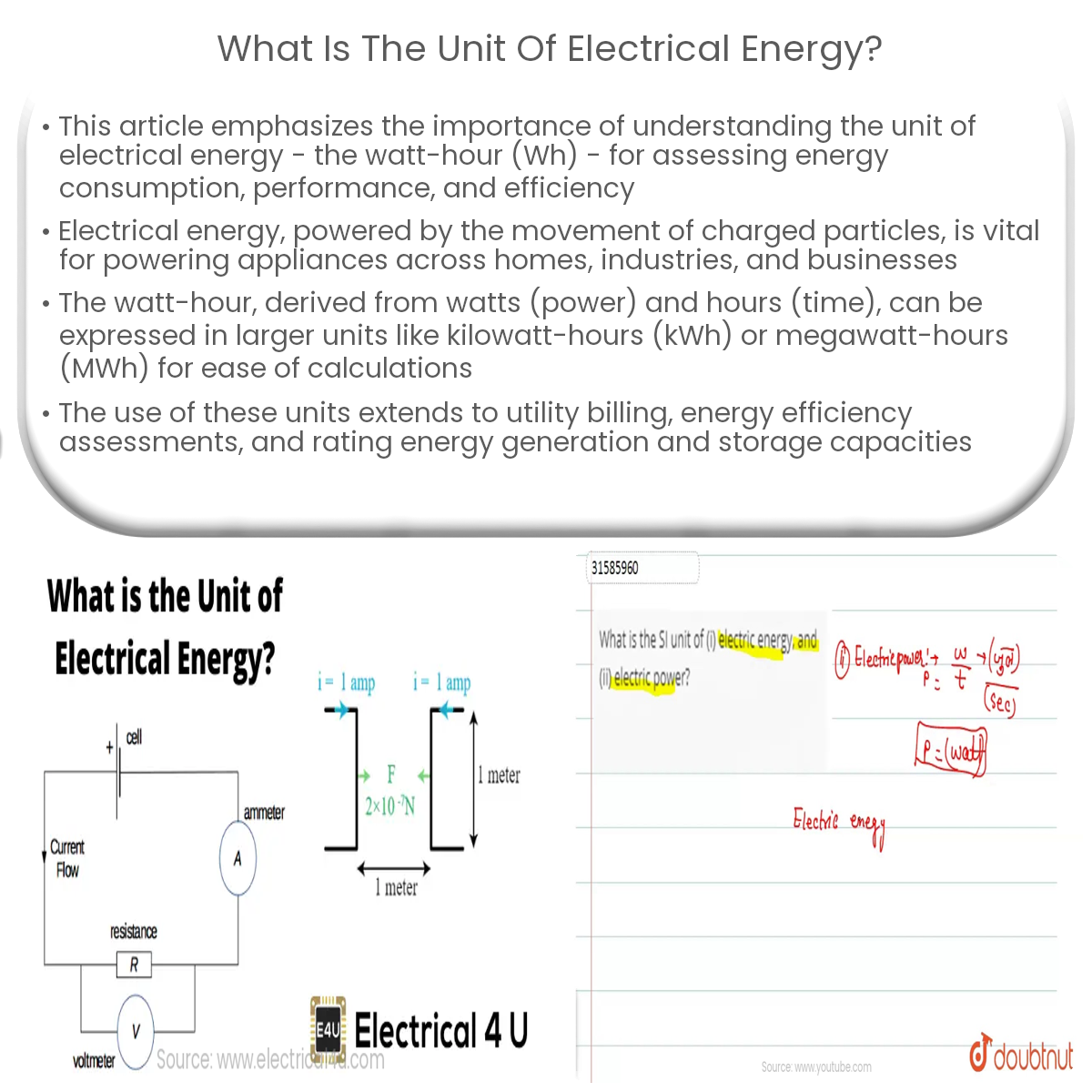
The unit of electrical energy is the watt-hour (Wh), with larger units like kilowatt-hour (kWh) and megawatt-hour (MWh) used for convenience.
Unit of Electrical Energy
Understanding the units of measurement in electrical systems is crucial for assessing performance, efficiency, and energy consumption. This article focuses on the unit of electrical energy and its applications in various contexts.
Electrical Energy: A Definition
Electrical energy is a form of energy resulting from the movement of charged particles, such as electrons, through a conductor. It is an essential resource in modern society, powering devices and appliances in homes, industries, and businesses. Electrical energy can be converted into other forms of energy, such as heat, light, or mechanical energy, depending on the application.
The Watt-hour: Unit of Electrical Energy
The unit of electrical energy is the watt-hour (Wh). A watt-hour represents the amount of electrical energy consumed by a device with a power rating of one watt operating for one hour. The watt-hour is derived from the unit of power, the watt (W), and the unit of time, the hour (h). The relationship between power, energy, and time can be expressed as:
E = P × t
Where E is energy in watt-hours, P is power in watts, and t is time in hours.
Since electrical energy consumption can vary significantly depending on the device and its usage, watt-hours are often expressed in larger units, such as kilowatt-hours (kWh) or megawatt-hours (MWh), to simplify calculations and comparisons. One kilowatt-hour (kWh) is equivalent to 1,000 watt-hours, while one megawatt-hour (MWh) is equivalent to 1,000,000 watt-hours.
Applications of the Watt-hour
The watt-hour and its multiples, such as the kilowatt-hour and megawatt-hour, are commonly used in various applications, including:
- Utility billing: Electricity providers typically bill customers based on their energy consumption in kilowatt-hours, making it a crucial unit for tracking usage and managing costs.
- Energy efficiency: Comparing the energy consumption of different devices or appliances in watt-hours or kilowatt-hours helps determine their efficiency and potential cost savings.
- Energy generation and storage: Power plants and energy storage systems, such as batteries, are rated based on their capacity to generate or store electrical energy in watt-hours, kilowatt-hours, or megawatt-hours.
Conclusion
The watt-hour is the standard unit of electrical energy, representing the energy consumed by a one-watt device operating for one hour. By understanding and utilizing the watt-hour and its multiples, individuals and businesses can better manage their energy consumption, assess efficiency, and optimize the performance of their electrical systems.