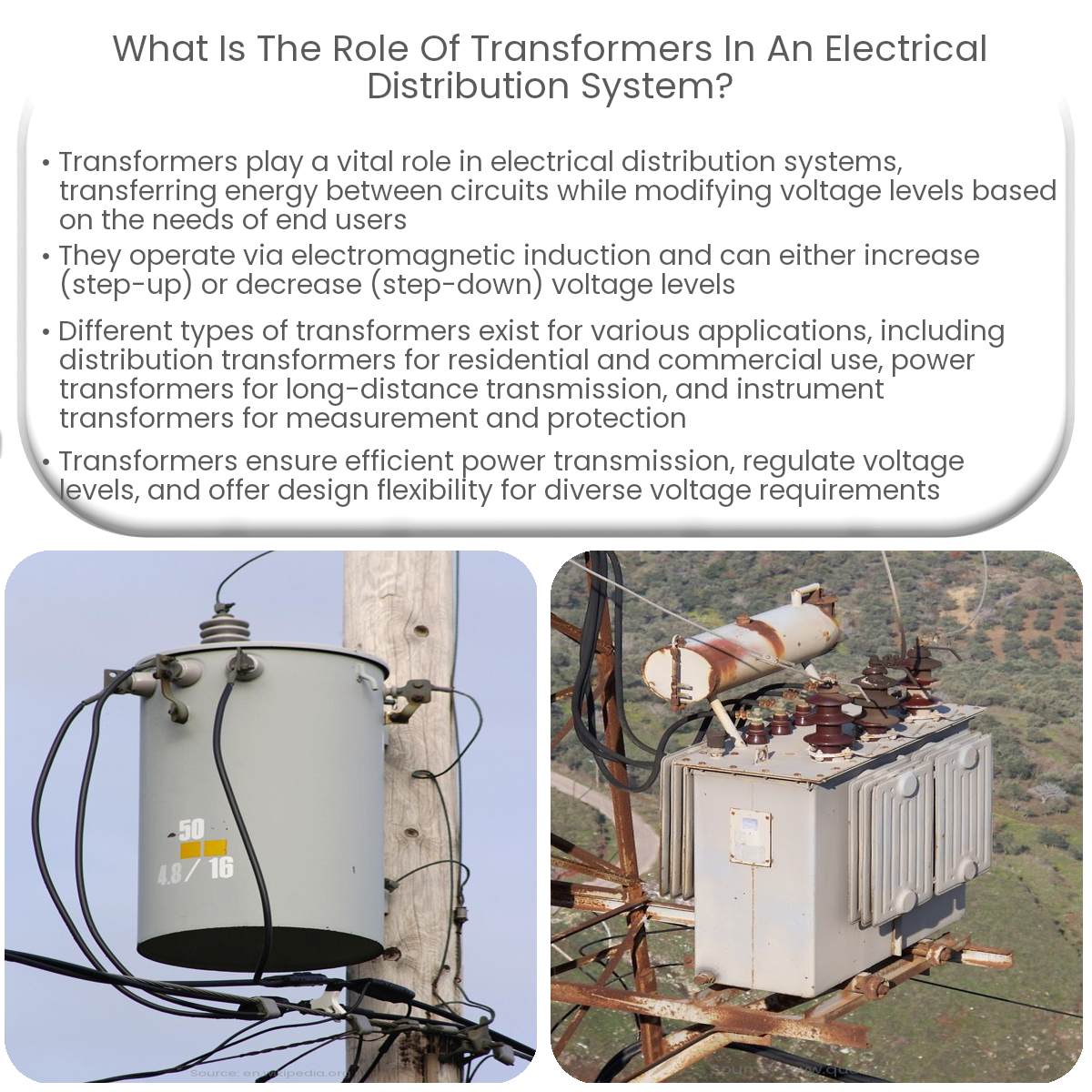
Transformers transfer electrical energy between circuits, adjusting voltage levels for efficient power transmission and safe use in distribution systems.
The Role of Transformers in Electrical Distribution Systems
Transformers play a crucial role in electrical distribution systems by transferring electrical energy between circuits while changing the voltage level to suit the needs of end users. They are essential for ensuring efficient power transmission and distribution, as well as maintaining the quality and safety of electrical systems.
Voltage Transformation
Transformers function by utilizing the principle of electromagnetic induction. They consist of two or more coils wrapped around a magnetic core, where an alternating current (AC) in the primary coil induces a magnetic field in the core, and the secondary coil transforms this field into a new AC voltage. The voltage transformation ratio depends on the number of turns in each coil, allowing transformers to step-up or step-down voltage levels as needed.
Step-Up and Step-Down Transformers
Transformers are commonly classified into two types based on their function: step-up and step-down transformers. Step-up transformers increase the voltage level, while step-down transformers decrease it. In an electrical distribution system, step-up transformers are used to increase the voltage for long-distance transmission, reducing energy loss due to resistance in power lines. Step-down transformers, on the other hand, lower the voltage to a level suitable for residential, commercial, and industrial use.
Types of Transformers
There are several types of transformers used in electrical distribution systems, depending on their application and capacity:
- Distribution Transformers: These transformers serve as the final step-down stage in the distribution system, providing the required voltage for residential and commercial use.
- Power Transformers: These large transformers are utilized in substations to step-up or step-down voltage levels for efficient long-distance transmission of electricity.
- Instrument Transformers: These transformers are used for measurement and protection purposes, such as current transformers (CT) and potential transformers (PT).
Benefits of Transformers in Electrical Distribution Systems
Transformers are an essential component of electrical distribution systems for several reasons:
- Efficient Power Transmission: By stepping up the voltage for long-distance transmission and stepping it down for end users, transformers minimize energy loss and ensure efficient power delivery.
- Voltage Regulation: Transformers provide a means of controlling and maintaining the voltage levels in electrical systems, ensuring the safe and reliable operation of equipment and appliances.
- Flexibility: Transformers can be designed to meet various voltage requirements, allowing them to cater to a wide range of applications in electrical distribution systems.