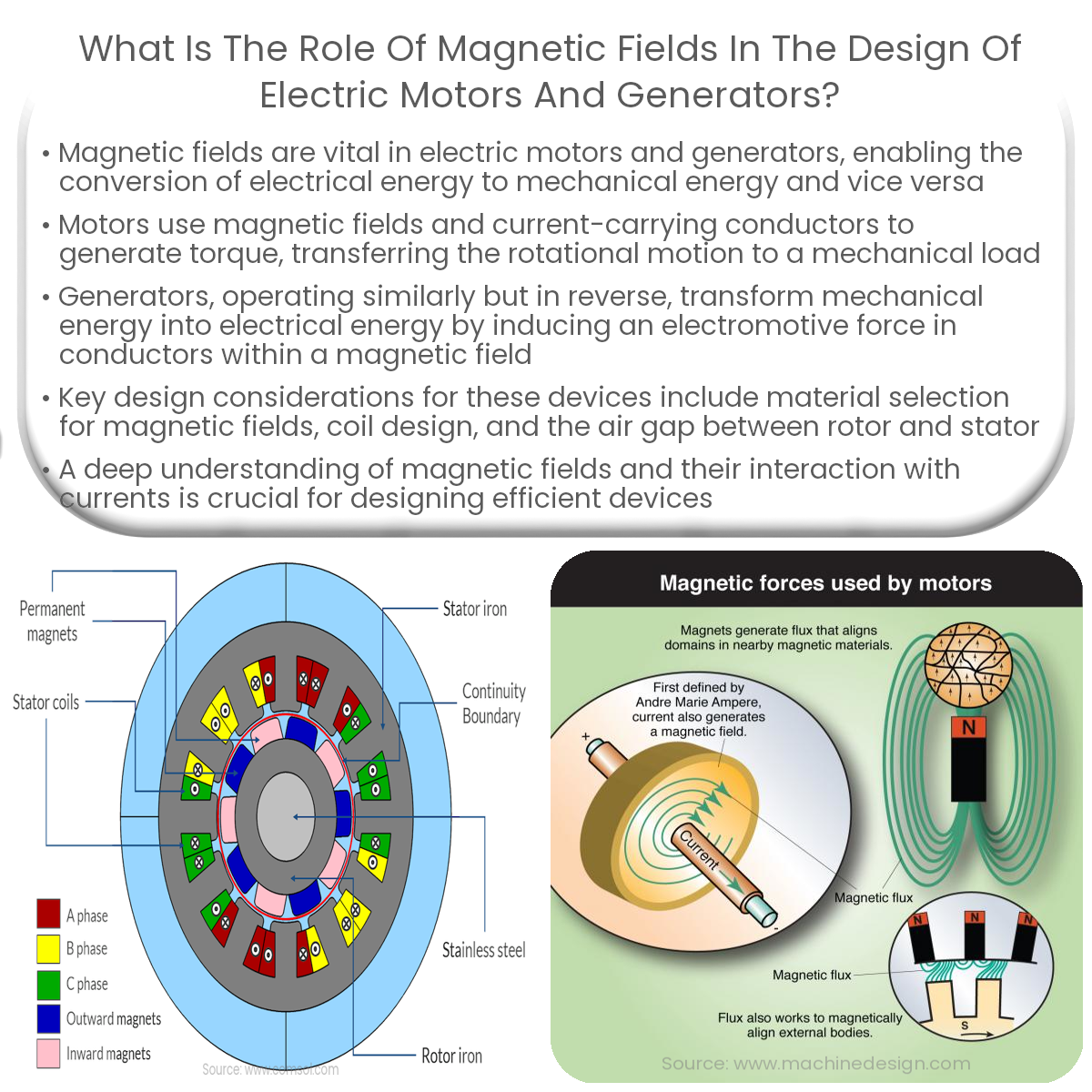
Magnetic fields are crucial in electric motors and generators, enabling the conversion of electrical energy to mechanical energy, and vice versa.
The Role of Magnetic Fields in Electric Motors and Generators
Magnetic fields play a critical role in the design and functioning of electric motors and generators, as they are responsible for converting electrical energy to mechanical energy, and vice versa. This article will delve into the significance of magnetic fields in these devices.
Electric Motors
An electric motor works by utilizing the interaction between magnetic fields and current-carrying conductors to generate torque. The primary components of a motor are the stator and rotor. The stator generates a magnetic field, often using electromagnets, while the rotor contains conductive windings through which current flows.
When an electric current flows through the rotor windings, it induces a magnetic field around them. This field interacts with the stator’s magnetic field, creating a force that causes the rotor to rotate. The rotational motion is then transferred to a mechanical load, such as a fan or pump, through a shaft. The relationship between the magnetic fields and the current is governed by the right-hand rule, which helps in determining the direction of the force.
Generators
Generators operate on the same principles as motors but in reverse. Instead of converting electrical energy into mechanical energy, generators transform mechanical energy into electrical energy. They achieve this by rotating a coil of wire within a magnetic field or by rotating a magnetic field within a stationary coil.
As the coil rotates, it cuts through the magnetic field lines, inducing an electromotive force (EMF) in the conductors, according to Faraday’s law of electromagnetic induction. This induced EMF generates a current, which is then extracted and used to power electrical devices.
Design Considerations
The performance of electric motors and generators relies heavily on the strength and uniformity of the magnetic fields involved. Key design considerations include:
- Material selection: The choice of magnetic materials, such as permanent magnets or soft magnetic materials for electromagnets, affects the strength and efficiency of the magnetic field.
- Coil design: The number of turns, wire size, and coil configuration impact the overall performance of the device.
- Air gap: The distance between the rotor and stator affects the magnetic field strength and the efficiency of the energy conversion process.
In conclusion, magnetic fields are integral to the operation of electric motors and generators, as they enable the conversion between electrical and mechanical energy. Understanding the interactions between magnetic fields, currents, and mechanical motion is essential for designing efficient and effective devices.