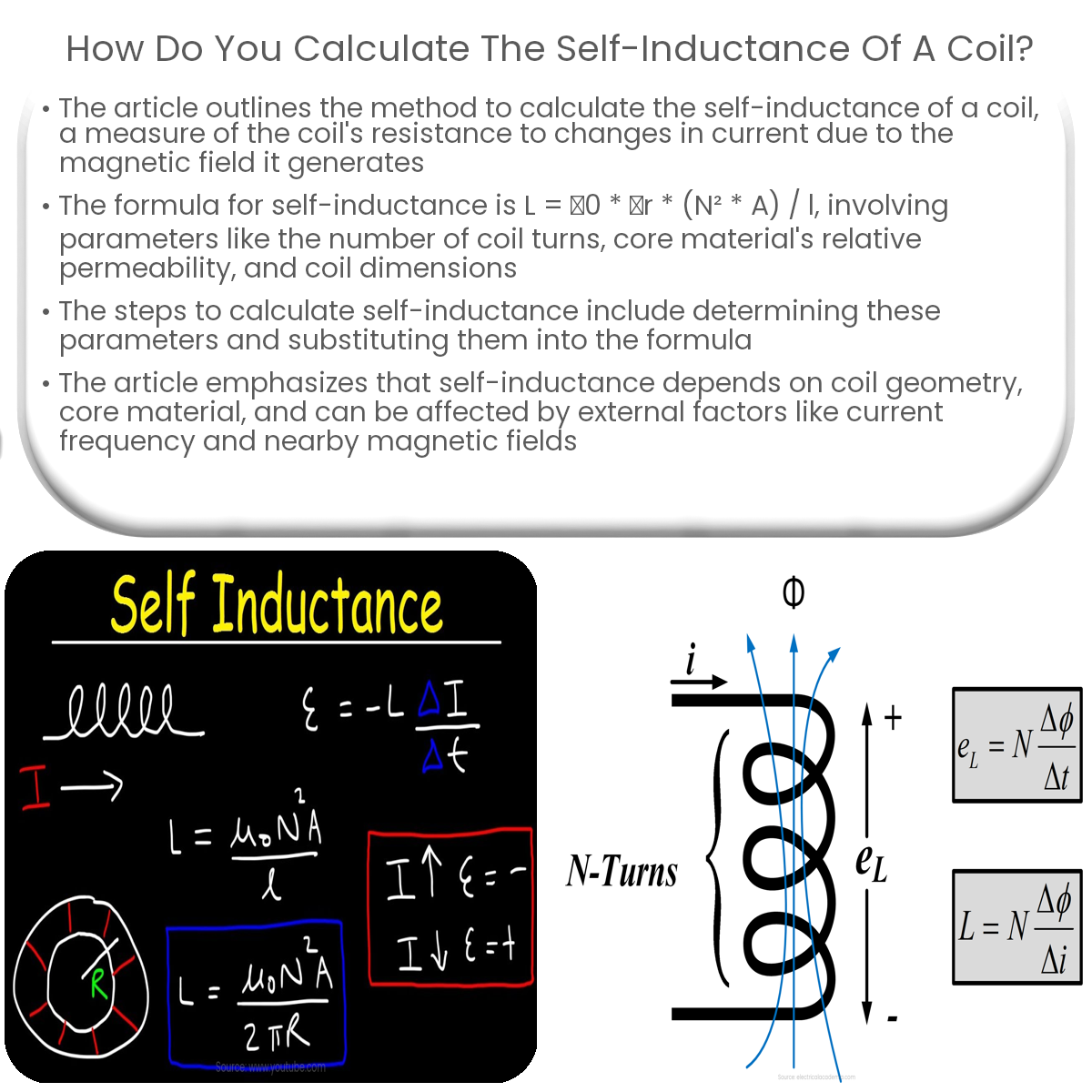
Self-inductance of a coil can be calculated using the formula L = μ0 * μr * (N² * A) / l, considering turns, length, area, and material permeability.
Calculating the Self-Inductance of a Coil
The self-inductance of a coil, also known as inductance, is a measure of how effectively the coil resists changes in the current flowing through it due to the magnetic field it generates. In this article, we will discuss the method to calculate the self-inductance of a coil.
Formula for Self-Inductance
The self-inductance (L) of a coil can be determined using the formula:
L = μ0 * μr * (N2 * A) / l
where:
- L is the self-inductance measured in henrys (H)
- μ0 is the permeability of free space (4π × 10-7 T·m/A)
- μr is the relative permeability of the core material (dimensionless)
- N is the number of turns in the coil
- A is the cross-sectional area of the coil, measured in square meters (m2)
- l is the length of the coil, measured in meters (m)
Steps to Calculate Self-Inductance
- Determine the number of turns (N) in the coil.
- Measure the length (l) and cross-sectional area (A) of the coil.
- Identify the core material and its relative permeability (μr).
- Calculate the product of the permeability of free space (μ0) and the relative permeability (μr).
- Substitute the values of N, A, l, and the product of μ0 and μr into the self-inductance formula and solve for L.
By following these steps, you can calculate the self-inductance of a coil. It is important to note that the self-inductance is dependent on the geometry and the core material of the coil. In practical applications, the self-inductance of a coil can also be affected by factors such as the frequency of the alternating current and the presence of nearby magnetic fields or conductive materials.