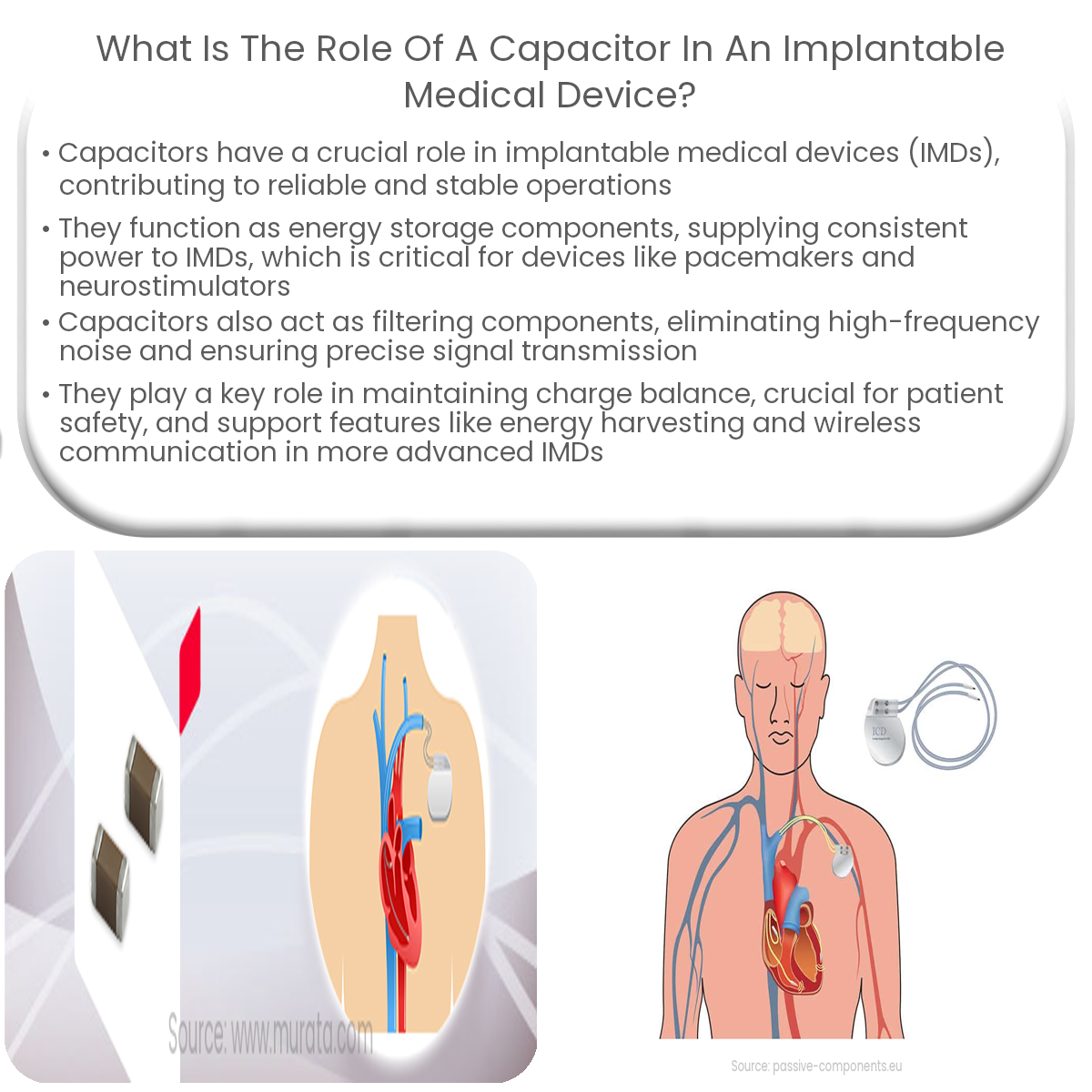
Capacitors in implantable medical devices provide energy storage, filter noise, maintain charge balance, and support energy harvesting and communication.
Role of a Capacitor in Implantable Medical Devices
Implantable medical devices (IMDs) are electronic devices that are surgically placed inside the human body to monitor health conditions, provide therapy, or replace damaged biological structures. Capacitors play a crucial role in the design and functionality of these devices, ensuring reliable and stable operation. This article explores the role of capacitors in IMDs and their significance.
Energy Storage and Supply
Capacitors in IMDs act as energy storage components, providing a stable and constant power supply to the device. They store electrical energy and release it when needed, ensuring the device operates seamlessly, even when power demand fluctuates. This is especially important for devices like pacemakers and neurostimulators, where any interruption in power supply could have critical consequences.
Filtering and Noise Reduction
Implantable medical devices must deliver accurate and precise signals, free from interference or noise. Capacitors serve as filtering components, removing unwanted noise and ensuring the quality of electrical signals. They can eliminate high-frequency noise, enhancing the performance of the device and preventing false readings or unintended activation.
Charge Balancing and Safety
Capacitors also play a vital role in maintaining charge balance and ensuring the safety of IMDs. Some devices, such as cochlear implants and retinal prostheses, require precise charge balancing to prevent damage to biological tissue. Capacitors help maintain a safe and balanced charge, protecting both the device and the patient.
Energy Harvesting and Wireless Communication
As IMDs become more advanced, energy harvesting and wireless communication capabilities are increasingly integrated into their designs. Capacitors are critical components in these systems, facilitating energy storage and transfer in energy harvesting modules and enabling signal coupling in wireless communication setups.
Conclusion
Capacitors play a pivotal role in the design and functionality of implantable medical devices. They provide energy storage and supply, filter noise and interference, maintain charge balance, and support energy harvesting and wireless communication. The use of capacitors in IMDs ensures the devices operate reliably and effectively, ultimately improving patient care and quality of life.