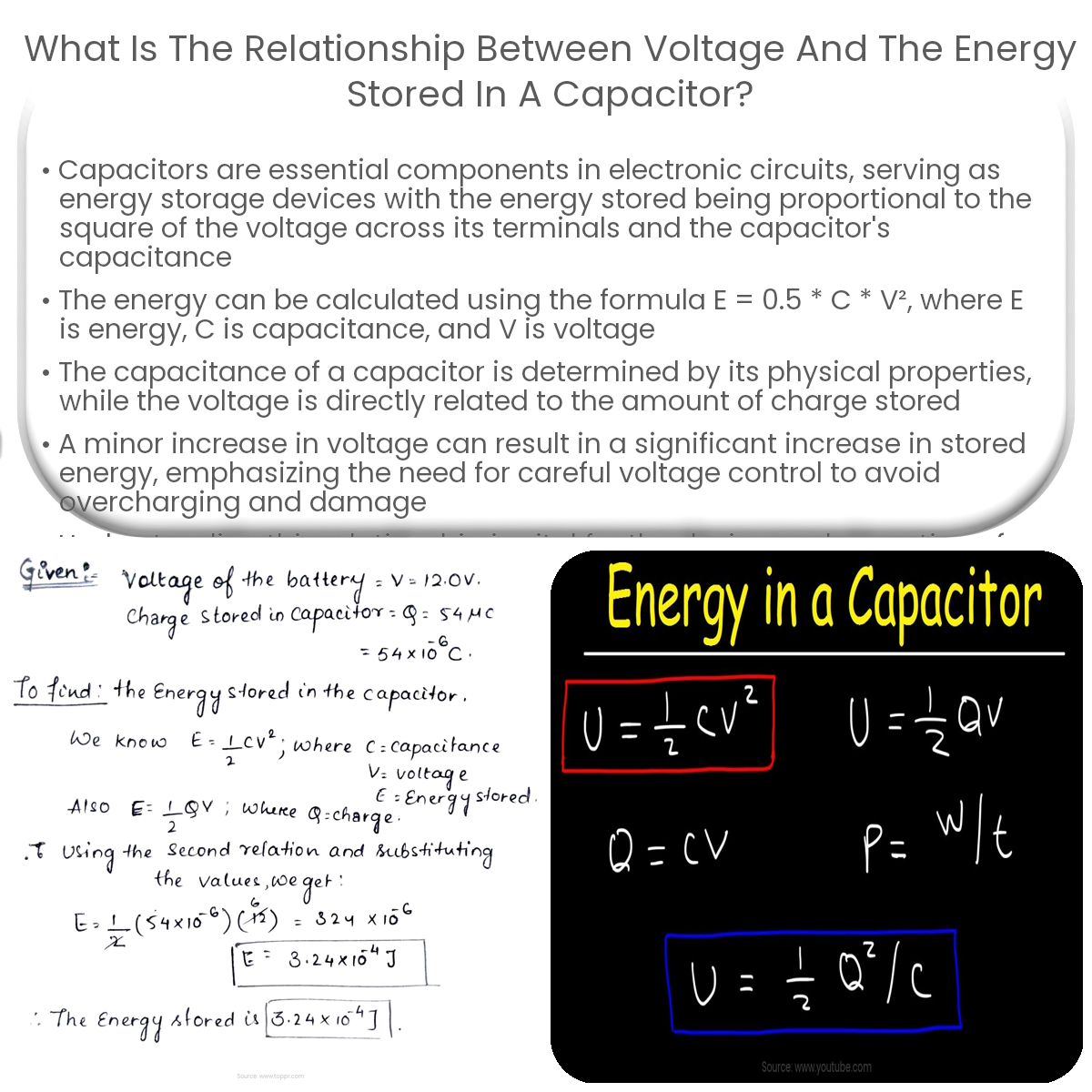
The energy stored in a capacitor is directly related to the voltage across its terminals, with energy proportional to the square of the voltage.
Introduction
Capacitors are crucial components in electronic circuits, serving as energy storage devices. The energy stored in a capacitor is directly related to the voltage across its terminals. This article will discuss the relationship between voltage and the energy stored in a capacitor.
Energy Storage in a Capacitor
When a voltage is applied across a capacitor, an electric field is created between its plates, and charges accumulate on the plates. The energy stored in a capacitor is proportional to the square of the voltage across its terminals and the capacitance of the capacitor.
The formula for calculating the energy (E) stored in a capacitor is given by:
E = 0.5 * C * V2
Where:
- E is the energy stored in the capacitor (in joules)
- C is the capacitance of the capacitor (in farads)
- V is the voltage across the capacitor (in volts)
Relationship Between Voltage and Stored Energy
The relationship between voltage and stored energy in a capacitor can be analyzed by considering the factors that influence each variable.
- Capacitance (C): The capacitance of a capacitor is determined by its physical properties, such as the surface area of its plates, the distance between the plates, and the dielectric constant of the material between the plates. A higher capacitance value allows a capacitor to store more energy for a given voltage.
- Voltage (V): The voltage across a capacitor’s terminals is directly related to the amount of charge stored on its plates. As the voltage increases, the electric field between the plates strengthens, leading to a higher charge accumulation and, consequently, more energy storage.
Since the energy stored in a capacitor is proportional to the square of the voltage, a small increase in voltage can result in a significant increase in stored energy. This relationship highlights the importance of carefully controlling the voltage across a capacitor to prevent overcharging and potential damage to the capacitor or the surrounding circuit.
Conclusion
The energy stored in a capacitor is directly related to the voltage across its terminals and the capacitance of the capacitor. Understanding the relationship between voltage and stored energy is essential for designing and operating electronic circuits that employ capacitors for energy storage, filtering, or other functions. By carefully managing the voltage across a capacitor, the energy storage capabilities can be optimized while avoiding potential damage to the capacitor and the circuit.