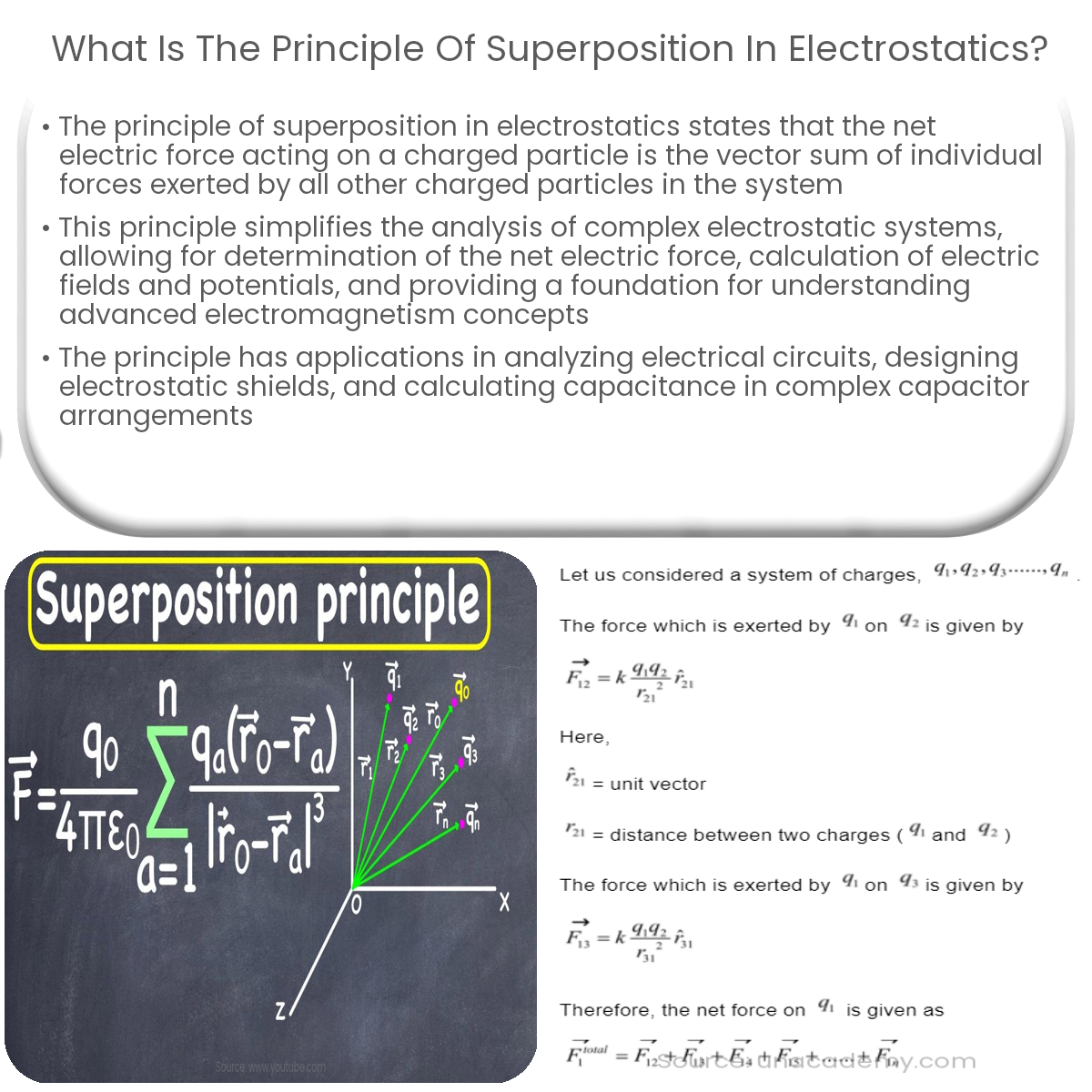
The principle of superposition in electrostatics states that the net electric force on a charge is the vector sum of forces from all other charges.
Principle of Superposition in Electrostatics
The principle of superposition is a fundamental concept in physics, specifically in electrostatics. In this article, we will explore the meaning, significance, and applications of the principle of superposition in electrostatics.
Understanding the Principle of Superposition
In the context of electrostatics, the principle of superposition states that the net electric force acting on a charged particle is the vector sum of the individual forces exerted by all other charged particles present in the system. This principle is applicable to linear systems and is valid when interactions between charges follow the Coulomb’s law.
Mathematical Representation
The principle of superposition can be mathematically expressed as:
Fnet = F1 + F2 + F3 + … + Fn
Where Fnet is the net electric force acting on a charged particle, and F1, F2, F3, …, Fn are the individual forces exerted by each of the n charges present in the system.
Significance of the Principle of Superposition
The principle of superposition simplifies the analysis of complex electrostatic systems with multiple charges. Some benefits of using this principle include:
- It allows us to determine the net electric force acting on a charged particle without considering the interactions between other charges.
- It enables the calculation of electric fields and potentials in a system by summing up the contributions from each charge.
- It provides a foundation for understanding more advanced concepts in electromagnetism, such as capacitance and electric circuits.
Applications of the Principle of Superposition
The principle of superposition in electrostatics has numerous applications in science and engineering, including:
- Electrical Circuits: The principle is applied to analyze the behavior of circuits with multiple voltage sources, resistors, and capacitors.
- Electrostatic Shielding: The distribution of charges on a conducting surface can be determined using the principle of superposition, leading to the design of effective electrostatic shields.
- Capacitance: The principle helps in calculating the capacitance of complex capacitor arrangements by considering the effect of each individual capacitor.
In conclusion, the principle of superposition is a crucial concept in electrostatics, simplifying the analysis of systems with multiple charges. By understanding this principle, we can better design and analyze electrical circuits, electrostatic shields, and capacitors in various applications.