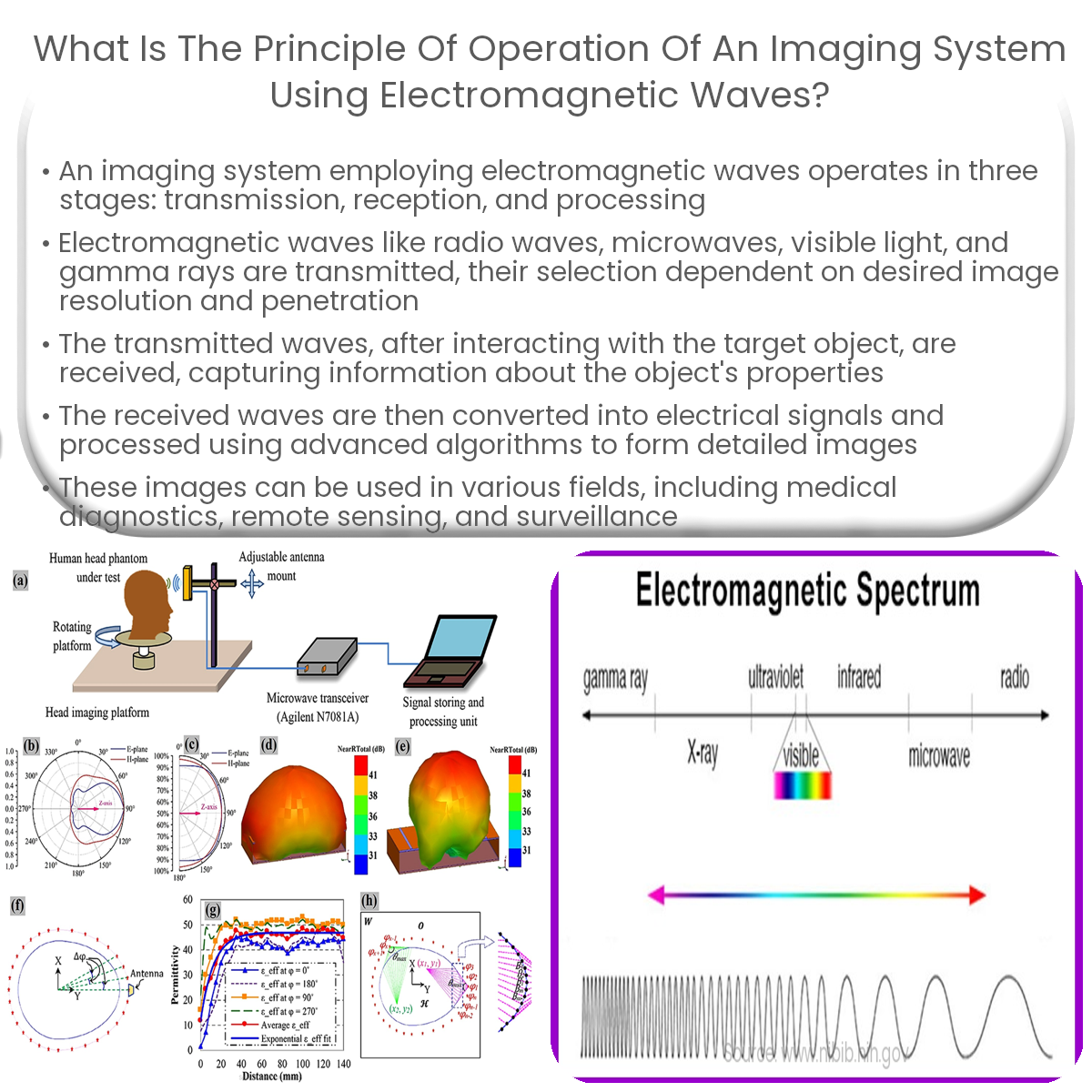
An imaging system using electromagnetic waves operates through transmission, reception, and processing of waves to capture and display detailed images.
Principle of Operation of an Imaging System Using Electromagnetic Waves
An imaging system that uses electromagnetic waves harnesses the properties of these waves to capture, process, and display detailed images. The principle of operation of such a system can be divided into three key stages: transmission, reception, and processing.
Transmission of Electromagnetic Waves
Electromagnetic waves, such as radio waves, microwaves, infrared, visible light, ultraviolet, X-rays, and gamma rays, have varying wavelengths and frequencies. Imaging systems use these properties to transmit waves and interact with the objects they aim to image. The type of electromagnetic wave used depends on the desired resolution and penetration capabilities.
- Radio waves have the longest wavelengths and are used in imaging systems like radar and synthetic aperture radar (SAR).
- Microwaves are used in ground-penetrating radar (GPR) and remote sensing applications.
- Infrared is employed in thermal imaging and night-vision systems.
- Visible light is used in optical imaging systems, such as cameras and microscopes.
- Ultraviolet, X-rays, and gamma rays have the shortest wavelengths and are utilized in systems like computed tomography (CT) and gamma cameras for medical imaging.
Reception of Electromagnetic Waves
After transmission, the electromagnetic waves interact with the target object and are either absorbed, transmitted, or reflected. The imaging system’s receiver captures the reflected or transmitted waves, providing information about the object’s properties, such as shape, composition, and internal structure.
- Reflection occurs when the waves bounce off the object’s surface. Systems like radar, GPR, and optical imaging capture the reflected waves.
- Transmission involves the waves passing through the object. Imaging systems like CT and X-ray machines utilize transmitted waves to gather information about the object’s internal structure.
- Absorption happens when the object absorbs the waves, leading to energy transfer. This property is exploited in thermal imaging systems to detect temperature differences.
Processing and Display
The received electromagnetic waves are converted into electrical signals and processed by the imaging system. This involves amplifying, filtering, and digitizing the signals. Advanced algorithms are used to reconstruct the images, revealing the target object’s properties and features. Finally, the images are displayed on a monitor or other output device, providing valuable information for various applications, from medical diagnostics to remote sensing and surveillance.