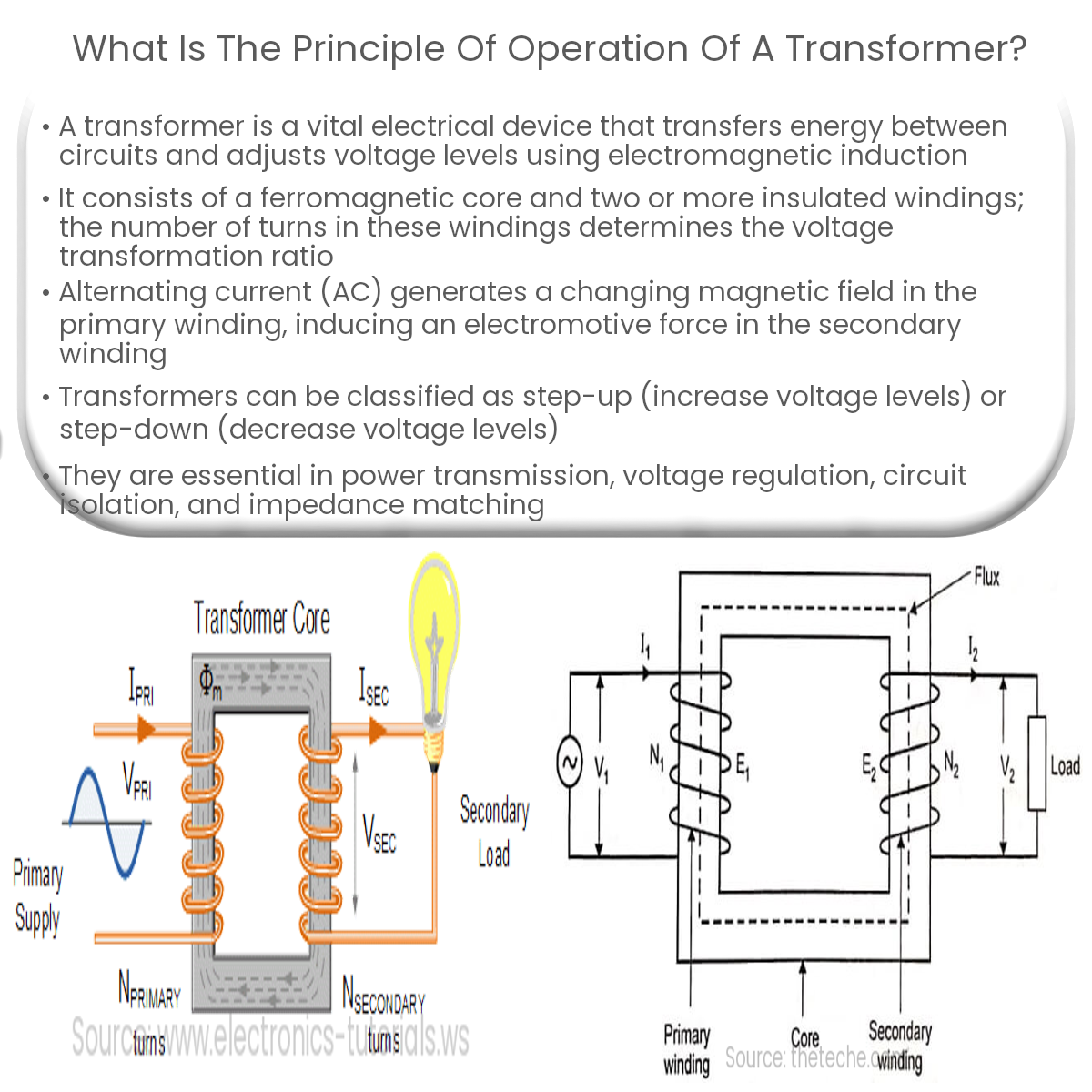
A transformer operates on the principle of electromagnetic induction, transferring electrical energy between circuits while altering voltage levels.
Principle of Operation of a Transformer
A transformer is an essential electrical device that transfers electrical energy between two or more circuits while altering voltage levels. The principle of operation of a transformer relies on the phenomenon of electromagnetic induction.
Electromagnetic Induction
Discovered by Michael Faraday in 1831, electromagnetic induction is the process by which a changing magnetic field induces an electromotive force (EMF) in a conductor. If the conductor forms a closed loop, the induced EMF generates an electric current.
Transformer Components
A typical transformer comprises two main components:
- Core: Made of ferromagnetic material, such as iron or silicon steel, which efficiently conducts magnetic flux
- Windings: Two or more sets of insulated conductive wire coils (primary and secondary windings) wrapped around the core
The primary winding is connected to the input voltage source, while the secondary winding is connected to the output load. The number of turns in the primary and secondary windings determines the voltage transformation ratio.
Operation of Transformers
When an alternating current (AC) flows through the primary winding, it generates a magnetic field that continuously changes its direction and magnitude. The core of the transformer conducts this changing magnetic field, which links to the secondary winding. The changing magnetic field induces an EMF in the secondary winding through the process of electromagnetic induction.
The transformer’s voltage transformation ratio is determined by the ratio of the number of turns in the primary winding (NP) to the number of turns in the secondary winding (NS):
VS/VP = NS/NP
Where VS is the secondary voltage and VP is the primary voltage.
Based on this ratio, transformers can be classified as:
- Step-up transformers: Increase voltage levels (NS > NP)
- Step-down transformers: Decrease voltage levels (NS < NP)
Applications of Transformers
Transformers play a critical role in various applications, such as:
- Power transmission and distribution
- Voltage regulation in electronic devices
- Isolation between circuits for safety or noise reduction
- Impedance matching in audio and communication systems
Conclusion
The principle of operation of a transformer is based on electromagnetic induction. By utilizing this phenomenon, transformers transfer electrical energy between circuits while altering voltage levels, making them an indispensable component in a wide range of electrical systems.