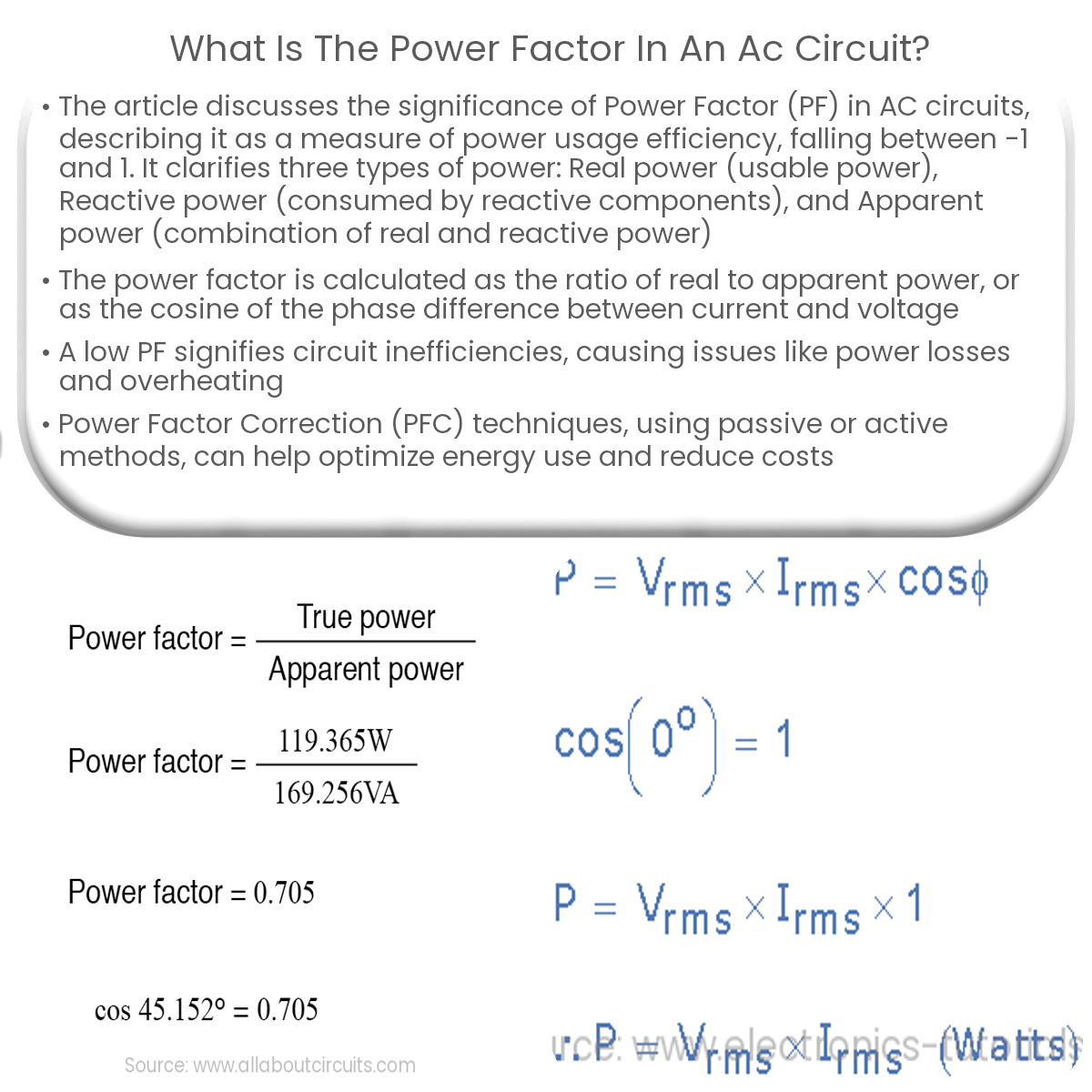
Power factor is the ratio of real power to apparent power in an AC circuit, indicating the efficiency of power usage and ranging between -1 and 1.
Understanding Power Factor in AC Circuits
Power factor (PF) is a critical concept in alternating current (AC) circuits, as it measures the efficiency of power usage. It is a dimensionless number between -1 and 1, representing the ratio of real power to apparent power. A power factor of 1 signifies that all power is being effectively utilized, while a value less than 1 indicates inefficiencies in the circuit.
Real, Reactive, and Apparent Power
Before diving into power factor, it’s essential to understand the three types of power in AC circuits:
- Real power (P) is the power consumed by resistive loads, measured in watts (W). This is the usable power in a circuit.
- Reactive power (Q) is the power consumed by reactive loads (inductors and capacitors), measured in volt-amperes reactive (VAR). This power does not perform any useful work but is necessary for the functioning of reactive components.
- Apparent power (S) is the combination of real and reactive power, measured in volt-amperes (VA). It represents the total power demanded by a circuit.
These three powers are related by the formula:
S^2 = P^2 + Q^2
Calculating Power Factor
Power factor is calculated using the following formula:
PF = P / S
It is also the cosine of the angle (θ) between current and voltage waveforms. A positive power factor indicates that the current waveform is in phase with the voltage waveform, while a negative power factor means they are out of phase.
Significance of Power Factor
A low power factor indicates that a circuit is inefficient and requires more current for the same amount of real power. This can lead to increased power losses, overheating, and a higher burden on the electrical infrastructure. To avoid these issues, industries often strive to maintain a power factor close to 1 by using power factor correction techniques, such as adding capacitors or inductors to the circuit.
Power Factor Correction
Power factor correction (PFC) is the process of improving a circuit’s power factor by reducing the reactive power component. PFC can be achieved using passive or active methods:
- Passive PFC: Capacitors or inductors are added to the circuit to balance the reactive power, thus increasing the power factor.
- Active PFC: Electronic devices, such as inverters or active filters, are used to generate a compensating current that cancels out the reactive power component.
By improving the power factor, industries can optimize their energy consumption and reduce costs while ensuring efficient operation of their electrical systems.