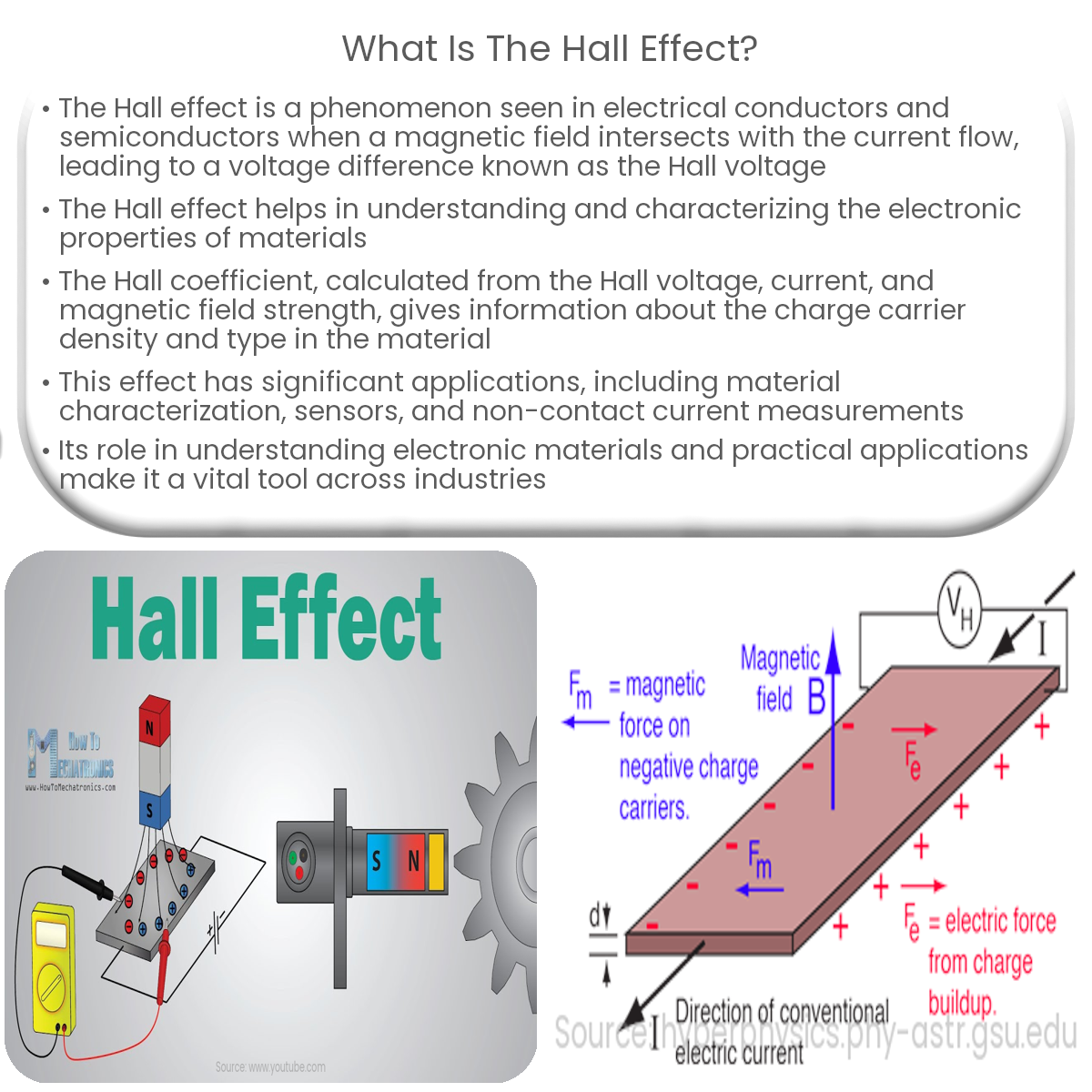
The Hall effect is a phenomenon in which a voltage difference develops across a conductor due to a magnetic field applied perpendicular to current flow.
The Hall Effect: An Overview
The Hall effect is a phenomenon observed in electrical conductors and semiconductors when a magnetic field is applied perpendicular to the current flow. Discovered by Edwin Hall in 1879, this effect is a crucial tool in understanding and characterizing the electronic properties of materials.
Understanding the Hall Effect
When a current-carrying conductor is placed in a magnetic field, the Lorentz force acts on the charge carriers (electrons or holes) and causes them to deflect to one side of the material. This deflection leads to a voltage difference across the conductor, known as the Hall voltage. The sign of the Hall voltage depends on the charge carrier type, providing crucial information about the material’s properties.
Measuring the Hall Effect
To measure the Hall effect, a thin, flat sample is placed in a magnetic field. A constant current is passed through the sample, and the Hall voltage is measured across the width of the sample. The Hall coefficient (RH) can be calculated using:
RH = VH / (I × B)
Where VH is the Hall voltage, I is the current, and B is the magnetic field strength. The Hall coefficient provides information about the charge carrier density and type in the material.
Applications of the Hall Effect
- Material Characterization: The Hall effect is widely used to determine the carrier concentration, mobility, and type (n-type or p-type) in semiconductors and conductors.
- Sensors: Hall effect sensors are used to measure magnetic fields, position, speed, and rotation in various applications, such as automotive systems and industrial automation.
- Current Measurement: Hall effect current sensors offer a non-contact method to measure AC or DC currents, providing accurate and reliable results without disturbing the current path.
In summary, the Hall effect is a fundamental phenomenon in solid-state physics that has played a vital role in advancing our understanding of electronic materials. Its practical applications in sensors and measurements continue to make it an essential tool in various industries.