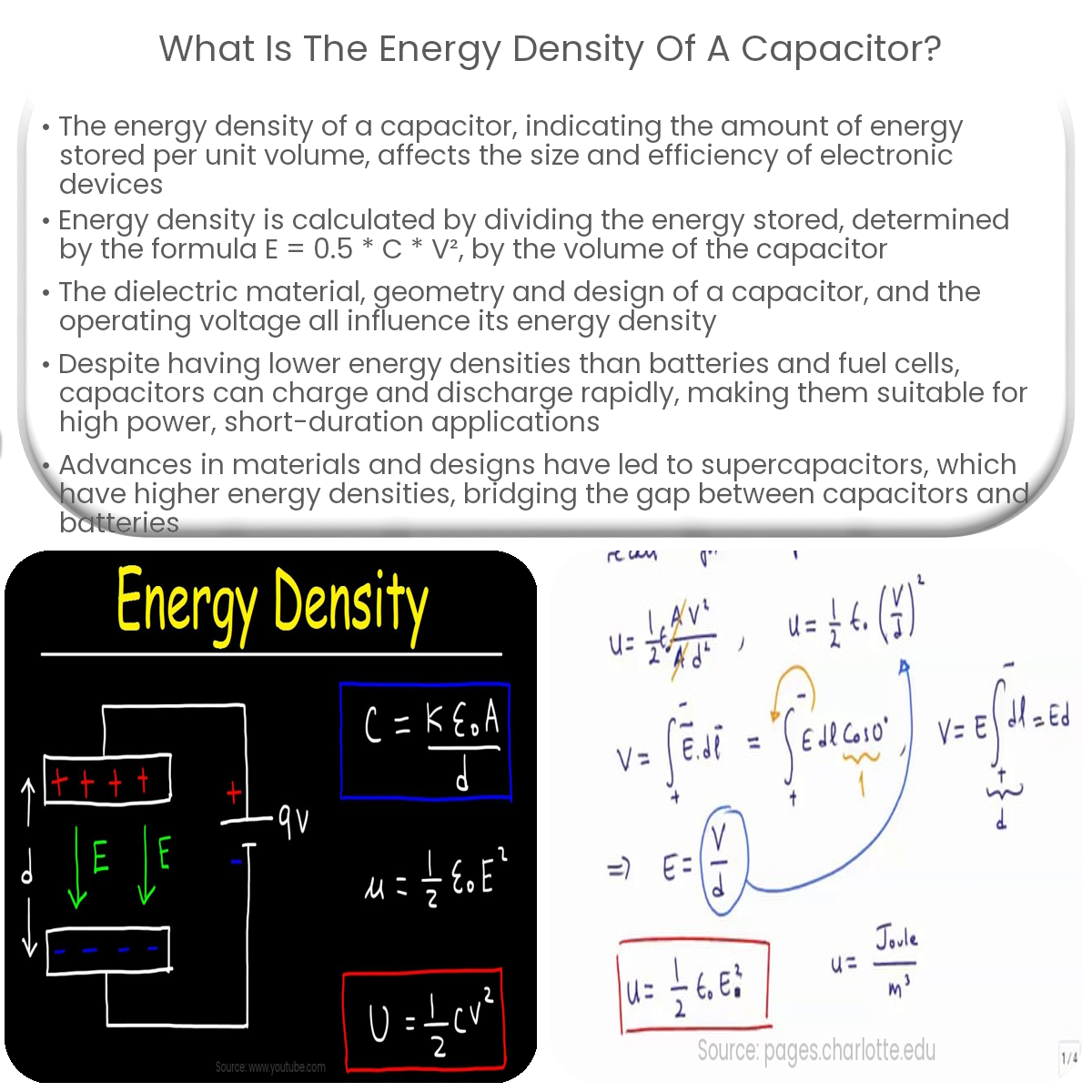
Energy density of a capacitor measures the amount of energy stored per unit volume, influenced by dielectric material, design, and operating voltage.
Energy Density of a Capacitor
The energy density of a capacitor is a measure of the amount of energy stored in a given volume of the capacitor. It is an important parameter to consider when designing or selecting capacitors for various applications, as it can influence the size and efficiency of the devices.
Calculating Energy Density
The energy stored in a capacitor can be calculated using the formula:
E = 0.5 * C * V2
Where E is the energy stored, C is the capacitance of the capacitor, and V is the voltage across the capacitor. The energy density (ρ) is then found by dividing the energy stored (E) by the volume (Vcap) of the capacitor:
ρ = E / Vcap
Factors Affecting Energy Density
There are several factors that can affect the energy density of a capacitor:
- Dielectric Material: The type of dielectric material used in a capacitor greatly influences its capacitance and, in turn, its energy density. Materials with higher dielectric constants can store more energy per unit volume, resulting in higher energy densities.
- Geometry and Design: The geometry and design of a capacitor, including its shape, size, and arrangement of the plates, can also impact its energy density. A larger surface area of the plates and smaller separation between them generally results in higher capacitance and energy density.
- Operating Voltage: The voltage applied to a capacitor directly affects the amount of energy it can store, with higher voltages resulting in higher energy densities. However, capacitors have a maximum voltage rating, beyond which the dielectric may break down and the capacitor may fail.
Comparing Capacitors and Other Energy Storage Devices
The energy density of capacitors is typically lower than that of batteries and fuel cells. However, capacitors can charge and discharge much more rapidly than batteries, making them suitable for applications requiring high power delivery over short periods of time, such as in electric vehicles or power electronics.
In recent years, the development of advanced materials and novel capacitor designs has led to the emergence of supercapacitors, which have significantly higher energy densities than traditional capacitors. Supercapacitors are finding increasing use in various applications, where they bridge the gap between conventional capacitors and batteries.