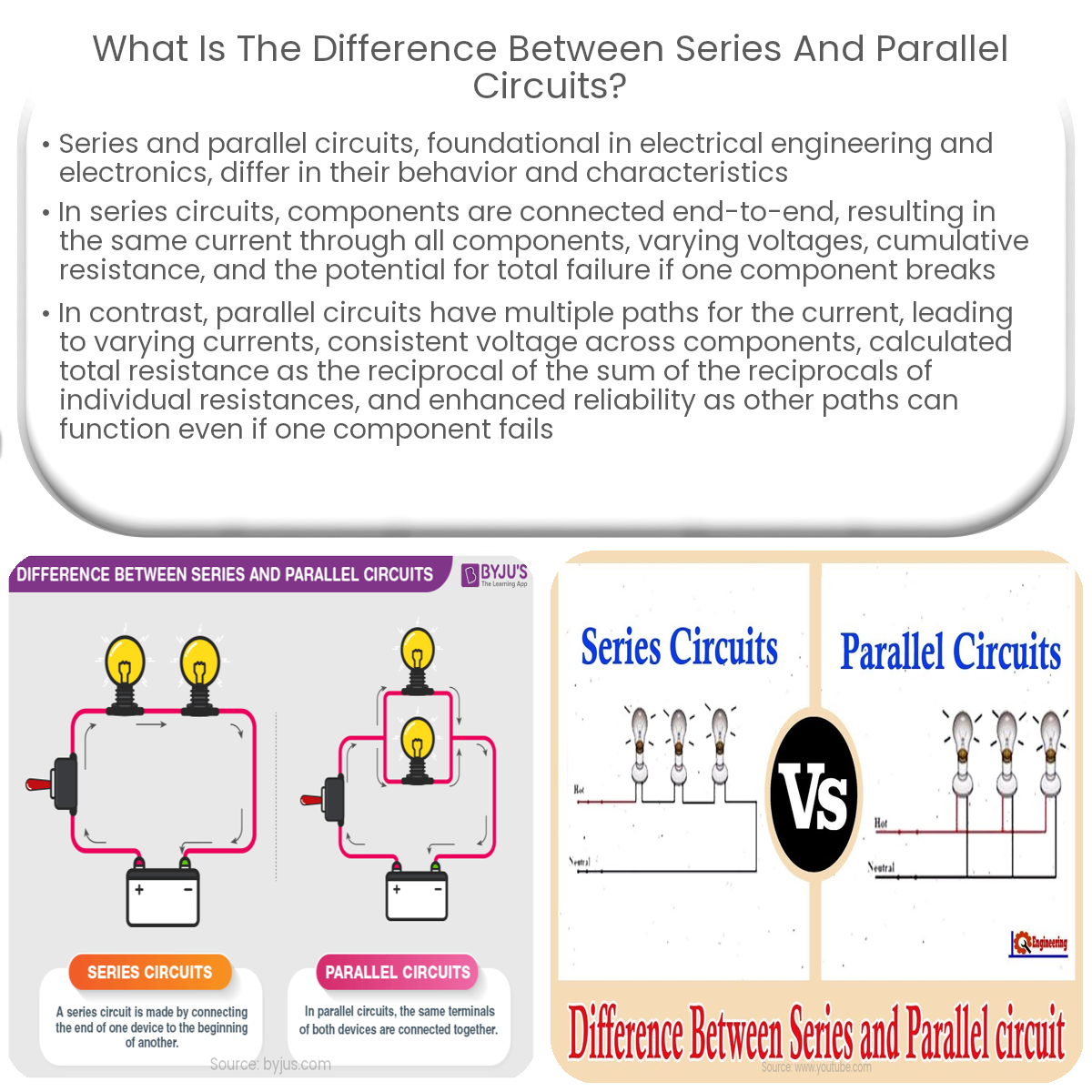
Series circuits have one current path, equal current through components, and divided voltage; parallel circuits have multiple paths, varying current, and equal voltage.
Difference Between Series and Parallel Circuits
Electric circuits are the foundation of electrical engineering and electronics. Understanding the differences between series and parallel circuits is crucial for designing and analyzing these systems. This article explores the fundamental differences between series and parallel circuits and their respective characteristics.
Series Circuits
In a series circuit, components are connected end-to-end in a single path, so the current flows through each component in turn. The main characteristics of series circuits are:
- Current: The current is the same through all components because there is only one path for the current to flow.
- Voltage: The total voltage across the circuit is the sum of the voltage drops across each component. The voltage across each component may differ, depending on its resistance.
- Resistance: The total resistance of the circuit is the sum of the individual resistances of each component.
- Failure: If one component fails, the entire circuit stops working, as there is no alternative path for the current to flow.
Parallel Circuits
In a parallel circuit, components are connected in multiple paths, allowing the current to flow through more than one path simultaneously. The main characteristics of parallel circuits are:
- Current: The total current in the circuit is the sum of the currents flowing through each path. The current through each component may differ, depending on its resistance.
- Voltage: The voltage across each component is the same, as they are all connected directly to the voltage source.
- Resistance: The total resistance of the circuit is the reciprocal of the sum of the reciprocals of the individual resistances of each component.
- Failure: If one component fails, the other paths can still function, as the current can flow through the remaining components.
Comparison of Series and Parallel Circuits
The key differences between series and parallel circuits can be summarized as follows:
- Series circuits have a single path for current flow, while parallel circuits have multiple paths.
- In series circuits, the current is the same through all components, while in parallel circuits, it can vary across components.
- In series circuits, the voltage is divided across components, while in parallel circuits, it remains the same across all components.
- Series circuits are more susceptible to component failure, while parallel circuits offer greater reliability.
In conclusion, understanding the differences between series and parallel circuits is essential for anyone interested in electrical engineering or electronics. These distinctions govern the behavior and characteristics of circuits, influencing their design, analysis, and practical applications.