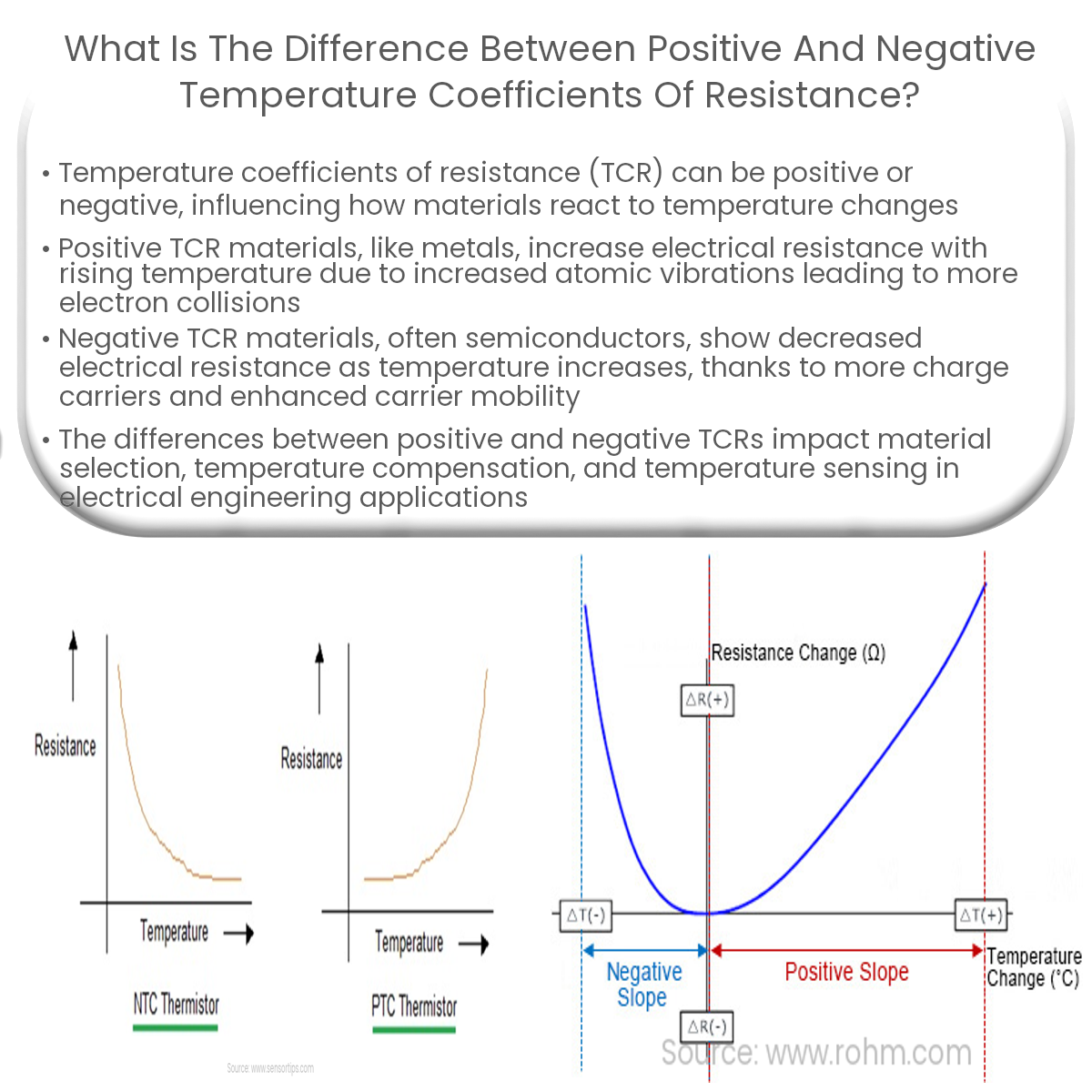
Positive temperature coefficients show increased resistance with rising temperature, while negative coefficients exhibit a decrease in resistance.
Positive vs. Negative Temperature Coefficients of Resistance
Temperature coefficients of resistance (TCR) play a crucial role in determining the behavior of materials in response to temperature changes. These coefficients can be either positive or negative, depending on the type of material and its electrical properties. This article explains the difference between positive and negative temperature coefficients of resistance and their implications for electrical engineering applications.
Positive Temperature Coefficient of Resistance (PTC)
A material with a positive temperature coefficient of resistance (PTC) exhibits an increase in electrical resistance as temperature rises. This behavior is commonly observed in conductive materials, such as metals. As temperature increases, the atoms in a metallic conductor vibrate more vigorously, leading to more frequent collisions with charge-carrying electrons. These collisions impede electron flow, resulting in increased resistance.
Examples of materials with positive temperature coefficients of resistance include copper, aluminum, and iron. PTC materials are often used in applications where temperature-dependent resistance changes are desirable, such as in heating elements and temperature sensors like resistance temperature detectors (RTDs).
Negative Temperature Coefficient of Resistance (NTC)
Conversely, a material with a negative temperature coefficient of resistance (NTC) exhibits a decrease in electrical resistance as temperature increases. This behavior is commonly observed in semiconductor materials, such as silicon and germanium. As temperature rises, the increased thermal energy in a semiconductor material results in the generation of more charge carriers (electrons and holes) and enhanced carrier mobility, ultimately leading to a decrease in resistance.
Examples of materials with negative temperature coefficients of resistance include thermistors, which are temperature-sensitive devices made from semiconductor materials, often metal oxides. NTC materials are widely used in temperature sensing and control applications, as well as in electronic circuits where temperature compensation is required.
Implications for Electrical Engineering
The differences between positive and negative temperature coefficients of resistance have several implications for electrical engineering:
- Material selection: Engineers must consider the TCR when selecting materials for specific applications, ensuring that the temperature-dependent resistance changes are suitable for the intended purpose.
- Temperature compensation: Understanding the TCR helps engineers design circuits and devices with temperature compensation features, maintaining consistent performance under varying temperature conditions.
- Temperature sensing: The TCR is a critical parameter in the design of temperature sensors, such as RTDs and thermistors, which exploit the temperature-dependent resistance of materials to measure temperature accurately.
In conclusion, the key difference between positive and negative temperature coefficients of resistance is their behavior in response to temperature changes. PTC materials exhibit an increase in resistance with rising temperature, while NTC materials show a decrease. Understanding these differences is essential for material selection, temperature compensation, and temperature sensing in electrical engineering applications.