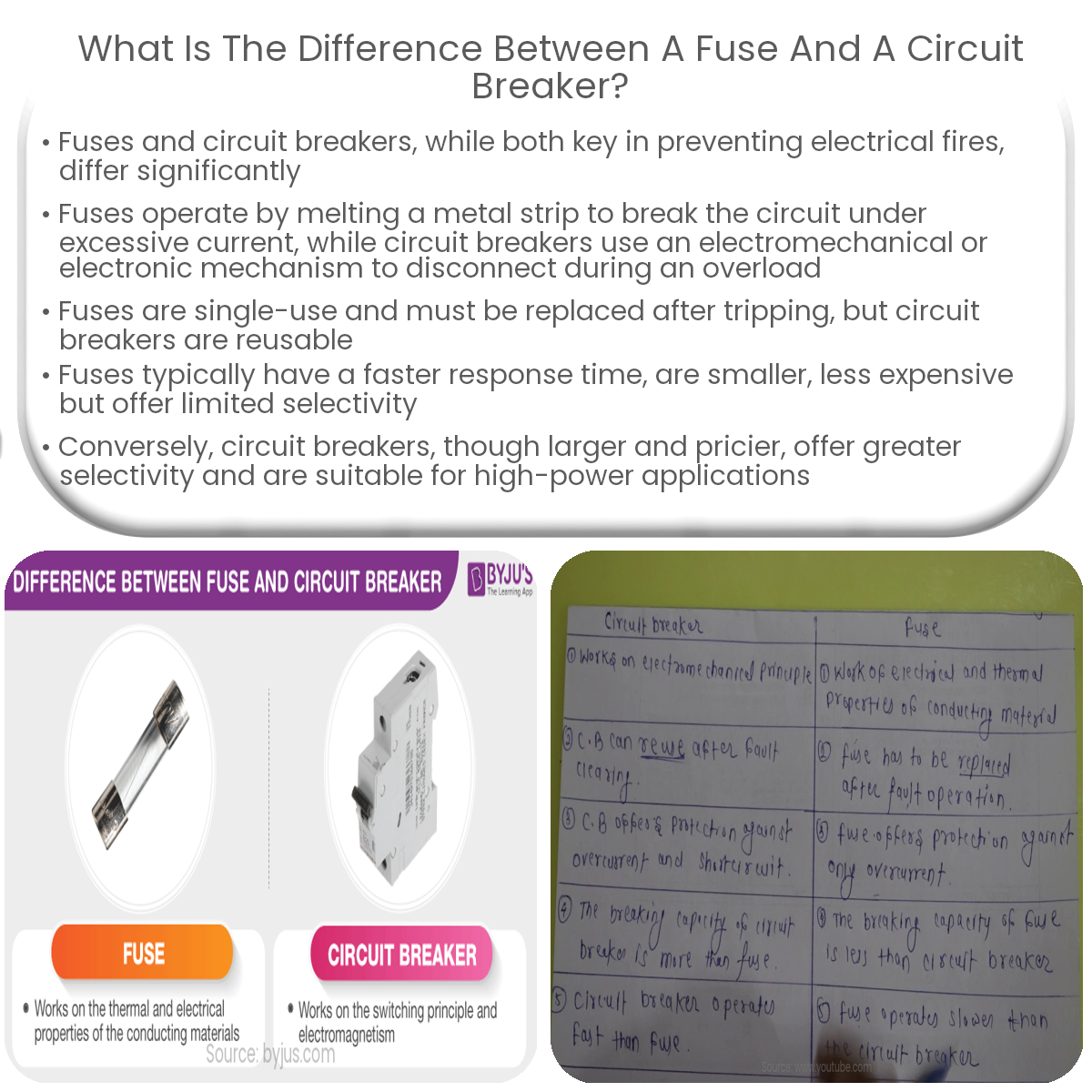
Fuses and circuit breakers differ in operating principle, reusability, response time, size, cost, and selectivity, each suited for specific applications.
Difference Between a Fuse and a Circuit Breaker
Fuses and circuit breakers are essential components in electrical systems, designed to protect equipment and prevent electrical fires by interrupting the flow of current when a fault is detected. This article highlights the key differences between fuses and circuit breakers to help you better understand their functions and applications.
1. Operating Principle
-
Fuse: A fuse contains a thin metal strip that melts when excessive current flows through it. The melted strip breaks the circuit, cutting off the power supply.
-
Circuit Breaker: A circuit breaker uses an electromechanical or electronic mechanism to trip and disconnect the circuit when an overload or short circuit occurs.
2. Reusability
-
Fuse: Fuses are typically single-use devices. Once the metal strip has melted, the fuse must be replaced with a new one.
-
Circuit Breaker: Circuit breakers are reusable. After tripping, they can be reset either manually or automatically, restoring the electrical connection.
3. Response Time
-
Fuse: Fuses generally have a faster response time, as the metal strip melts almost instantaneously when subjected to excessive current.
-
Circuit Breaker: Circuit breakers have a slightly slower response time due to their mechanical or electronic components, which can be an advantage in certain applications.
4. Size and Cost
-
Fuse: Fuses are smaller and less expensive than circuit breakers. They are often used in residential and low-power applications.
-
Circuit Breaker: Circuit breakers are larger and more expensive, but their reusability and advanced features make them suitable for industrial and high-power applications.
5. Selectivity and Coordination
-
Fuse: Fuses offer limited selectivity and coordination, as it can be difficult to accurately match fuse ratings to the specific requirements of an electrical system.
-
Circuit Breaker: Circuit breakers provide greater selectivity and coordination, as their trip settings can be adjusted to match the precise needs of the electrical system.
In conclusion, the main differences between fuses and circuit breakers lie in their operating principles, reusability, response time, size, cost, and selectivity. Choosing between a fuse and a circuit breaker depends on factors such as the specific application, budget, and system requirements.