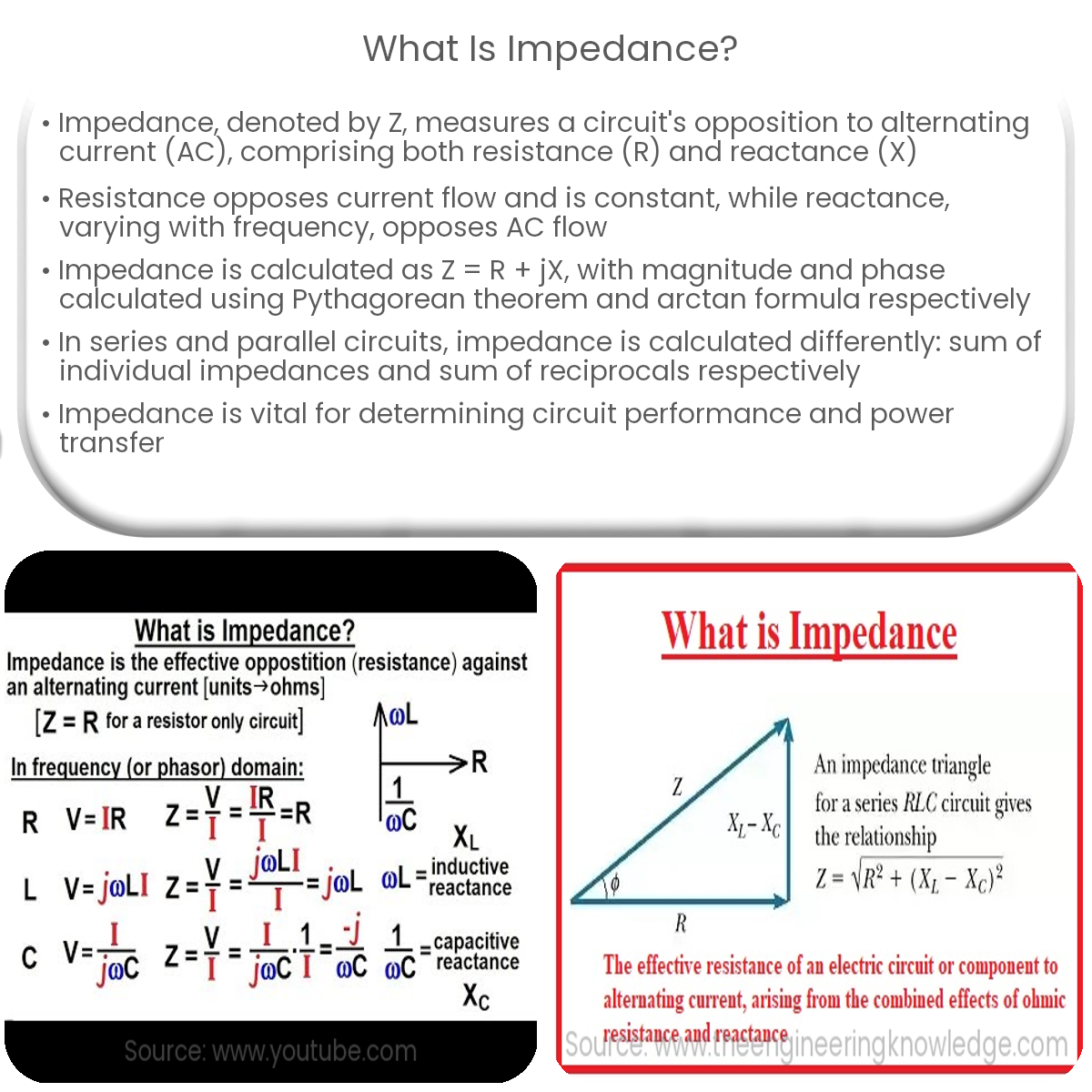
Impedance is a complex quantity that measures a circuit’s opposition to alternating current, encompassing both resistance and reactance components.
What is Impedance?
Impedance, represented by the symbol Z, is a complex quantity that measures the opposition a circuit offers to the flow of alternating current (AC). It encompasses both resistance and reactance, which respectively describe the opposition to direct current (DC) and the time-varying component of the opposition to AC.
Components of Impedance
There are two main components of impedance:
- Resistance (R): The opposition to the flow of current in a circuit caused by resistive elements, such as resistors. Resistance remains constant, irrespective of the frequency of the applied voltage.
- Reactance (X): The opposition to the flow of AC caused by reactive elements, such as capacitors and inductors. Reactance varies with frequency and can be capacitive (negative) or inductive (positive).
Calculating Impedance
Impedance is a complex quantity with both magnitude and phase. To calculate the impedance of a circuit, one must consider both the resistance and reactance. The impedance Z can be represented as a complex number, with the real part being the resistance (R) and the imaginary part being the reactance (X):
Z = R + jX
Here, j is the imaginary unit, equal to the square root of -1.
The magnitude of impedance, denoted by |Z|, can be calculated using the Pythagorean theorem:
|Z| = √(R² + X²)
The phase angle (θ) between the current and voltage in the circuit can be determined using the following formula:
θ = arctan(X/R)
Impedance in Series and Parallel Circuits
In a series circuit, impedances simply add up:
Z_total = Z1 + Z2 + … + Zn
In a parallel circuit, the reciprocal of the total impedance is equal to the sum of the reciprocals of the individual impedances:
1/Z_total = 1/Z1 + 1/Z2 + … + 1/Zn
Significance of Impedance
Impedance is a crucial parameter in AC circuit analysis, as it helps in determining current, voltage, and power in the circuit. Furthermore, impedance matching is vital in maximizing power transfer between components and minimizing signal reflection and loss in communication and electronic systems.