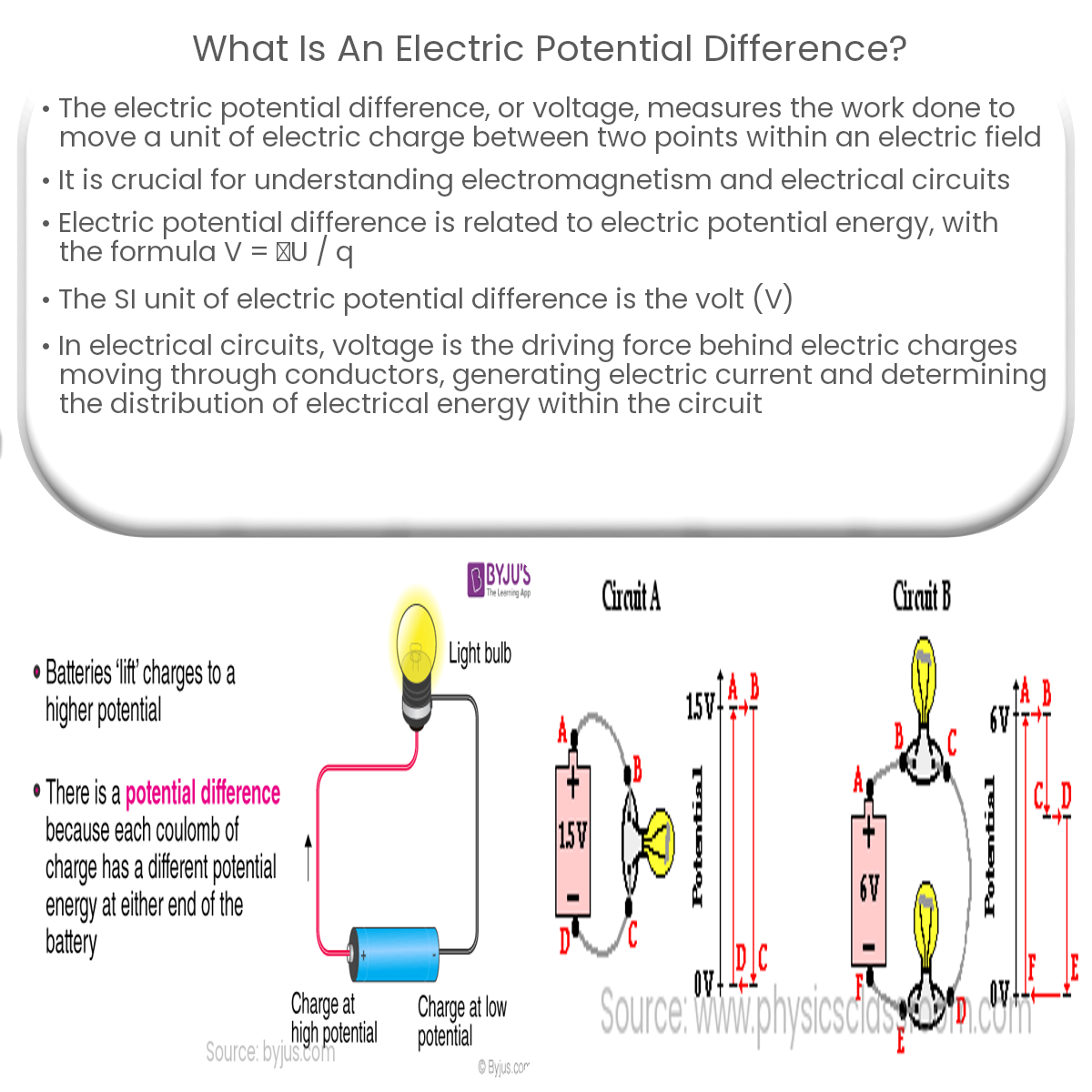
Electric potential difference, or voltage, is the work done per unit charge to move a charge between two points in an electric field.
Understanding Electric Potential Difference
The electric potential difference, also known as voltage, is a measure of the work done to move a unit of electric charge from one point to another within an electric field. It’s an essential concept in the study of electromagnetism and electrical circuits, as it helps to describe how electric charges interact and how electrical energy is converted into other forms of energy.
Electric Potential Energy and Work
Electric potential difference is closely related to the concept of electric potential energy. The electric potential energy of a charged particle depends on its position within an electric field, created by other charged particles or objects. When the charged particle is moved, work is done against the electric field, resulting in a change in its electric potential energy.
The electric potential difference is defined as the work done per unit charge to move the charge between two points. Mathematically, it can be expressed as:
V = ΔU / q
Where V is the electric potential difference, ΔU is the change in electric potential energy, and q is the charge being moved.
Units of Electric Potential Difference
The SI unit of electric potential difference is the volt (V), named after the Italian physicist Alessandro Volta. One volt is defined as the potential difference that causes one joule of work to be done when moving one coulomb of charge between two points.
Calculating Electric Potential Difference
In a uniform electric field, the electric potential difference between two points can be calculated using the formula:
V = Ed
Where V is the electric potential difference, E is the electric field strength, and d is the distance between the two points.
In the case of point charges or non-uniform electric fields, the electric potential difference can be determined by integrating the electric field along the path between the two points.
Significance in Electrical Circuits
Electric potential difference plays a crucial role in electrical circuits, as it’s the driving force that causes electric charges to move through conductors, generating an electric current. In a closed circuit, the electric potential difference, or voltage, across a power source, such as a battery or a generator, is what provides the energy to drive the current. The electric potential difference across other circuit components, like resistors, capacitors, and inductors, determines the distribution of electrical energy within the circuit and governs the behavior of the current and voltage.