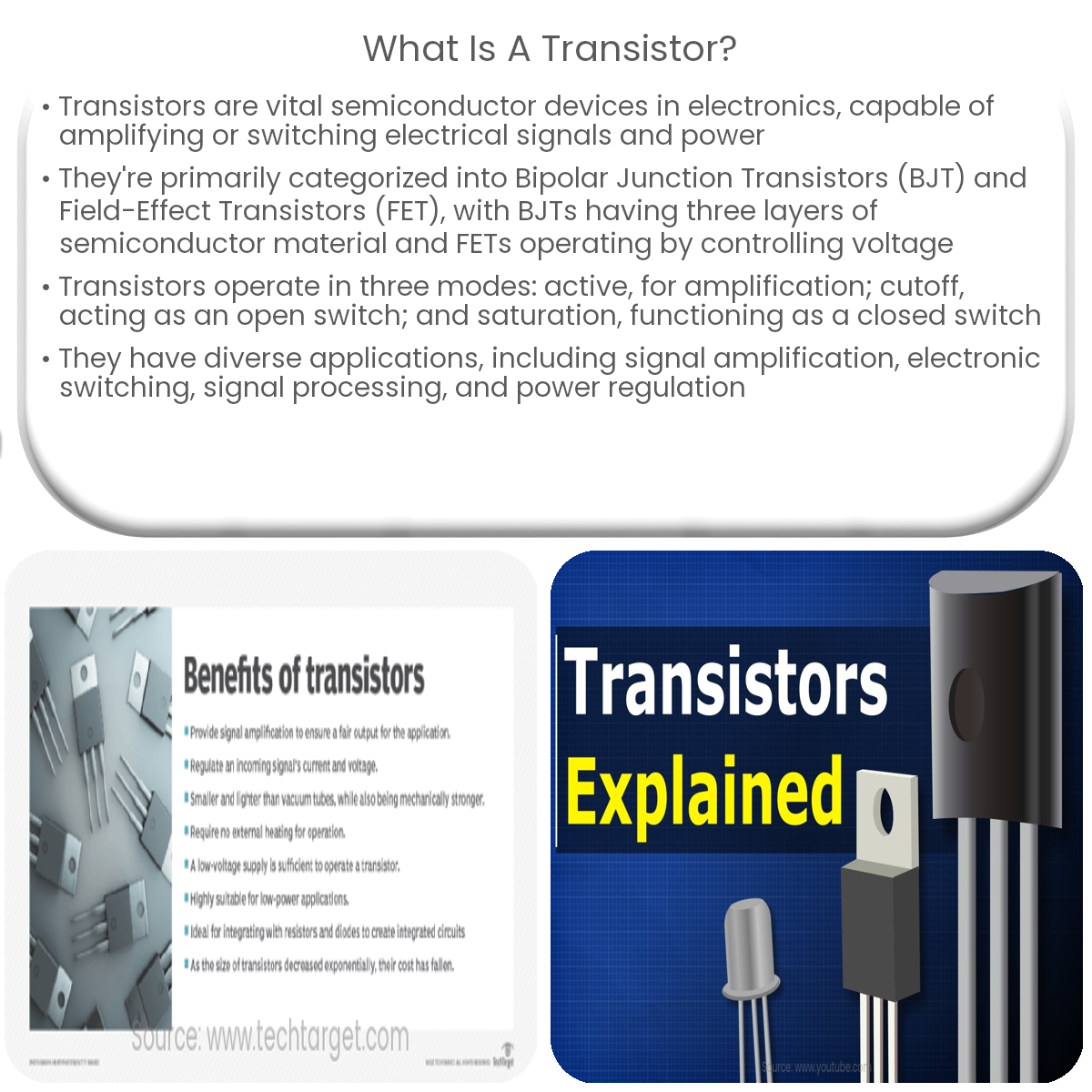
A transistor is a semiconductor device that can amplify or switch electrical signals, enabling the control of current flow between two terminals.
Introduction to Transistors
A transistor is a semiconductor device that can amplify or switch electrical signals and power. It is a crucial component in electronic devices and circuits, enabling the control of current flow between two terminals using a third terminal.
Types of Transistors
Transistors are classified into two main categories based on their structure and operation: Bipolar Junction Transistors (BJT) and Field-Effect Transistors (FET).
BJT: A BJT has three layers of semiconductor material, namely the emitter, base, and collector. There are two types of BJTs: NPN and PNP, distinguished by the arrangement of N-type and P-type materials.
FET: FETs operate through the control of voltage applied to the gate terminal, which influences the current between the source and drain terminals. FETs can be categorized into Junction Field-Effect Transistors (JFET) and Metal-Oxide-Semiconductor Field-Effect Transistors (MOSFET).
Transistor Operation
Transistors can be operated in three modes: active, cutoff, and saturation.
Active mode: In this mode, a small current at the base terminal controls a larger current between the collector and emitter terminals. The transistor works as an amplifier in active mode.
Cutoff mode: In cutoff mode, there is no current flow between the collector and emitter terminals, and the transistor acts as an open switch.
Saturation mode: In saturation mode, the transistor is fully turned on and acts as a closed switch, allowing maximum current flow between the collector and emitter terminals.
Applications of Transistors
Transistors are versatile components with numerous applications in modern electronics. Some of the most common uses include:
Amplification: Transistors amplify weak signals, making them suitable for audio and radio frequency applications.
Switching: Transistors can act as electronic switches, used in digital circuits and microcontrollers for on/off control of other components.
Signal processing: Transistors are essential for analog and digital signal processing, such as filtering, modulation, and demodulation.
Power regulation: Transistors help regulate voltage and current in power supply circuits and other power management applications.