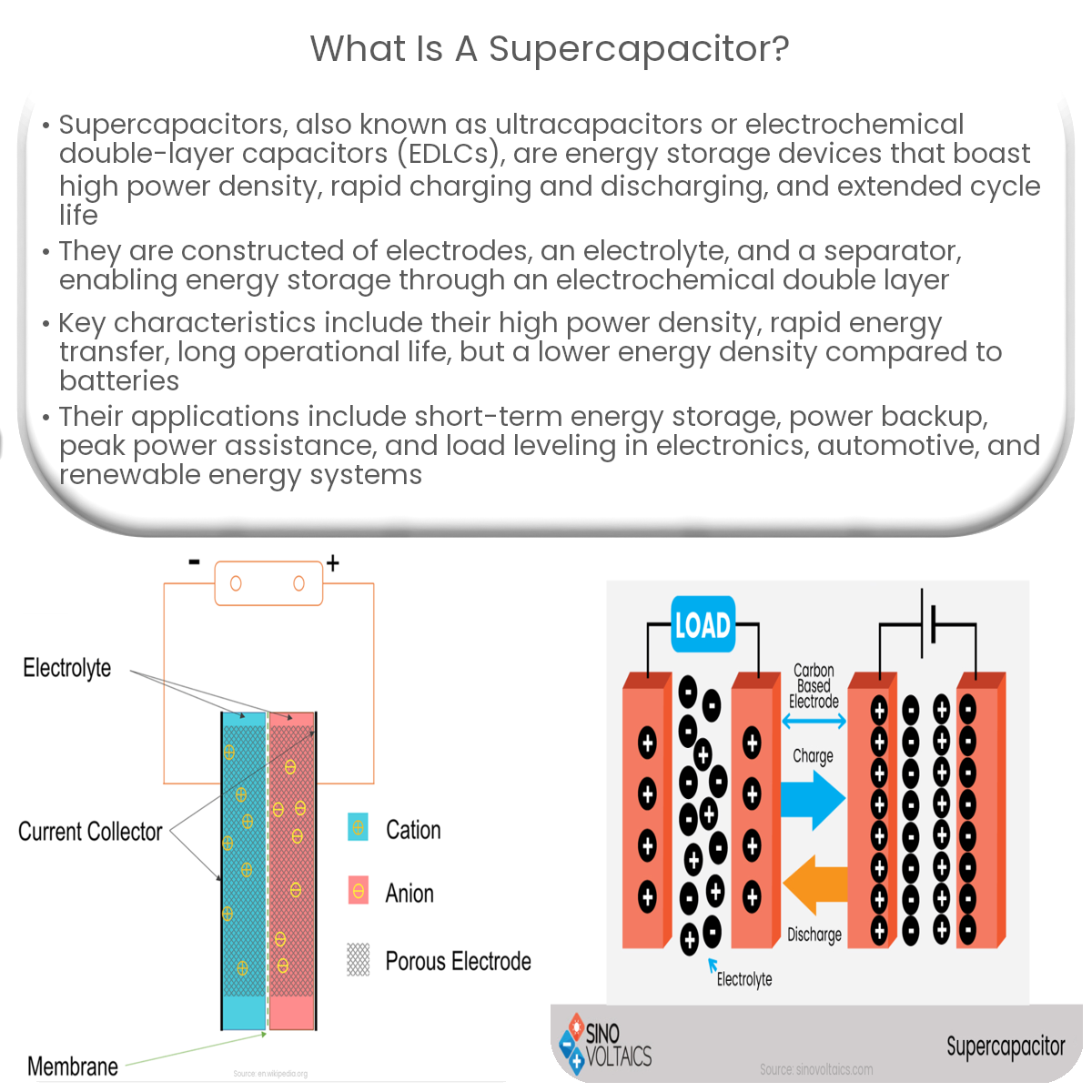
Supercapacitors, also known as ultracapacitors or electrochemical double-layer capacitors (EDLCs), are energy storage devices that offer high power density, rapid charging and discharging capabilities, and long cycle life.
Supercapacitors: An Introduction
Supercapacitors, also known as ultracapacitors or electrochemical double-layer capacitors (EDLCs), are energy storage devices that offer high power density, rapid charging and discharging capabilities, and long cycle life. They bridge the gap between conventional capacitors and rechargeable batteries, making them suitable for various applications in electronics, automotive, and renewable energy systems. This article provides an overview of the structure, characteristics, and applications of supercapacitors.
Structure of a Supercapacitor
A supercapacitor consists of the following components:
- Electrodes: The electrodes are made of high-surface-area materials, such as activated carbon, carbon nanotubes, or graphene, which facilitate rapid ion adsorption and desorption.
- Electrolyte: The electrolyte is a conductive medium, either aqueous or organic, that allows the transport of ions between the electrodes.
- Separator: The separator is a non-conductive porous membrane that prevents electrical contact between the electrodes while allowing ion migration.
Unlike conventional capacitors, supercapacitors store energy through the formation of an electrochemical double layer at the electrode-electrolyte interface, which leads to their unique characteristics.
Characteristics of Supercapacitors
Supercapacitors exhibit several distinctive characteristics, including:
- High power density: Due to the rapid ion adsorption and desorption at the electrode surface, supercapacitors can deliver high power density, making them suitable for applications that require bursts of power.
- Rapid charging and discharging: Supercapacitors can be charged and discharged within seconds to minutes, enabling fast energy transfer.
- Long cycle life: Supercapacitors can undergo millions of charge and discharge cycles without significant degradation, ensuring a long operational life.
- Low energy density: Despite their high power density, supercapacitors have a lower energy density compared to batteries, limiting their use in long-term energy storage applications.
Applications of Supercapacitors
Supercapacitors are used in a variety of applications, such as:
- Energy storage: They can be used for short-term energy storage in applications like regenerative braking systems, where rapid charging and discharging are essential.
- Power backup: Supercapacitors can provide backup power for critical systems, such as uninterruptible power supplies (UPS) or emergency lighting.
- Peak power assistance: In electric vehicles, supercapacitors can be used to supplement batteries during high-power demands, such as acceleration or hill climbing.
- Load leveling: Supercapacitors can be used in renewable energy systems, such as solar or wind power, to smooth out power fluctuations and maintain grid stability.
In conclusion, supercapacitors are versatile energy storage devices that offer high power density, rapid charging and discharging capabilities, and long cycle life. They are well-suited for various applications in electronics, automotive, and renewable energy systems, where rapid energy transfer