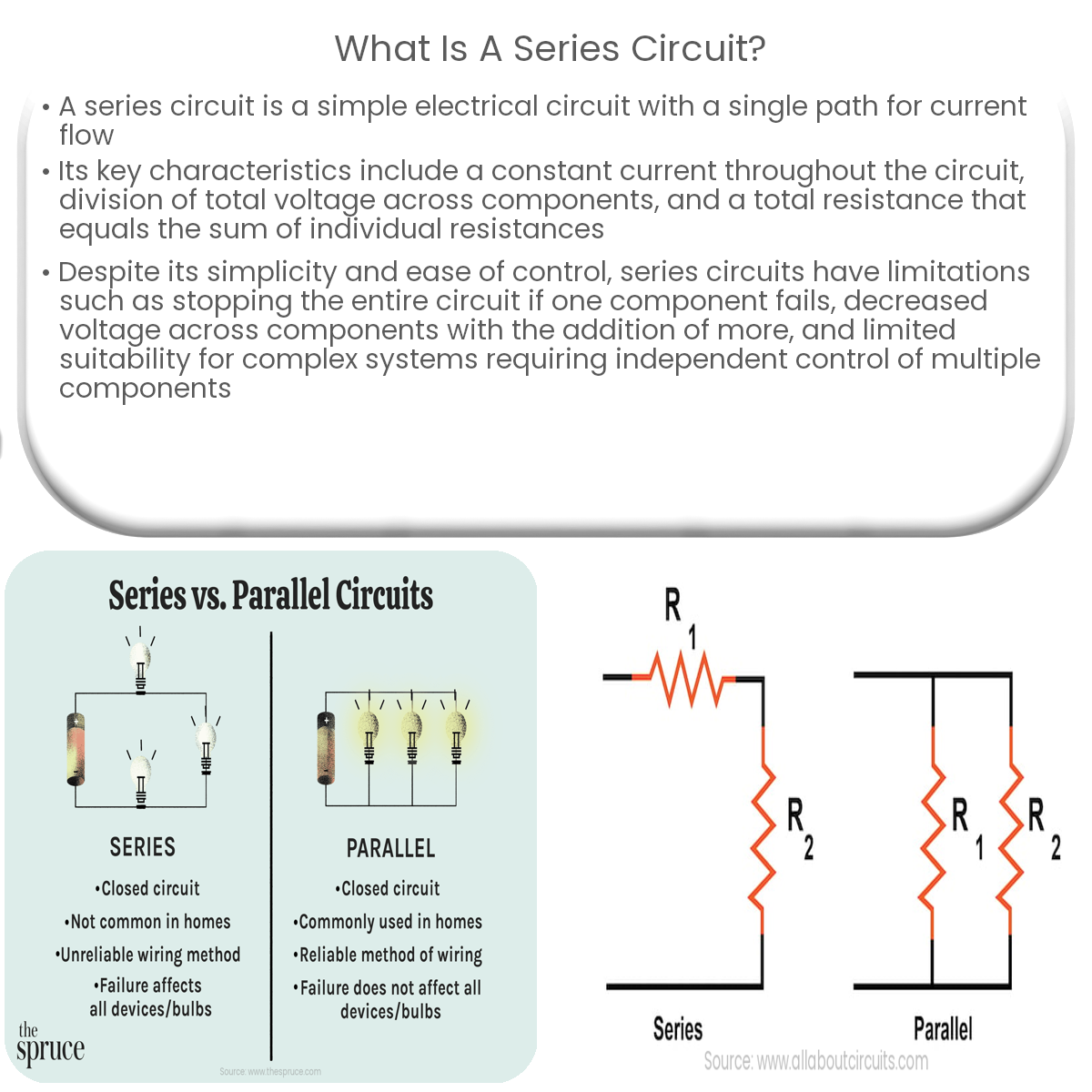
A series circuit connects components in a single path, with constant current, divided voltage, and a total resistance equal to the sum of components.
Introduction to Series Circuits
A series circuit is a fundamental type of electrical circuit that connects components in a linear sequence, one after the other, with a single path for the current to flow through. In this article, we will explore the characteristics, advantages, and disadvantages of series circuits.
Characteristics of Series Circuits
Series circuits have the following characteristics:
- Single path for current: The current flows through one continuous path, passing through each component in sequence.
- Constant current: The current is the same at any point in the circuit, as there is only one path for it to flow through.
- Voltage divides across components: The total voltage across the circuit is divided among the components, with each component’s voltage drop proportional to its resistance.
- Resistance adds up: The total resistance in a series circuit is the sum of the individual resistances of each component.
Advantages of Series Circuits
Series circuits offer several advantages, including:
- Simple design: Series circuits are straightforward and easy to understand, making them ideal for basic electrical applications and education purposes.
- Easy current control: Since the current is the same throughout the circuit, it can be easily controlled by adjusting the total resistance.
- Sequential operation: Components can be arranged to operate in a specific order, which can be useful for certain applications, such as in a combination lock.
Disadvantages of Series Circuits
Despite their simplicity, series circuits have some limitations:
- Dependency on all components: If one component fails, the entire circuit stops working, as the current cannot bypass the failed component.
- Decreased voltage across components: As the total voltage is divided among the components, adding more components can result in insufficient voltage for individual components to function.
- Limited applications: Series circuits are not suitable for complex electrical systems or applications requiring independent control of multiple components.
In conclusion, a series circuit is a basic type of electrical circuit with a single path for current flow. While its simplicity makes it suitable for specific applications and educational purposes, its limitations make it less ideal for more complex electrical systems.