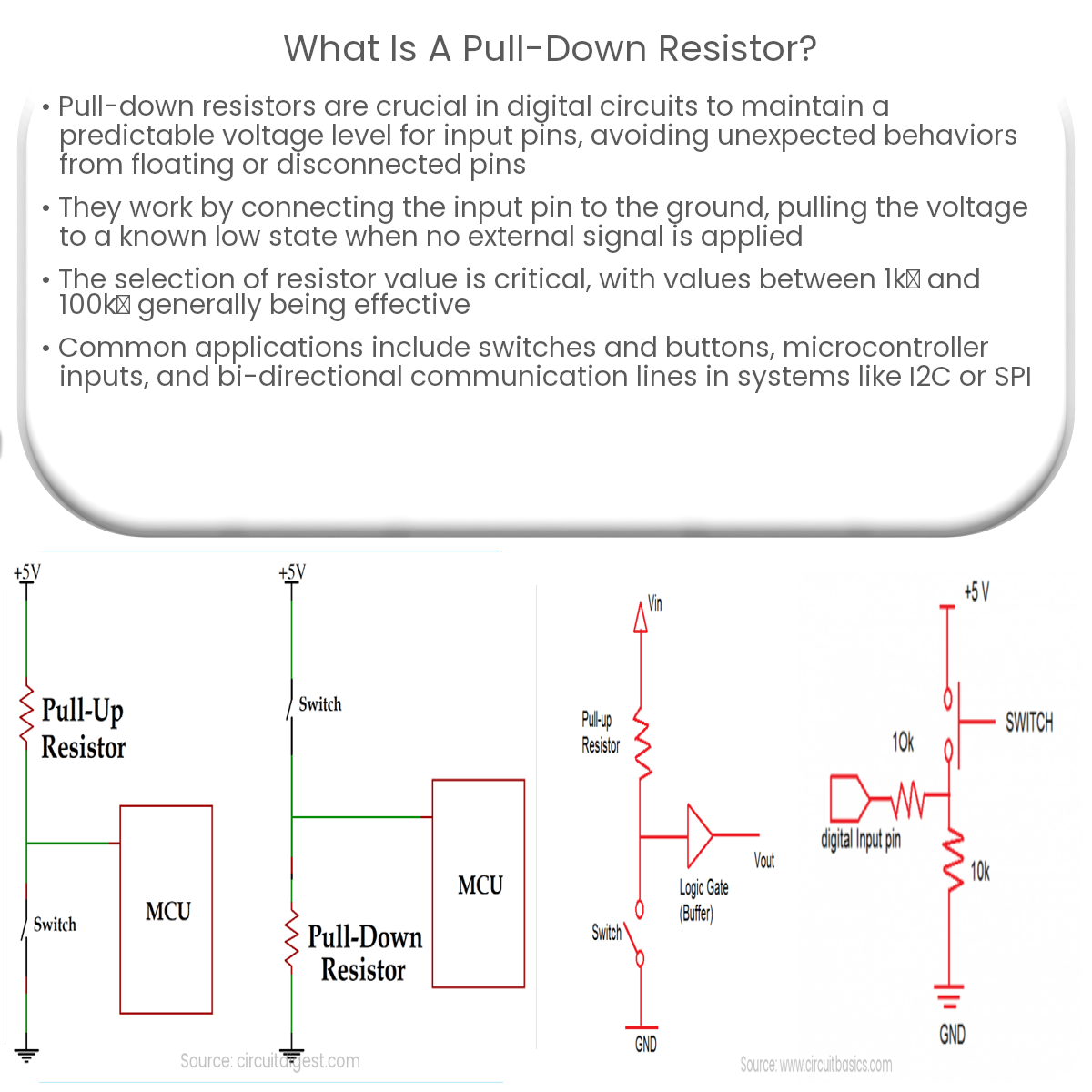
A pull-down resistor is an electronic component used in digital circuits to maintain a stable low voltage level on input pins.
Understanding Pull-Down Resistors
A pull-down resistor is a fundamental electronic component often utilized in digital circuits to ensure a stable and predictable voltage level for input pins. In this article, we’ll dive into the basics of pull-down resistors, their purpose, and typical applications.
The Purpose of Pull-Down Resistors
In digital circuits, input pins can be in one of two states: high (1) or low (0). However, when an input pin is left floating or disconnected, its state becomes unpredictable, often causing unexpected behavior. To avoid this, pull-down resistors are employed to pull the voltage level of the input pin towards a known low state (0).
How Pull-Down Resistors Work
A pull-down resistor is connected between the input pin and ground (GND). When the input is not driven by an external signal, the pull-down resistor maintains the input pin at a low voltage level, ensuring a stable and predictable ‘0’ state. When the input pin is connected to a higher voltage level, the resistor’s influence is overridden, and the pin transitions to a high ‘1’ state.
Choosing the Right Resistor Value
The value of the pull-down resistor plays a significant role in its effectiveness. A value that is too low can cause excessive current flow, while a value that is too high can result in the input pin not being adequately pulled down. Generally, values between 1kΩ and 100kΩ are suitable for most applications, with 10kΩ being a common choice.
Common Applications
- Switches and buttons: Pull-down resistors are often used with switches and buttons to maintain a defined ‘off’ state when the switch is open, preventing false triggers.
- Microcontroller inputs: When using microcontrollers with digital inputs, pull-down resistors can help ensure that input pins maintain a stable ‘0’ state when no signal is applied.
- Bi-directional communication lines: In communication systems like I2C or SPI, pull-down resistors can be utilized to maintain a known idle state on the bus when no devices are actively driving the line.
In summary, pull-down resistors are essential components in digital electronics, ensuring stable and predictable voltage levels on input pins. By selecting the appropriate resistor value and understanding their applications, you can effectively avoid unwanted behavior in your circuits.