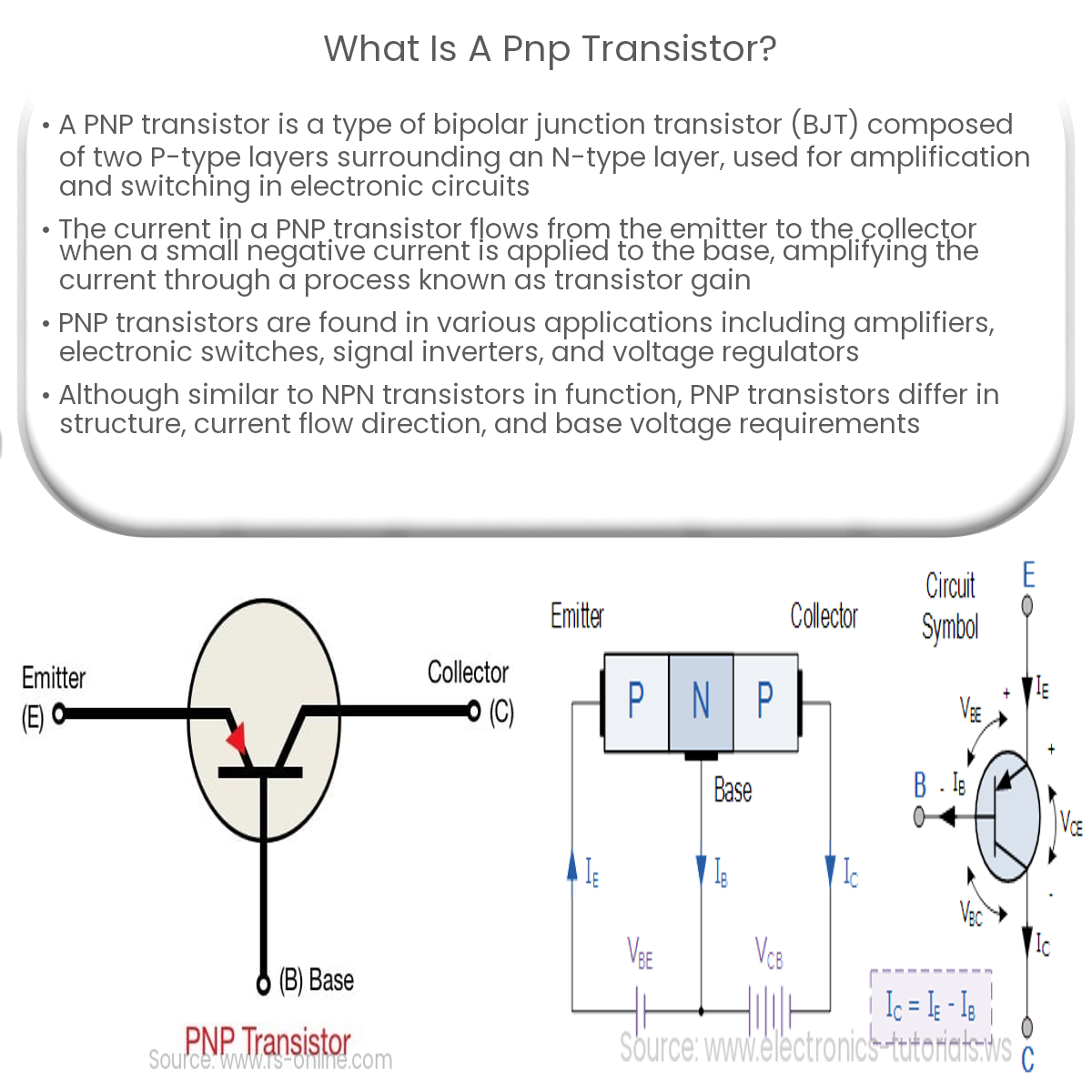
A PNP transistor is a type of bipolar junction transistor with two P-type layers surrounding an N-type layer, used for amplification and switching.
Introduction to PNP Transistors
A PNP transistor is a type of bipolar junction transistor (BJT) composed of two P-type semiconductor layers surrounding an N-type layer. It serves as a current-controlled device, commonly used for amplification and switching applications in electronic circuits.
Structure and Operation
PNP transistors consist of three layers: an N-type base, sandwiched between two P-type layers known as the emitter and collector. The current flows from the emitter to the collector when a small current is applied at the base. The transistor is considered “on” when the base-emitter junction is forward-biased, and “off” when it is reverse-biased.
Working Principle
In a PNP transistor, when a negative voltage is applied to the base relative to the emitter, the base-emitter junction is forward-biased, allowing the flow of holes (positive charge carriers) from the emitter to the base. As the base is thin and lightly doped, most of these holes continue to the collector, creating a larger current flow between the emitter and the collector. This current amplification factor is known as the transistor’s gain.
Applications
PNP transistors have various applications in electronic circuits, including:
- Amplifiers: PNP transistors are used in various types of amplifiers, such as audio, radio frequency, and operational amplifiers.
- Switching: They can function as electronic switches in digital circuits, turning devices on or off based on input signals.
- Signal Inversion: PNP transistors can be used for inverting signals in circuits, such as inverting amplifiers and oscillators.
- Power Management: They play a crucial role in voltage regulators, providing stable output voltage levels.
Comparison with NPN Transistors
Although both PNP and NPN transistors have similar functions, their structure and operation differ:
- PNP transistors are constructed with two P-type layers surrounding an N-type layer, while NPN transistors have two N-type layers surrounding a P-type layer.
- In PNP transistors, the current flows from the emitter to the collector, whereas, in NPN transistors, the current flows from the collector to the emitter.
- PNP transistors require a negative base voltage to turn on, while NPN transistors require a positive base voltage.
Despite these differences, both PNP and NPN transistors are widely used in electronic circuits, depending on the specific requirements of the application.