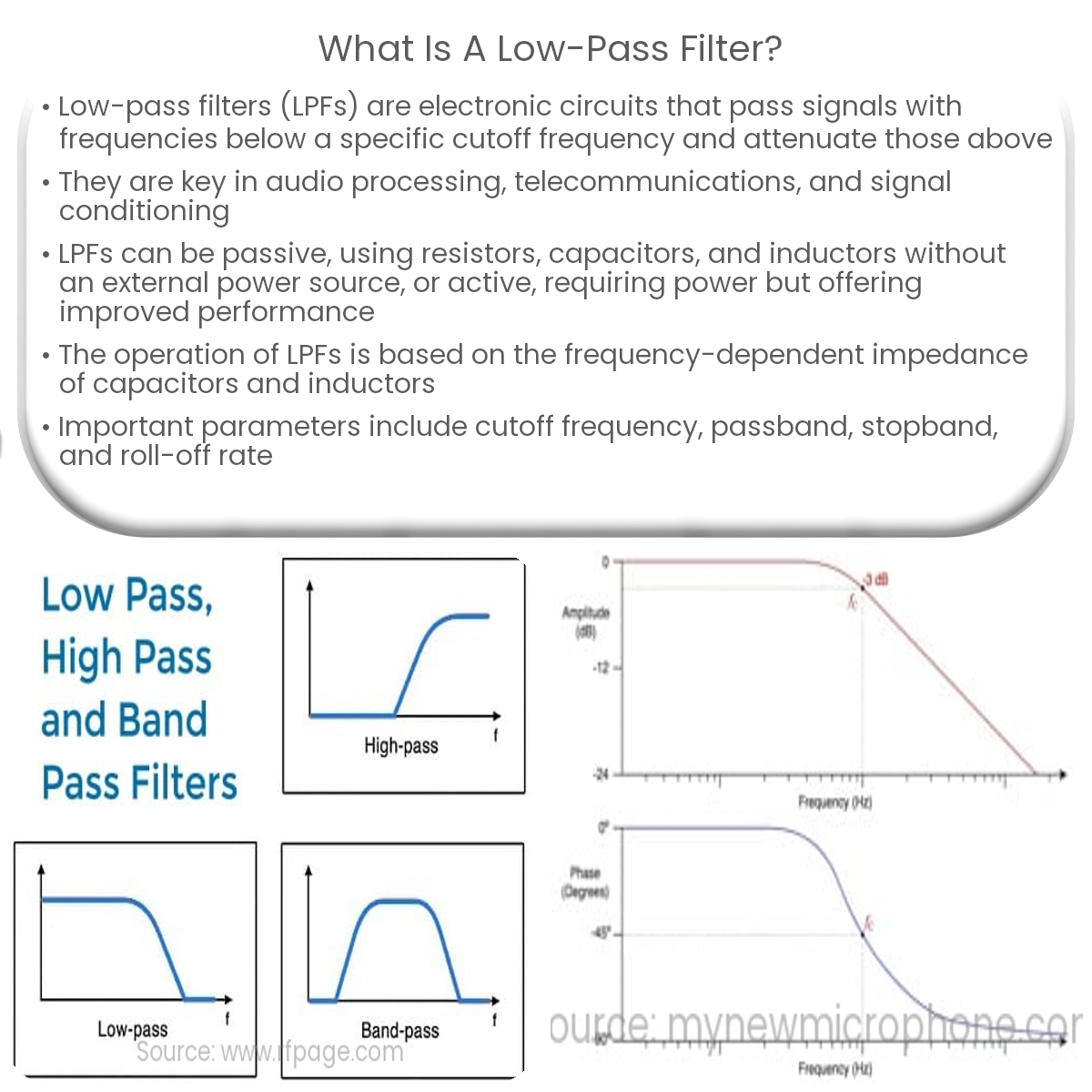
A low-pass filter is an electronic circuit that allows signals with frequencies below a cutoff frequency to pass, while attenuating higher frequencies.
Introduction to Low-Pass Filters
A low-pass filter (LPF) is an electronic circuit that allows signals with frequencies below a specific cutoff frequency to pass through while attenuating signals with frequencies above the cutoff frequency. This frequency-selective behavior makes low-pass filters an essential tool in various applications such as audio processing, telecommunications, and signal conditioning.
Types of Low-Pass Filters
Low-pass filters can be categorized into two main types:
- Passive Low-Pass Filters: These filters consist of passive components such as resistors, capacitors, and inductors. Passive filters do not require an external power source to function, and their design can be simple, like an RC (resistor-capacitor) or an LC (inductor-capacitor) circuit.
- Active Low-Pass Filters: Active filters use active components like operational amplifiers (op-amps) in addition to passive components. Active filters can offer better performance, control, and versatility compared to their passive counterparts but require an external power source.
Working Principle of Low-Pass Filters
The fundamental principle behind the operation of a low-pass filter is the frequency-dependent impedance offered by capacitors and inductors. In a simple RC low-pass filter, the capacitor’s impedance decreases with increasing frequency. Therefore, at higher frequencies, more of the signal’s voltage is dropped across the capacitor, resulting in a weaker output signal. Conversely, at lower frequencies, the capacitor’s impedance is higher, allowing the signal to pass through with minimal attenuation.
Filter Characteristics and Parameters
Key parameters to consider while designing or analyzing a low-pass filter include:
- Cutoff Frequency: The frequency at which the filter transitions from the passband to the stopband. The cutoff frequency is usually defined as the point where the output signal’s amplitude is reduced to 70.7% of the input signal.
- Passband: The range of frequencies below the cutoff frequency that passes through the filter with minimal attenuation.
- Stopband: The range of frequencies above the cutoff frequency that is significantly attenuated by the filter.
- Roll-off Rate: The rate at which the filter attenuates signals in the transition region between the passband and the stopband. This is typically expressed in decibels per octave (dB/octave) or decibels per decade (dB/decade).
Applications of Low-Pass Filters
Low-pass filters find applications in various fields, such as:
- Audio processing: To eliminate high-frequency noise and interference.
- Signal conditioning: To remove unwanted high-frequency components before sampling in analog-to-digital converters (ADCs).
- Telecommunications: To prevent signal aliasing in data transmission systems.
- Control systems: To smoothen the output of a system by filtering high-frequency fluctuations.