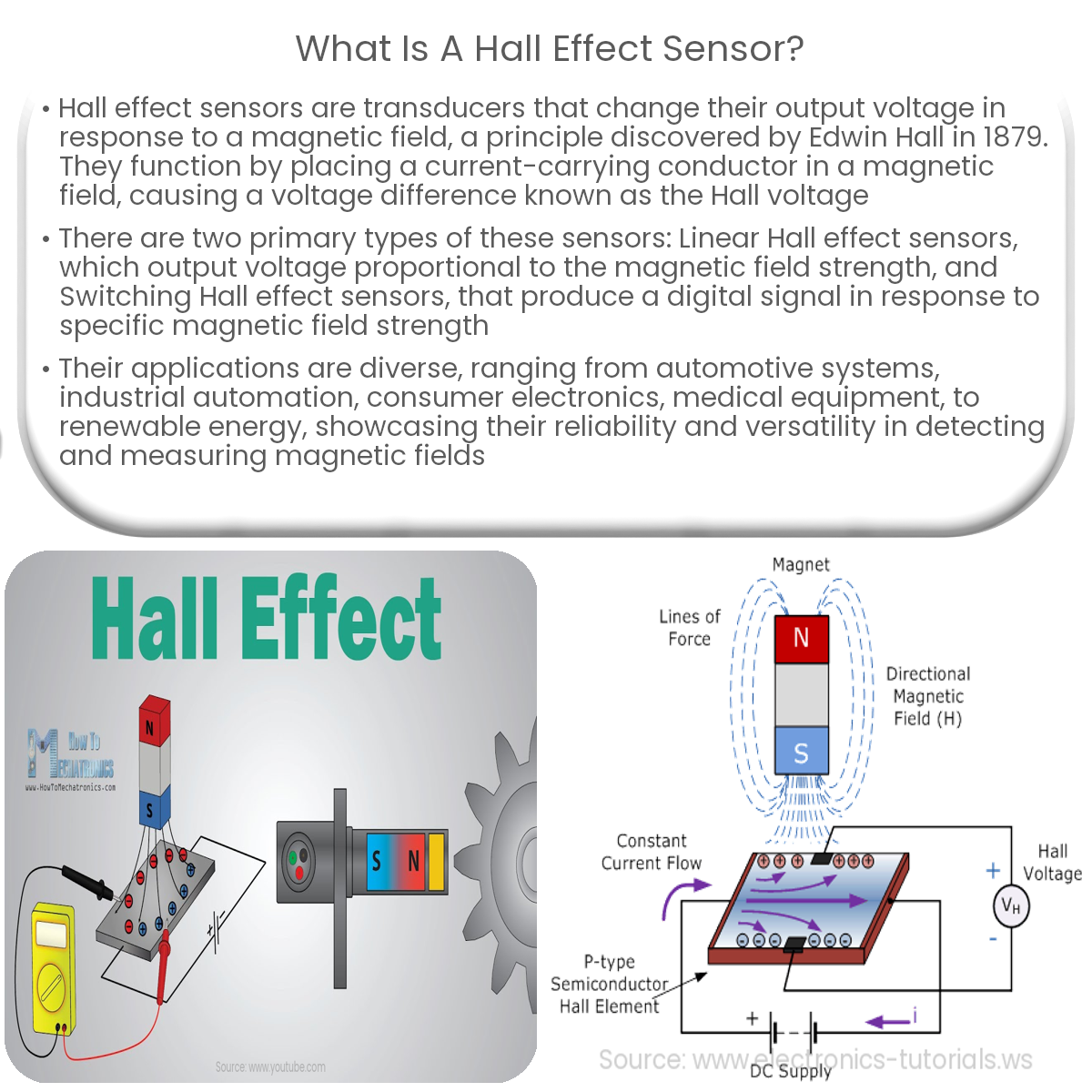
A Hall effect sensor is a transducer that varies output voltage in response to a magnetic field, used for measuring fields, detecting position, and sensing proximity.
Introduction to Hall Effect Sensors
A Hall effect sensor is a transducer that varies its output voltage in response to a magnetic field. It operates based on the Hall effect, a phenomenon discovered by Edwin Hall in 1879. Hall effect sensors are used in various applications, such as measuring magnetic fields, detecting position or movement, and sensing proximity.
Working Principle of Hall Effect Sensors
The Hall effect occurs when a current-carrying conductor is placed in a magnetic field perpendicular to the direction of the current flow. The magnetic field exerts a force on the moving charge carriers, causing them to accumulate on one side of the conductor. This results in a voltage difference across the conductor, known as the Hall voltage.
Hall effect sensors typically consist of a thin, flat piece of semiconductor material, such as gallium arsenide, indium antimonide, or silicon, with current-carrying contacts on opposite sides. When a magnetic field is applied perpendicular to the sensor, the Hall voltage is generated across the width of the material.
Types of Hall Effect Sensors
There are two main types of Hall effect sensors:
- Linear Hall effect sensors: These sensors produce an output voltage that is proportional to the strength of the magnetic field. They are used for measuring magnetic field strength or detecting the position of magnetic objects.
- Switching Hall effect sensors: Also known as digital or threshold sensors, these devices produce a digital output signal that switches between two states, typically on and off, in response to a specific magnetic field strength. They are commonly used for proximity sensing, speed measurement, and detecting the presence of magnetic materials.
Applications of Hall Effect Sensors
Hall effect sensors are versatile and have numerous applications, including:
- Automotive systems: wheel speed sensors, throttle position sensors, and gear position sensors
- Industrial automation: detecting the position of machine parts, linear or angular displacement sensing, and contactless current measurement
- Consumer electronics: smartphones, tablets, and laptops for sensing magnetic fields, proximity, and position
- Medical equipment: magnetic field measurements for magnetic resonance imaging (MRI) systems
- Renewable energy: monitoring the position and rotation of wind turbines and solar panels
Overall, Hall effect sensors provide a reliable, contactless, and versatile solution for detecting and measuring magnetic fields in a wide range of applications.