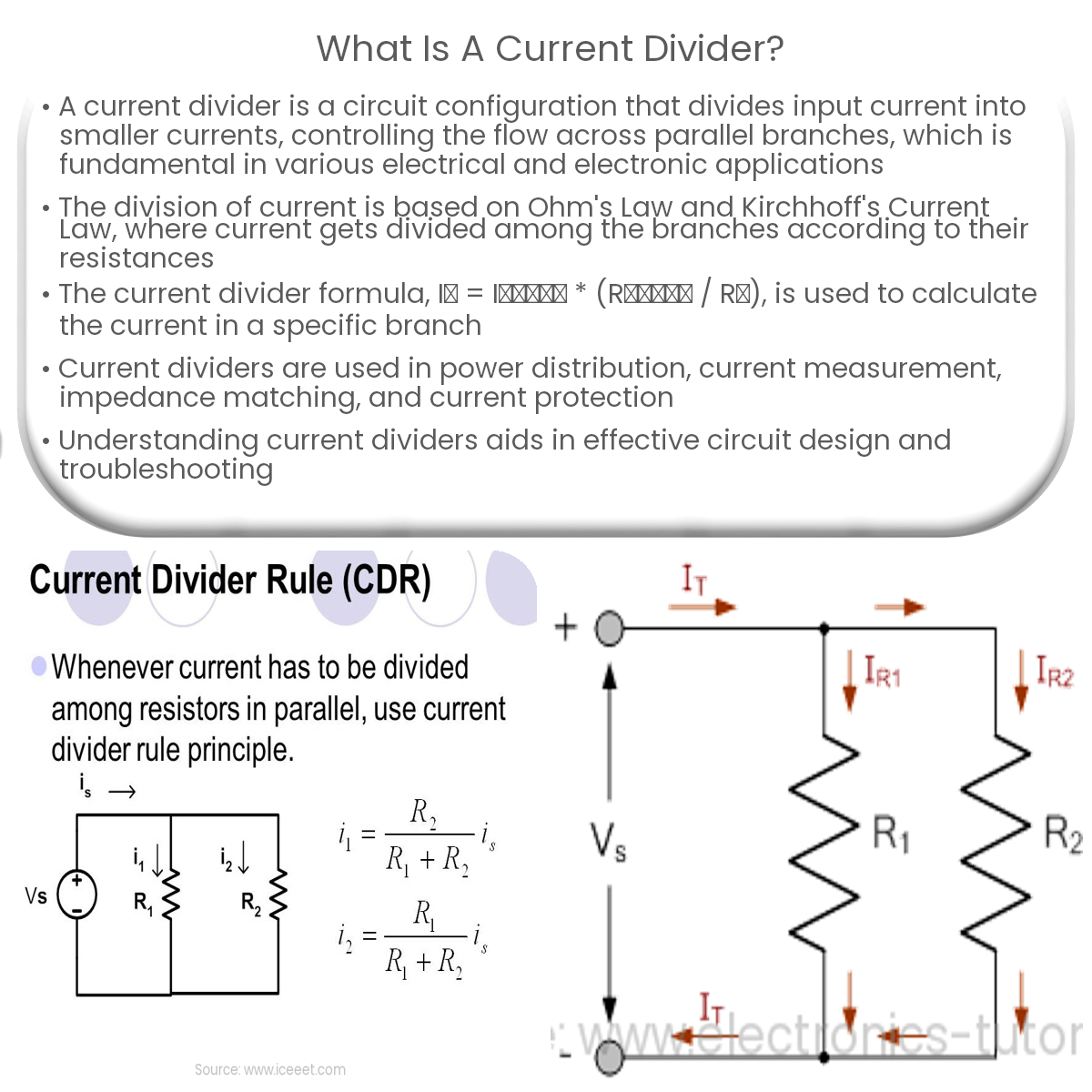
A current divider is a circuit that distributes input current among multiple branches, dividing it based on the resistances or impedances in each.
Introduction to Current Dividers
A current divider is a circuit that distributes an input current among multiple branches, proportionally dividing it based on the resistances or impedances in each branch. Current dividers are essential in various electronic applications, such as current sensing, current protection, and biasing of multiple devices.
Basic Current Divider Circuit
A basic current divider consists of two or more resistors or impedances connected in parallel. The input current (Iin) is applied to the parallel combination, and the output currents (Iout1, Iout2, …) are measured through each resistor or impedance. According to Ohm’s Law (V = I × R) and Kirchhoff’s Current Law (sum of currents entering a junction equals the sum of currents leaving the junction), the currents in each branch are determined by the resistances or impedances.
Current Divider Formula
The output current through one of the resistors in a simple two-resistor current divider can be calculated using the following formula:
Iout1 = Iin × (R2 / (R1 + R2))
Where:
- Iin is the input current applied to the parallel combination of resistors R1 and R2.
- R1 and R2 are the resistance values of the two resistors connected in parallel.
- Iout1 is the output current through resistor R1.
Applications of Current Dividers
Current dividers have various applications in electronic circuits, such as:
- Current sensing: Current dividers can be used to monitor current in a circuit by creating a proportional current through a sensing resistor or shunt.
- Current protection: In power distribution systems, current dividers can be employed to distribute current among multiple parallel paths to protect devices from overcurrent.
- Biasing multiple devices: Current dividers can be used to supply appropriate bias currents to multiple devices connected in parallel, such as transistors or LEDs.
Conclusion
A current divider is a fundamental circuit configuration that divides input current among multiple branches based on the resistances or impedances in each branch. Understanding current dividers is essential for circuit analysis, design, and various applications in electronics.