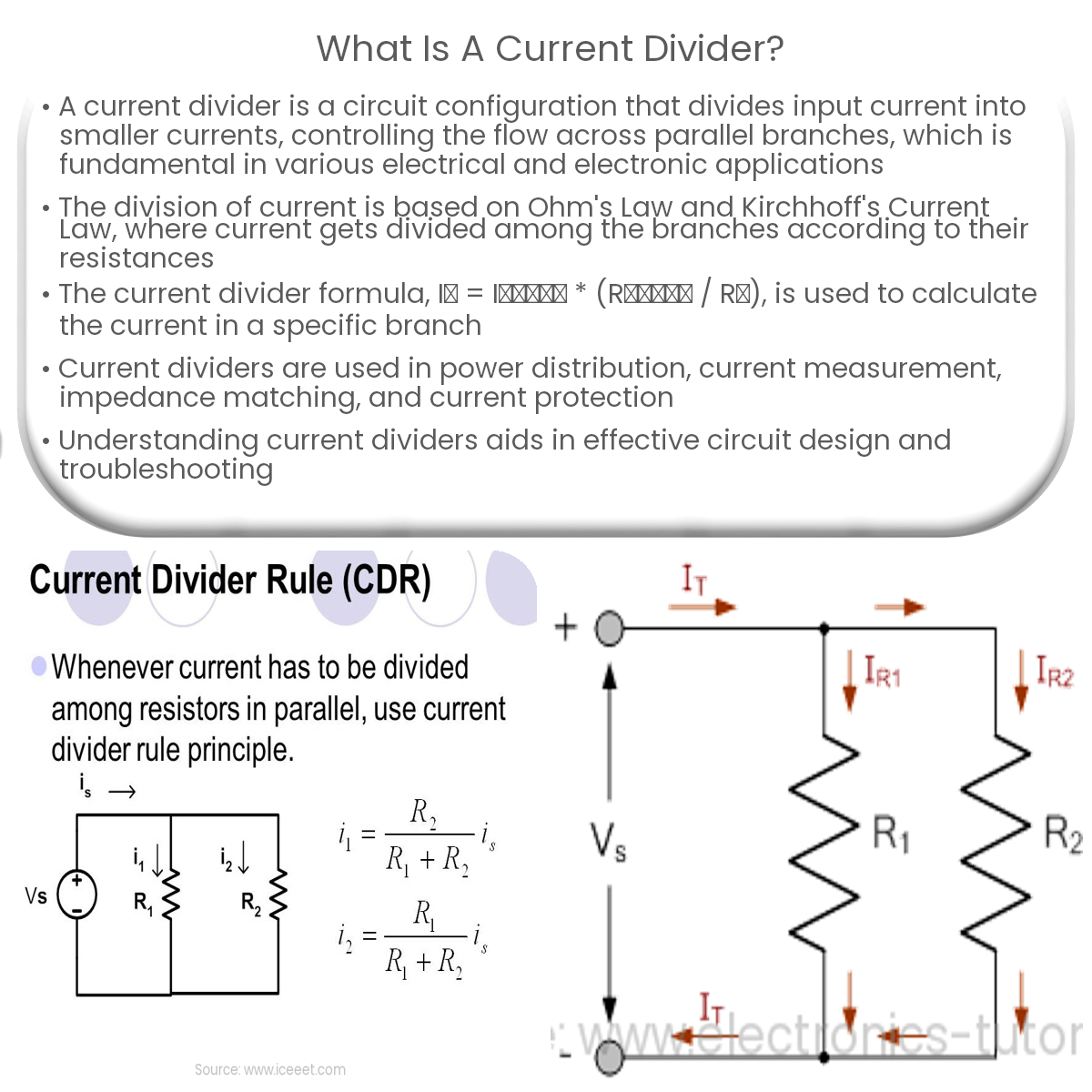
A current divider is a circuit that splits input current into multiple output currents in proportion to the resistances of the connected components.
Introduction to Current Dividers
A current divider is an electrical circuit designed to split an input current into two or more output currents in proportion to the resistances or impedances of the connected components. Current dividers are widely used in electronic circuits for controlling and distributing current among multiple branches or loads.
Current Divider Principle
The current divider circuit is typically comprised of two or more resistors or impedances connected in parallel, with the input current (Iin) being applied to the junction of these parallel elements. The output currents (Iout) are measured through each branch, and their sum is equal to the input current. The principle of the current divider is based on Ohm’s Law and Kirchhoff’s Current Law.
Ohm’s Law and Kirchhoff’s Current Law
Ohm’s Law states that the current flowing through a resistor is proportional to the voltage across it and inversely proportional to its resistance:
I = V / R
Kirchhoff’s Current Law states that the sum of the currents entering a junction is equal to the sum of the currents leaving the junction:
Iin = I1 + I2 + … + In
Current Divider Equation
Using Ohm’s Law and Kirchhoff’s Current Law, we can derive the current divider equation for a circuit with two resistors, R1 and R2:
I2 = Iin * (R1 / (R1 + R2))
Similarly, the output current I1 can be found by:
I1 = Iin * (R2 / (R1 + R2))
Calculating Output Currents
With the current divider equation, we can calculate the output currents by following these steps:
- Identify the input current (Iin) and the resistor values (R1 and R2).
- Calculate the total resistance of the parallel resistors (R1 + R2).
- Find the fraction of the input current by dividing R1 or R2 by the total resistance (R1 / (R1 + R2) or R2 / (R1 + R2)).
- Multiply the input current (Iin) by the fraction obtained in the previous step to get the output current (Iout).
By following these steps, you can calculate the output currents of any simple current divider circuit.
Example Calculation
Let’s consider a current divider circuit with an input current of 12 mA, R1 equal to 4 kΩ, and R2 equal to 6 kΩ. Applying the current divider equation:
I1 = 12 mA * (6 kΩ / (4 kΩ + 6 kΩ))
I1 = 12 mA